
UniVI





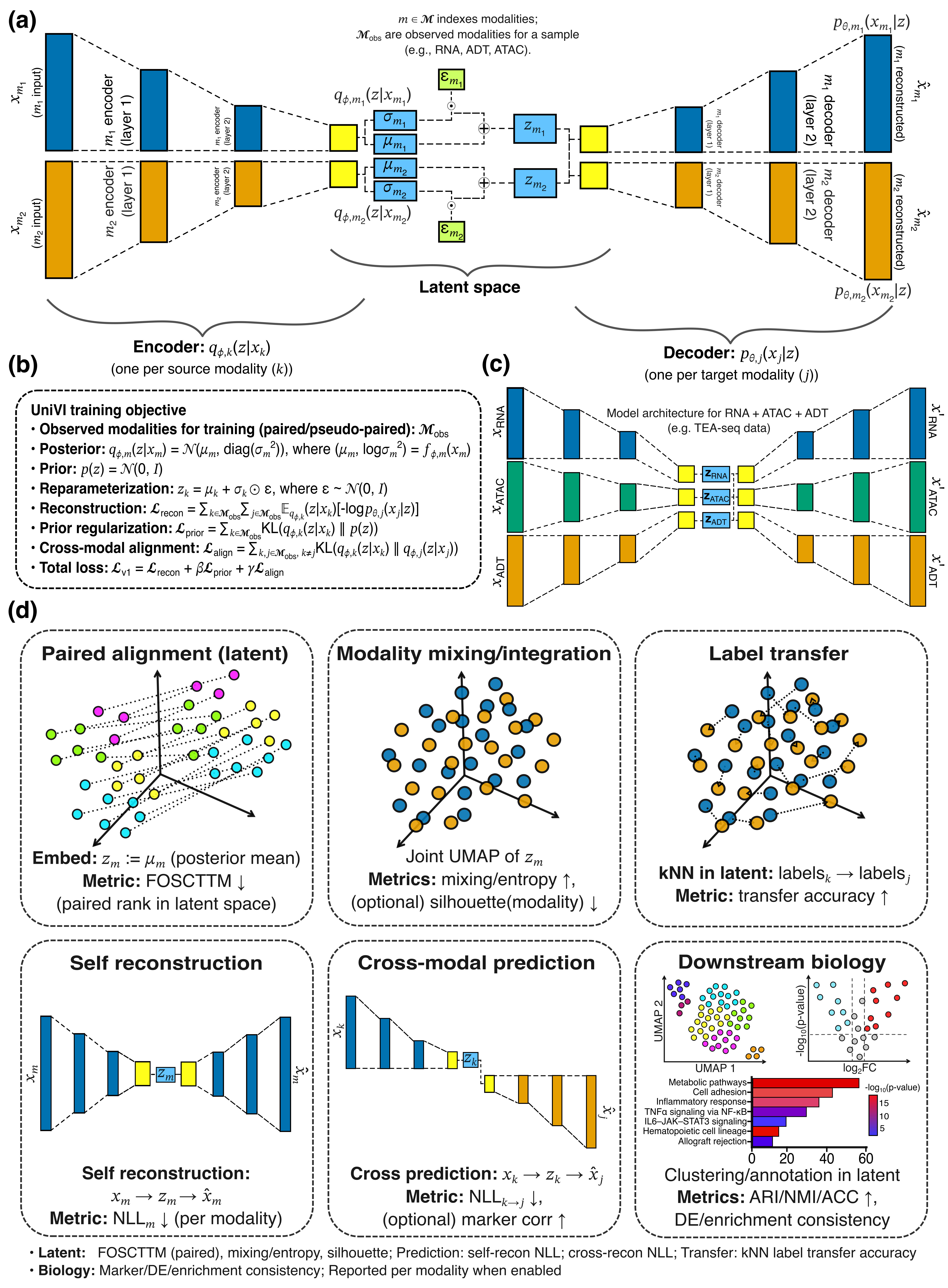
UniVI is a multi-modal variational autoencoder (VAE) toolkit for aligning and integrating single-cell modalities such as RNA, ADT (CITE-seq), ATAC, and coverage-aware / proportion-like assays (e.g., single-cell methylome features).
Common use cases:
- Joint embedding of paired multimodal data (CITE-seq, Multiome, TEA-seq)
- Bridge mapping / projection of unimodal cohorts into a paired latent
- Cross-modal imputation (RNA→ADT, ATAC→RNA, RNA→methylome, …)
- Denoising / reconstruction with likelihood-aware decoders
- Evaluation (FOSCTTM, Recall@k, mixing/entropy, label transfer, clustering)
- Optional supervised heads, MoE gating diagnostics, and transformer encoders
Preprint
If you use UniVI in your work, please cite:
Ashford AJ, Enright T, Somers J, Nikolova O, Demir E.
Unifying multimodal single-cell data with a mixture-of-experts β-variational autoencoder framework.
bioRxiv (2025; updated 2026). doi: 10.1101/2025.02.28.640429
@article{Ashford2025UniVI,
  title   = {Unifying multimodal single-cell data with a mixture-of-experts β-variational autoencoder framework},
  author  = {Ashford, A. J. and Enright, T. and Somers, J. and Nikolova, O. and Demir, E.},
  journal = {bioRxiv},
  date    = {2025},
  doi     = {10.1101/2025.02.28.640429},
  url     = {https://www.biorxiv.org/content/10.1101/2025.02.28.640429},
  note    = {Preprint (updated 2026)}
}
Installation
PyPI
pip install univi
UniVI requires PyTorch. If
import torchfails, install PyTorch for your platform/CUDA from PyTorch’s official install instructions.
Conda / mamba
conda install -c conda-forge univi
# or
mamba install -c conda-forge univi
Development install (from source)
git clone https://github.com/Ashford-A/UniVI.git
cd UniVI

conda env create -f envs/univi_env.yml
conda activate univi_env

pip install -e .
Data expectations
UniVI expects per-modality AnnData objects.
- Each modality is an
AnnData - For paired settings, modalities share the same cells (
obs_names, same order) - Raw counts often live in
.layers["counts"] - Model inputs typically live in
.X(or.obsm["X_*"]for ATAC LSI)
Recommended convention:
.layers["counts"]= raw counts / raw signal.X/.obsm["X_*"]= model input space (log1p RNA, CLR ADT, LSI ATAC, methyl fractions, etc.).layers["denoised_*"]/.layers["imputed_*"]= UniVI outputs
Methylome / coverage-aware modalities
Two common patterns:
A) Fraction-valued features (simple path)
If .X contains values in [0, 1] (fraction methylated) and you don’t need coverage-aware likelihoods:
- store fractions in
.X - use
likelihood="beta"
B) Counts + coverage (recommended when available)
If you have both:
- successes (e.g., methylated counts) and
- total_count (coverage / trials)
Use:
likelihood="binomial"orlikelihood="beta_binomial"(often preferred)
In this setup the model input can still be fractions/embeddings in .X, but the reconstruction loss is computed against recon_targets (successes + total_count) supplied by the dataset/collate path.
Quickstart (Python / Jupyter)
Minimal “notebook path”: load paired AnnData → train → encode/evaluate.
import numpy as np
import scanpy as sc
import torch
from torch.utils.data import DataLoader, Subset

from univi import UniVIMultiModalVAE, ModalityConfig, UniVIConfig, TrainingConfig
from univi.data import MultiModalDataset, align_paired_obs_names, collate_multimodal_xy_recon
from univi.trainer import UniVITrainer
1) Load paired AnnData
rna = sc.read_h5ad("path/to/rna_citeseq.h5ad")
adt = sc.read_h5ad("path/to/adt_citeseq.h5ad")

adata_dict = align_paired_obs_names({"rna": rna, "adt": adt})
2) Dataset + dataloaders (MultiModalDataset option)
device = "cuda" if torch.cuda.is_available() else ("mps" if torch.backends.mps.is_available() else "cpu")

dataset = MultiModalDataset(
    adata_dict=adata_dict,
    X_key="X",     # uses .X as model input
    device=None,   # dataset yields CPU tensors; model moves to GPU
)

n = rna.n_obs
idx = np.arange(n)
rng = np.random.default_rng(0)
rng.shuffle(idx)
split = int(0.8 * n)
train_idx, val_idx = idx[:split], idx[split:]

train_loader = DataLoader(
    Subset(dataset, train_idx),
    batch_size=256,
    shuffle=True,
    num_workers=0,
    collate_fn=collate_multimodal_xy_recon,  # safe even if recon_targets are absent
)
val_loader = DataLoader(
    Subset(dataset, val_idx),
    batch_size=256,
    shuffle=False,
    num_workers=0,
    collate_fn=collate_multimodal_xy_recon,
)
3) Model config + train
univi_cfg = UniVIConfig(
    latent_dim=30,
    beta=1.15,
    gamma=3.25,
    modalities=[
        # Likelihood guidance:
        # - RNA (normalized/log1p): often "gaussian"
        # - RNA (raw counts): "nb" or "zinb"
        # - ADT (CLR/scaled): often "gaussian"
        # - ATAC (binarized peaks): "bernoulli"
        # - ATAC (peak counts): "poisson" (sometimes; often too restrictive if overdispersed)
        # - ATAC (LSI / reduced features): often "gaussian" for integration-focused workflows
        # - Methylome fractions in (0,1): "beta"
        # - Methylome counts+coverage: "binomial" or "beta_binomial" (often preferred)
        #
        # IMPORTANT for "binomial" / "beta_binomial":
        #   The reconstruction target must include BOTH successes and total_count
        #   (passed via `recon_targets` as a keyword argument to the model/training step), e.g.:
        #     {"successes": m, "total_count": n}
        #
        # NOTE:
        # Manuscript-style "gaussian" decoders on normalized feature spaces often produce the most
        # cell-to-cell aligned latent spaces for integration-focused use cases. For some assay types
        # (including methylome), a more distribution-matched likelihood may be preferable depending
        # on whether your goal is alignment vs calibrated reconstruction/generation.
        #
        ModalityConfig(
            name="rna",
            input_dim=rna.n_vars,
            encoder_hidden=[1024, 512, 256, 128],
            decoder_hidden=[128, 256, 512, 1024],
            likelihood="gaussian",
        ),
        ModalityConfig(
            name="adt",
            input_dim=adt.n_vars,
            encoder_hidden=[256, 128, 64],
            decoder_hidden=[64, 128, 256],
            likelihood="gaussian",
        ),
    ],
)

train_cfg = TrainingConfig(
    n_epochs=2000,
    batch_size=256,
    lr=1e-3,
    weight_decay=1e-4,
    device=device,
    early_stopping=True,
    best_epoch_warmup=50,
    patience=50,
)

model = UniVIMultiModalVAE(
    univi_cfg,
    loss_mode="v1",       # "v1" recommended (used in the manuscript)
    v1_recon="avg",
    normalize_v1_terms=True,
).to(device)

trainer = UniVITrainer(
    model=model,
    train_loader=train_loader,
    val_loader=val_loader,
    train_cfg=train_cfg,
    device=device,
)

trainer.fit()
Quickstart: RNA + methylome (beta-binomial with recon_targets)
Assumes:
meth.Xis a convenient model input (fractions or embeddings)meth.layers["meth_successes"]stores methylated countsmeth.layers["meth_total_count"]stores coverage / trials
rna  = sc.read_h5ad("path/to/rna.h5ad")
meth = sc.read_h5ad("path/to/meth.h5ad")

adata_dict = align_paired_obs_names({"rna": rna, "meth": meth})

recon_targets_spec = {
    "meth": {
        "successes_layer": "meth_successes",
        "total_count_layer": "meth_total_count",
    }
}

dataset = MultiModalDataset(
    adata_dict=adata_dict,
    X_key="X",
    device=None,
    recon_targets_spec=recon_targets_spec,
)

train_loader = DataLoader(
    dataset,
    batch_size=256,
    shuffle=True,
    num_workers=0,
    collate_fn=collate_multimodal_xy_recon,
)

univi_cfg = UniVIConfig(
    latent_dim=30,
    beta=1.15,
    gamma=3.25,
    modalities=[
        ModalityConfig("rna",  rna.n_vars,  [1024, 512, 256, 128], [128, 256, 512, 1024], likelihood="gaussian"),
        ModalityConfig("meth", meth.n_vars, [512, 256, 128],       [128, 256, 512],       likelihood="beta_binomial"),
    ],
)

train_cfg = TrainingConfig(n_epochs=2000, batch_size=256, lr=1e-3, weight_decay=1e-4, device=device)

model = UniVIMultiModalVAE(univi_cfg, loss_mode="v1", v1_recon="avg", normalize_v1_terms=True).to(device)
trainer = UniVITrainer(model=model, train_loader=train_loader, val_loader=None, train_cfg=train_cfg, device=device)
trainer.fit()
When
recon_targetsare present in the batch,UniVITrainerforwards them intomodel(..., recon_targets=...)automatically.
Saving + loading
import torch
from univi import UniVIMultiModalVAE

ckpt = {
    "model_state_dict": model.state_dict(),
    "model_config": univi_cfg,
    "train_cfg": train_cfg,
    "history": getattr(trainer, "history", None),
    "best_epoch": getattr(trainer, "best_epoch", None),
}
torch.save(ckpt, "./saved_models/univi_model_state.pt")

ckpt = torch.load("./saved_models/univi_model_state.pt", map_location=device)
model = UniVIMultiModalVAE(ckpt["model_config"]).to(device)
model.load_state_dict(ckpt["model_state_dict"])
model.eval()
print("Best epoch:", ckpt.get("best_epoch"))
After training: what you can do with a UniVI model
UniVI models are generative (decoders + likelihoods) and alignment-oriented (shared latent space). After training, you typically use two modules:
univi.evaluation: encoding, denoising, cross-modal prediction (imputation), generation, and metricsunivi.plotting: Scanpy/Matplotlib helpers for UMAPs, legends, confusion matrices, MoE gate plots, and reconstruction-error plots
0) Imports + plotting defaults
import numpy as np
import scipy.sparse as sp
import torch

from univi.evaluation import (
    encode_adata,
    encode_fused_adata_pair,
    cross_modal_predict,
    denoise_adata,
    denoise_from_multimodal,
    evaluate_alignment,
    reconstruction_metrics,
    # NEW (generation + recon error workflows)
    generate_from_latent,
    fit_label_latent_gaussians,
    sample_latent_by_label,
    evaluate_cross_reconstruction,
)
from univi.plotting import (
    set_style,
    umap,
    umap_by_modality,
    compare_raw_vs_denoised_umap_features,
    plot_confusion_matrix,
    write_gates_to_obs,
    plot_moe_gate_summary,
    # NEW (reconstruction error plots)
    plot_reconstruction_error_summary,
    plot_featurewise_reconstruction_scatter,
)

set_style(font_scale=1.2, dpi=150)
device = "cuda" if torch.cuda.is_available() else ("mps" if torch.backends.mps.is_available() else "cpu")
Helper for sparse matrices:
def to_dense(X):
    return X.toarray() if sp.issparse(X) else np.asarray(X)
1) Encode a modality into latent space (.obsm["X_univi"])
Use this when you have one observed modality at a time (RNA-only, ADT-only, ATAC-only, methylome-only, etc.):
Z_rna = encode_adata(
    model,
    adata=rna,
    modality="rna",
    device=device,
    layer=None,          # uses adata.X by default
    X_key="X",
    batch_size=1024,
    latent="moe_mean",   # {"moe_mean","moe_sample","modality_mean","modality_sample"}
    random_state=0,
)
rna.obsm["X_univi"] = Z_rna
Then plot:
umap(
    rna,
    obsm_key="X_univi",
    color=["celltype.l2", "batch"],
    legend="outside",
    legend_subset_topk=25,
    savepath="umap_rna_univi.png",
    show=False,
)
2) Encode a fused multimodal latent (true paired/multi-observed cells)
When you have multiple observed modalities for the same cells, you can encode the fused posterior (and optionally MoE router gates/logits):
fused = encode_fused_adata_pair(
    model,
    adata_by_mod={"rna": rna, "adt": adt},   # same obs_names, same order
    device=device,
    batch_size=1024,
    use_mean=True,
    return_gates=True,
    return_gate_logits=True,
    write_to_adatas=True,                   # writes obsm + gate columns
    fused_obsm_key="X_univi_fused",
    gate_prefix="gate",
)

# fused["Z_fused"] -> (n_cells, latent_dim)
# fused["gates"]  -> (n_cells, n_modalities) or None (if fused transformer posterior is used)
Plot fused:
umap(
    rna,
    obsm_key="X_univi_fused",
    color=["celltype.l2", "batch"],
    legend="outside",
    savepath="umap_fused.png",
    show=False,
)
Plot fused both modalities by modality and celltype:
umap_by_modality(
    {"rna": rna, "adt": adt},
    obsm_key="X_univi_fused",
    color=["univi_modality", "celltype.l2"],
    legend="outside",
    size=8,
    savepath="umap_fused_both_modalities.png",
    show=False,
)
3) Cross-modal prediction (imputation): encode source → decode target
Example: RNA → ADT (same pattern applies to RNA→methylome, methylome→RNA, etc.). UniVI will automatically handle decoder output types internally (e.g. Gaussian returns tensor; NB returns {"mu","log_theta"}; ZINB returns {"mu","log_theta","logit_pi"}; Poisson returns {"rate","log_rate"}; Beta/Beta-Binomial return parameter dicts) and return an appropriate mean-like prediction for downstream evaluation/plotting.
adt_hat_from_rna = cross_modal_predict(
    model,
    adata_src=rna,
    src_mod="rna",
    tgt_mod="adt",
    device=device,
    layer=None,
    X_key="X",
    batch_size=512,
    use_moe=True,
)
adt.layers["imputed_from_rna"] = adt_hat_from_rna
4) Denoising (self-reconstruction or true fused denoising)
Option A — self-denoise a single modality (same as “reconstruct”)
denoise_adata(
    model,
    adata=rna,
    modality="rna",
    device=device,
    out_layer="denoised_self",
    overwrite_X=False,
    batch_size=512,
)
Option B — true multimodal denoising via fused latent
denoise_adata(
    model,
    adata=rna,                         # output written here
    modality="rna",
    device=device,
    out_layer="denoised_fused",
    overwrite_X=False,
    batch_size=512,
    adata_by_mod={"rna": rna, "adt": adt},
    layer_by_mod={"rna": None, "adt": None},  # None -> use .X
    X_key_by_mod={"rna": "X", "adt": "X"},
    use_mean=True,
)
Compare raw vs denoised marker overlays:
compare_raw_vs_denoised_umap_features(
    rna,
    obsm_key="X_univi",
    features=["MS4A1", "CD3D", "NKG7"],
    raw_layer=None,
    denoised_layer="denoised_fused",
    savepath="umap_raw_vs_denoised.png",
    show=False,
)
5) Quantify reconstruction / imputation error vs ground truth
You can compute featurewise + summary errors between:
- cross-reconstructed (RNA→ADT, ATAC→RNA, methylome→RNA, …)
- denoised outputs (self or fused)
- and the true observed data
A) Basic metrics on two matrices
true = to_dense(adt.X)
pred = adt.layers["imputed_from_rna"]

m = reconstruction_metrics(true, pred)
print("MSE mean:", m["mse_mean"])
print("Pearson mean:", m["pearson_mean"])
B) One-call evaluation for cross-reconstruction / denoising
This will:
- generate predictions via UniVI (handling decoder output types correctly),
- align to the requested truth matrix (layer/X_key), and
- return metrics + optional per-feature vectors.
rep = evaluate_cross_reconstruction(
    model,
    adata_src=rna,
    adata_tgt=adt,
    src_mod="rna",
    tgt_mod="adt",
    device=device,
    src_layer=None,
    tgt_layer=None,
    batch_size=512,
    # optionally restrict to a feature subset (e.g., top markers)
    feature_names=None,
)
print(rep["summary"])   # mse_mean/median, pearson_mean/median, etc.
Plot reconstruction-error summaries:
plot_reconstruction_error_summary(
    rep,
    title="RNA → ADT imputation error",
    savepath="recon_error_summary.png",
    show=False,
)
And featurewise scatter (true vs predicted) for selected features:
plot_featurewise_reconstruction_scatter(
    rep,
    features=["CD3", "CD4", "MS4A1"],
    savepath="recon_scatter_selected_features.png",
    show=False,
)
6) Alignment evaluation (FOSCTTM, Recall@k, mixing/entropy, label transfer, gates)
metrics = evaluate_alignment(
    Z1=rna.obsm["X_univi"],
    Z2=adt.obsm["X_univi"],
    metric="euclidean",
    recall_ks=(1, 5, 10),
    k_mixing=20,
    k_entropy=30,
    labels_source=rna.obs["celltype.l2"].to_numpy(),
    labels_target=adt.obs["celltype.l2"].to_numpy(),
    compute_bidirectional_transfer=True,
    k_transfer=15,
    json_safe=True,
)
Confusion matrix:
plot_confusion_matrix(
    np.asarray(metrics["label_transfer_cm"]),
    labels=np.asarray(metrics["label_transfer_label_order"]),
    title="Label transfer (RNA → ADT)",
    normalize="true",
    savepath="label_transfer_confusion.png",
    show=False,
)
7) Generate new data from latent space (sampling / “in silico cells”)
UniVI decoders define a likelihood per modality (Gaussian, NB, ZINB, Poisson, Bernoulli, Beta, Binomial/Beta-Binomial, etc.). Generation is done as:
- pick latent samples
z ~ p(z)(or a conditional latent distribution) - decode with the modality decoder(s)
- return mean-like reconstructions or (optionally) sample from the likelihood
A) Unconditional generation (standard normal prior)
Xgen = generate_from_latent(
    model,
    n=5000,
    target_mod="rna",
    device=device,
    z_source="prior",         # "prior" or provide z directly
    return_mean=True,         # mean-like output
    sample_likelihood=False,  # if True: sample from likelihood when supported
)
# Xgen shape: (5000, n_genes)
B) Cell-type–conditioned generation via empirical latent neighborhoods
This is the “no classifier head needed” option:
- encode a reference cohort
- pick cells with a given label
- sample around their latent distribution (Gaussian fit, or jitter)
Z = rna.obsm["X_univi"]
labels = rna.obs["celltype.l2"].to_numpy()

# Fit a per-label Gaussian in latent space
label_gauss = fit_label_latent_gaussians(Z, labels)

# Sample latent points for a chosen label
z_B = sample_latent_by_label(label_gauss, label="B cell", n=2000, random_state=0)

# Decode to RNA space
X_B = generate_from_latent(
    model,
    z=z_B,
    target_mod="rna",
    device=device,
    return_mean=True,
)
C) Cluster-aware generation (no annotations required)
If you don’t have labels, you can cluster Z (e.g., k-means), fit cluster Gaussians, then sample by cluster id.
D) Head-guided generation (optional, when a classifier head exists)
If you trained a classification head, you can optionally bias latent selection toward a desired label by filtering or optimizing candidate z’s (implementation depends on your head setup). UniVI supports this workflow when the head is present, but the label-agnostic Gaussian/cluster methods work everywhere.
8) MoE gating diagnostics (precision contributions + optional learnable router)
UniVI can report per-cell modality contribution weights for the analytic fusion path (MoE/PoE-style).
There are two related notions of “who contributed how much” to the fused latent:
- Precision-only (always available): derived from each modality’s posterior uncertainty in latent space.
- Router × precision (optional): if your trained model exposes router logits, UniVI can combine router probabilities with precision to produce contribution weights.
Note: This section applies to analytic fusion (Gaussian experts in latent space). If you use a fused transformer posterior, there may be no analytic precision/router attribution and gates can be unavailable or not meaningful.
A) Compute per-cell contribution weights (recommended)
from univi.evaluation import to_dense, encode_moe_gates_from_tensors
from univi.plotting import write_gates_to_obs, plot_moe_gate_summary

gate = encode_moe_gates_from_tensors(
    model,
    x_dict={"rna": to_dense(rna.X), "adt": to_dense(adt.X)},
    device=device,
    batch_size=1024,
    modality_order=["rna", "adt"],
    kind="router_x_precision",  # falls back to "effective_precision" if router logits are unavailable
    return_logits=True,
)

W    = gate["weights"]         # (n_cells, n_modalities), rows sum to 1
mods = gate["modality_order"]  # e.g. ["rna", "adt"]

print("Requested kind:", gate.get("requested_kind"))
print("Effective kind:", gate.get("kind"))
print("Per-modality mean:", gate.get("per_modality_mean"))
print("Has logits:", gate.get("logits") is not None)
If you want precision-only weights (no router influence), set kind="effective_precision".
B) Write weights to .obs (for plotting / grouping)
write_gates_to_obs(
    rna,
    gates=W,
    modality_names=mods,
    gate_prefix="moe_gate",          # creates obs cols: moe_gate_{mod}
    gate_logits=gate.get("logits"),  # optional; may be None
)
C) Plot contribution usage (overall + grouped)
plot_moe_gate_summary(
    rna,
    gate_prefix="moe_gate",
    groupby="celltype.l3",           # or "celltype.l2", "batch", etc.
    agg="mean",
    savepath="moe_gates_by_celltype.png",
    show=False,
)
D) Optional: log gates alongside alignment metrics
evaluate_alignment(...) evaluates geometric alignment (FOSCTTM, Recall@k, mixing/entropy, label transfer).
If you want to save gate summaries alongside those metrics, just merge dictionaries:
from univi.evaluation import evaluate_alignment

metrics = evaluate_alignment(
    Z1=rna.obsm["X_univi"],
    Z2=adt.obsm["X_univi"],
    labels_source=rna.obs["celltype.l3"].to_numpy(),
    labels_target=adt.obs["celltype.l3"].to_numpy(),
    json_safe=True,
)

metrics["moe_gates"] = {
    "kind": gate.get("kind"),
    "requested_kind": gate.get("requested_kind"),
    "modality_order": mods,
    "per_modality_mean": gate.get("per_modality_mean"),
    # (optional) store full matrices; omit if you want small JSON
    # "weights": W,
    # "logits": gate.get("logits"),
}
Advanced topics
Training objectives (v1 vs v2/lite)
- v1 (“paper”): per-modality posteriors + reconstruction scheme (cross/self/avg) + posterior alignment
- v2/lite: fused posterior (MoE/PoE by default; optional fused transformer) + per-modality recon + β·KL + γ·alignment
Choose via loss_mode at construction time (Python) or config JSON (scripts).
Decoder output types (what UniVI handles for you)
Decoders can return either:
- a tensor (e.g. Gaussian)
- or a dict (e.g. NB/ZINB/Poisson/Beta/Beta-Binomial parameter dicts)
UniVI evaluation utilities unwrap these and return mean-like matrices for plotting/evaluation.
Advanced topics
Training objectives (v1 vs v2/lite)
- v1 (“paper”): per-modality posteriors + reconstruction scheme (cross/self/avg) + posterior alignment across modalities
- v2/lite: fused posterior (MoE/PoE-style by default; optional fused transformer) + per-modality recon + β·KL + γ·alignment (L2 on latent means)
Choose via loss_mode at construction time (Python) or config JSON (scripts).
Decoder output types (what UniVI handles for you)
Decoders can return either:
- a tensor (e.g. Gaussian)
- or a dict (e.g. NB/ZINB/Poisson/Beta/Beta-Binomial parameter dicts)
UniVI evaluation utilities unwrap these and return mean-like matrices for plotting/evaluation.
Advanced model features
This section covers the “advanced” knobs in univi/models/univi.py and when to use them. Everything below is optional: you can train and evaluate UniVI without touching any of it.
1) Fused multimodal transformer posterior (optional)
What it is:
A single fused encoder that tokenizes each observed modality, concatenates tokens, runs a multimodal transformer, and outputs a fused posterior (mu_fused, logvar_fused).
Why you’d use it:
- You want the posterior to be learned jointly across modalities (rather than fused analytically via PoE/MoE precision fusion).
- You want token-level interpretability hooks (e.g., ATAC top-k peak indices; optional attention maps if enabled in the encoder stack).
- You want a learnable “cross-modality mixing” mechanism beyond precision fusion.
How to enable (config):
-
Set
cfg.fused_encoder_type = "multimodal_transformer". -
Optionally set:
cfg.fused_modalities = ["rna","adt","atac"](defaults to all)cfg.fused_require_all_modalities = True(default): only use fused posterior when all required modalities are present; otherwise falls back tomixture_of_experts().
Key API points:
- Training: the model will automatically decide whether to use fused encoder or fallback based on presence and
fused_require_all_modalities. - Encoding: use
model.encode_fused(...)to get the fused latent and optionally gates from fallback fusion.
mu, logvar, z = model.encode_fused(
    {"rna": X_rna, "adt": X_adt, "atac": X_atac},
    use_mean=True,
)
2) Attention bias for transformer encoders (distance bias for ATAC, optional)
What it is: A safe, optional attention bias that can encourage local genomic context for tokenized ATAC (or any modality tokenizer that supports it). It’s a no-op unless:
- the encoder is transformer-based and
- its tokenizer exposes
build_distance_attn_bias()and - you pass
attn_bias_cfg.
Why you’d use it:
- ATAC token sets are sparse and positional: distance-aware attention can help the transformer focus on local regulatory structure.
How to use (forward / encode / predict):
Pass attn_bias_cfg into forward(...), encode_fused(...), or predict_heads(...).
attn_bias_cfg = {
  "atac": {"type": "distance", "lengthscale_bp": 50_000, "same_chrom_only": True}
}

out = model(x_dict=x_dict, epoch=ep, attn_bias_cfg=attn_bias_cfg)
mu, logvar, z = model.encode_fused(x_dict, attn_bias_cfg=attn_bias_cfg)
pred = model.predict_heads(x_dict, attn_bias_cfg=attn_bias_cfg)
Notes:
- For the fused multimodal transformer posterior, UniVI applies distance bias within the ATAC token block and leaves cross-modality blocks neutral (0), so it won’t artificially “force” cross-modality locality.
3) Learnable MoE gating for fusion (optional)
What it is: A learnable gate that produces per-cell modality weights and uses them to scale per-modality precisions before PoE-style fusion. This is off by default; without it, fusion is pure precision fusion.
Why you’d use it:
- Modalities have variable quality per cell (e.g., low ADT counts, sparse ATAC, stressed RNA, low methylome coverage).
- You want a data-driven “trust score” per modality per cell.
- You want interpretable per-cell reliance weights (gate weights) to diagnose integration behavior.
How to enable (config):
-
cfg.use_moe_gating = True -
Optional:
cfg.moe_gating_type = "per_modality"(default) or"shared"cfg.moe_gating_hidden = [..],cfg.moe_gating_dropout,cfg.moe_gating_batchnorm,cfg.moe_gating_activationcfg.moe_gate_epsto avoid exact zeros in gated precisions
How to retrieve gates:
Use encode_fused(..., return_gates=True) (works when not using fused transformer posterior; if fused posterior is used, gates are None).
mu, logvar, z, gates, gate_logits = model.encode_fused(
    x_dict,
    use_mean=True,
    return_gates=True,
    return_gate_logits=True,
)

# gates: (n_cells, n_modalities) in the model's modality order
Tip: Gate weights are useful for plots like “ADT reliance by celltype” or identifying low-quality subsets.
4) Multi-head supervised decoders (classification + adversarial heads)
UniVI supports two supervised head systems:
A) Legacy single label head (kept for backwards compatibility)
What it is:
A single categorical head via label_decoder controlled by init args:
n_label_classes,label_loss_weight,label_ignore_index,classify_from_mu,label_head_name
When to use it: If you already rely on the legacy label head in notebooks/scripts and want a stable API.
Label names helpers:
model.set_label_names(["B", "T", "NK", ...])
B) New cfg.class_heads multi-head system (recommended for new work)
What it is:
Any number of heads defined via ClassHeadConfig. Heads can be:
- categorical: softmax + cross-entropy
- binary: single logit + BCEWithLogitsLoss (optionally with
pos_weight)
Heads can also be adversarial: they apply a gradient reversal layer (GRL) to encourage invariance (domain confusion).
Why you’d use it:
- Predict multiple labels simultaneously (celltype, batch, donor, tissue, QC flags, etc.).
- Add domain-adversarial training (e.g., suppress batch/donor information).
- Semi-supervised setups where only some labels exist per head.
How labels are passed at training time:
y should be a dict keyed by head name:
y = {
  "celltype": celltype_ids,   # categorical (shape [B] or one-hot [B,C])
  "batch": batch_ids,         # adversarial categorical, for batch-invariant latents
  "is_doublet": doublet_01,   # binary head (0/1, ignore_index supported)
}
out = model(x_dict=x_dict, epoch=ep, y=y)
How to predict heads after training:
Use predict_heads(...) to run encoding + head prediction in one call.
pred = model.predict_heads(x_dict, return_probs=True)
# pred[head] returns probabilities (softmax for categorical, sigmoid for binary)
Head label name helpers (categorical):
model.set_head_label_names("celltype", ["B", "T", "NK", ...])
Inspect head configuration (useful for logging):
meta = model.get_classification_meta()
5) Label expert injection into the fused posterior (semi-supervised “label as expert”)
What it is: Optionally treats labels as an additional expert by encoding the label into a Gaussian posterior and fusing it with the base fused posterior. Controlled by:
use_label_encoder=Trueandn_label_classes>0label_encoder_warmup(epoch threshold before injection starts)label_moe_weight(how strong labels influence fusion)unlabeled_logvar(large => labels contribute little when missing)
Why you’d use it:
- Semi-supervised alignment: labels can stabilize the latent when paired signals are weak.
- Controlled injection after warmup to avoid early collapse.
How to use in encoding:
encode_fused(..., inject_label_expert=True, y=...)
mu, logvar, z = model.encode_fused(
    x_dict,
    epoch=ep,
    y={"label": y_ids},          # or just pass y_ids if using legacy path
    inject_label_expert=True,
)
6) Recon scaling across modalities (important when dims differ a lot)
What it is: Per-modality reconstruction losses are typically summed across features; large modalities (RNA) can dominate gradients. UniVI supports:
recon_normalize_by_dim+recon_dim_power(divide byD**power)- per-modality
ModalityConfig.recon_weight
Defaults:
- v1-style losses: normalize is off by default,
power=0.5 - v2/lite: normalize is on by default,
power=1.0
Why you’d use it:
- Stabilize training when RNA has 2k–20k dims but ADT has 30–200 dims and ATAC-LSI has ~50–500 dims (and methylome features may vary widely too).
- Tune modality balance without hand-waving.
How to tune:
- For “equal per-cell contribution” across modalities:
recon_normalize_by_dim=Trueandrecon_dim_power=1.0 - If you want a softer correction:
power=0.5 - Or set
recon_weightper modality.
7) Convenience APIs
encode_fused(...)
Purpose: Encode any subset of modalities into a fused posterior, with optional gate outputs.
mu, logvar, z = model.encode_fused(
    x_dict,
    epoch=0,
    use_mean=True,                 # True: return mu; False: sample
    inject_label_expert=True,
    attn_bias_cfg=None,
)

# Optional: get fusion gates (only when fused transformer posterior is NOT used)
mu, logvar, z, gates, gate_logits = model.encode_fused(
    x_dict,
    return_gates=True,
    return_gate_logits=True,
)
predict_heads(...)
Purpose: Encode fused latent, then emit probabilities/logits for the legacy head + all multi-head configs.
pred = model.predict_heads(x_dict, return_probs=True)
# pred[head] -> probs (softmax/sigmoid)
Repository structure
UniVI/
├── README.md                              # Project overview, installation, quickstart
├── LICENSE                                # MIT license text file
├── pyproject.toml                         # Python packaging config (pip / PyPI)
├── assets/                                # Static assets used by README/docs
│   └── figures/                           # Schematic figure(s) for repository front page
├── conda.recipe/                          # Conda build recipe (for conda-build)
│   └── meta.yaml
├── envs/                                  # Example conda environments
│   ├── UniVI_working_environment.yml
│   ├── UniVI_working_environment_v2_full.yml
│   ├── UniVI_working_environment_v2_minimal.yml
│   └── univi_env.yml                      # Recommended env (CUDA-friendly)
├── data/                                  # Small example data notes (datasets are typically external)
│   └── README.md                          # Notes on data sources / formats
├── notebooks/                             # End-to-end Jupyter Notebook analyses and examples
│   ├── GR_manuscript_reproducibility/     # Reproduce figures from revised manuscript (in progress for Genome Research; bioRxiv manuscript v2)
│   │   ├── UniVI_manuscript_GR-Figure__2__CITE_paired.ipynb
│   │   ├── UniVI_manuscript_GR-Figure__3__CITE_paired_biological_latent.ipynb
│   │   ├── UniVI_manuscript_GR-Figure__4__Multiome_paired.ipynb
│   │   ├── UniVI_manuscript_GR-Figure__5__Multiome_bridge_mapping_and_fine-tuning.ipynb
│   │   ├── UniVI_manuscript_GR-Figure__6__TEA-seq_tri-modal.ipynb
│   │   ├── UniVI_manuscript_GR-Figure__7__AML_bridge_mapping_and_fine-tuning.ipynb
│   │   ├── UniVI_manuscript_GR-Figure__8__benchmarking_against_pytorch_tools.ipynb
│   │   ├── UniVI_manuscript_GR-Figure__8__benchmarking_against_R_tools.ipynb
│   │   ├── UniVI_manuscript_GR-Figure__8__benchmarking_merging_and_plotting_runs.ipynb
│   │   ├── UniVI_manuscript_GR-Figure__9__paired_data_ablation_and_computational_scaling_performance.ipynb
│   │   ├── UniVI_manuscript_GR-Figure__9__paired_data_ablation_and_computational_scaling_performance_compile_plots_from_results_df.ipynb
│   │   ├── UniVI_manuscript_GR-Figure_10__cell_population_ablation_MoE.ipynb
│   │   ├── UniVI_manuscript_GR-Figure_10__cell_population_ablation_MoE_compile_plots_from_results_df.ipynb
│   │   ├── UniVI_manuscript_GR-Supple_____grid-sweep.ipynb
│   │   └── UniVI_manuscript_GR-Supple_____grid-sweep_compile_plots_from_results_df.ipynb
│   └── UniVI_additional_examples/         # Additional examples of UniVI workflow functionality
│       └── Multiome_NB-RNA-counts_Poisson_or_Bernoulli-ATAC_peak-counts_Peak_perturbation_to_RNA_expression_cross-generation_experiment.ipynb
├── parameter_files/                       # JSON configs for model + training + data selectors
│   ├── defaults_*.json                    # Default configs (per experiment)
│   └── params_*.json                      # Example “named” configs (RNA, ADT, ATAC, methylome, etc.)
├── scripts/                               # Reproducible entry points (revision-friendly)
│   ├── train_univi.py                     # Train UniVI from a parameter JSON
│   ├── evaluate_univi.py                  # Evaluate trained models (FOSCTTM, label transfer, etc.)
│   ├── benchmark_univi_citeseq.py         # CITE-seq-specific benchmarking script
│   ├── run_multiome_hparam_search.py
│   ├── run_frequency_robustness.py        # Composition/frequency mismatch robustness
│   ├── run_do_not_integrate_detection.py  # “Do-not-integrate” unmatched population demo
│   ├── run_benchmarks.py                  # Unified wrapper (includes optional Harmony baseline)
│   └── revision_reproduce_all.sh          # One-click: reproduces figures + supplemental tables
└── univi/                                 # UniVI Python package (importable as `import univi`)
    ├── __init__.py                        # Package exports and __version__
    ├── __main__.py                        # Enables: `python -m univi ...`
    ├── cli.py                             # Minimal CLI (e.g., export-s1, encode)
    ├── pipeline.py                        # Config-driven model+data loading; latent encoding helpers
    ├── diagnostics.py                     # Exports Supplemental_Table_S1.xlsx (env + hparams + dataset stats)
    ├── config.py                          # Config dataclasses (UniVIConfig, ModalityConfig, TrainingConfig)
    ├── data.py                            # Dataset wrappers + matrix selectors (layer/X_key, obsm support)
    ├── evaluation.py                      # Metrics (FOSCTTM, mixing, label transfer, feature recovery)
    ├── matching.py                        # Modality matching / alignment helpers
    ├── objectives.py                      # Losses (ELBO variants, KL/alignment annealing, etc.)
    ├── plotting.py                        # Plotting helpers + consistent style defaults
    ├── trainer.py                         # UniVITrainer: training loop, logging, checkpointing
    ├── interpretability.py                # Helper scripts for transformer token weight interpretability
    ├── figures/                           # Package-internal figure assets (placeholder)
    │   └── .gitkeep
    ├── models/                            # VAE architectures + building blocks
    │   ├── __init__.py
    │   ├── mlp.py                         # Shared MLP building blocks
    │   ├── encoders.py                    # Modality encoders (MLP + transformer + fused transformer)
    │   ├── decoders.py                    # Likelihood-specific decoders (NB, ZINB, Gaussian, Beta, Binomial/Beta-Binomial, etc.)
    │   ├── transformer.py                 # Transformer blocks + encoder (+ optional attn bias support)
    │   ├── tokenizer.py                   # Tokenization configs/helpers (top-k / patch)
    │   └── univi.py                       # Core UniVI multi-modal VAE
    ├── hyperparam_optimization/           # Hyperparameter search scripts
    │   ├── __init__.py
    │   ├── common.py
    │   ├── run_adt_hparam_search.py
    │   ├── run_atac_hparam_search.py
    │   ├── run_citeseq_hparam_search.py
    │   ├── run_multiome_hparam_search.py
    │   ├── run_rna_hparam_search.py
    │   └── run_teaseq_hparam_search.py
    └── utils/                             # General utilities
        ├── __init__.py
        ├── io.py                          # I/O helpers (AnnData, configs, checkpoints)
        ├── logging.py                     # Logging configuration / progress reporting
        ├── seed.py                        # Reproducibility helpers (seeding RNGs)
        ├── stats.py                       # Small statistical helpers / transforms
        └── torch_utils.py                 # PyTorch utilities (device, tensor helpers)
License
MIT License — see LICENSE.
Contact, questions, and bug reports
-
Questions / comments: open a GitHub Issue with the
questionlabel (or use Discussions) -
Bug reports: include:
- UniVI version:
python -c "import univi; print(univi.__version__)" - minimal notebook/code snippet
- stack trace + OS/CUDA/PyTorch versions
- UniVI version:
1 maintainer

Release files for univi 0.4.7
For a detailed explanation of source distributions (sdists) and built distributions (wheels), please see the package formats documentation.
Source distribution (sdist)
| File | Size | Uploaded | |
|---|---|---|---|
| univi-0.4.7.tar.gz | 131.5 kB | Details |
Built distribution (wheel)
| File | Interpreter | ABI | Platform | Reset |
|---|---|---|---|---|
| univi-0.4.7-py3-none-any.whl | Python 3 | none | any | Details |
Total release size: 253.1 kB
Release files / univi-0.4.7.tar.gz
| Download URL | univi-0.4.7.tar.gz |
|---|---|
| Size | 131.5 kB |
| Tags | Source |
|
SHA-256 checksum How to use checksums |
41f8ac6f79b1a672c95cb08611c8be8d0df65cdc8b9208399fa98e0bec8dc10c
|
|
BLAKE2b-256 checksum How to use checksums |
6c05308250269a0f82a0eea687d01c5083874416494d309ac32f07019de0c48a
|
| Upload date | |
|
Uploaded using Trusted Publishing? What is trusted publishing? |
No |
| Uploaded via |
twine/6.2.0 CPython/3.10.19
|
Release files / univi-0.4.7-py3-none-any.whl
| Download URL | univi-0.4.7-py3-none-any.whl |
|---|---|
| Size | 121.6 kB |
| Tags | Python 3 |
|
SHA-256 checksum How to use checksums |
cb933ebdd74e5fb5cda439a56069911f45cc6edcb24aa05bcdf4e0ded07d1503
|
|
BLAKE2b-256 checksum How to use checksums |
12b96294782c16415e76831fd8ce407a9749583eec1c0ac0a70d7647b979badd
|
| Upload date | |
|
Uploaded using Trusted Publishing? What is trusted publishing? |
No |
| Uploaded via |
twine/6.2.0 CPython/3.10.19
|














