
ACSNI
Automatic context-specific network inference
Determining tissue- and disease-specific circuit of biological pathways remains a fundamental goal of molecular biology. Many components of these biological pathways still remain unknown, hindering the full and accurate characterisation of biological processes of interest. ACSNI leverages artificial intelligence for the reconstruction of a biological pathway, aids the discovery of pathway components and classification of the crosstalk between pathways in specific tissues.
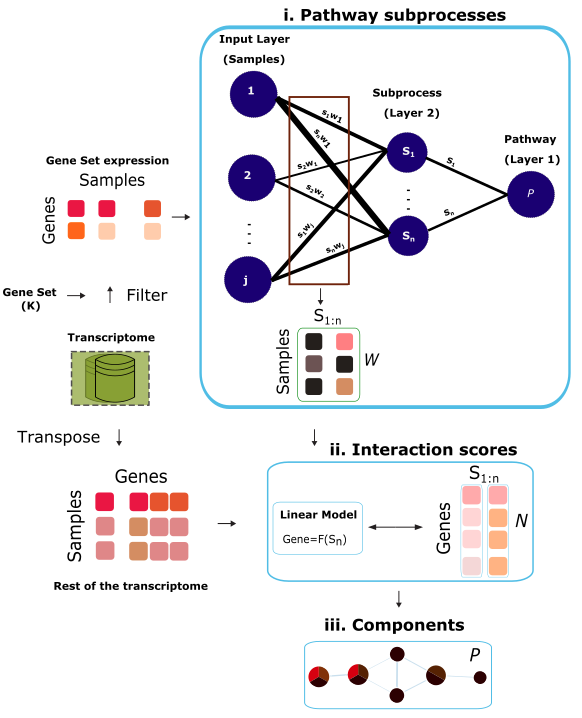
This tool is built in python3.8 with tensorflow backend and keras functional API.
Installation and running the tool
The best way to get ACSNI along with all the dependencies is to install the release from python package installer (pip)
pip install ACSNI
This will add four command line scripts:
| Script | Context | Usage |
|---|---|---|
| ACSNI-run | Gene set analysis | ACSNI-run -h |
| ACSNI-derive | Single gene analysis | ACSNI-derive -h |
| ACSNI-get | Link pathway trait | ACSNI-get -h |
| ACSNI-split | Split expression data | ACSNI-split -h |
Utility functions can be imported using conventional python system like from ACSNI.dbs import ACSNIResults
Input ACSNI-run
Expression Matrix - The expression file (.csv), specified by -i, where columns are samples and rows are genes.
The expression values should be normalised (eg. TPM, CPM, RSEM). Make sure the column name of the 1st column is "gene".
| gene | Sample1 | Sample2 | Sample3 |
|---|---|---|---|
| Foxp1 | 123.2 | 274.1 | 852.6 |
| PD1 | 324.2 | 494.1 | 452.6 |
| CD8 | 523.6 | 624.1 | 252.6 |
This input should not be transformed in any way (e.g. log, z-scale)
Gene set matrix - The prior matrix (.csv) file, specified by -t, where rows are genes and column is a binary
pathway membership. Where "1" means that a gene is in the pathway and "0" means that the gene is not know a priori.
The standard prior looks like below. Make sure the column name of the 1st column is "gene".
| gene | Pathway |
|---|---|
| Foxp1 | 0 |
| PD1 | 0 |
| CD8 | 1 |
You can also supply gene IDs instead of gene symbols.
The tool can handle multiple pathway columns in the -t file as below.
| gene | Pathway1 | Pathway2 | Pathway3 |
|---|---|---|---|
| Foxp1 | 0 | 0 | 0 |
| PD1 | 0 | 1 | 0 |
| CD8 | 1 | 0 | 1 |
Note: Each pathway above is analysed independently, and the outputs have no in-built relationship. The tool is designed to get a granular view of a single pathway at a time.
Output ACSNI-run
Database (.ptl)
| Content | Information |
|---|---|
| co | Pathway Code |
| w | Subprocess space |
| n | Interaction scores |
| p | Score classification |
| d | Interaction direction |
| run_info | Run parameters |
| methods | Extractor functions |
Predicted Network (.csv)
| Content | Meaning |
|---|---|
| name | Gene |
| sub | Subprocess |
| direction | Direction of interactions with subprocess |
Null (.csv) {Shuffled expression matrix}
Input ACSNI-derive
Expression Matrix - See ``-i``` description above.
Note - We recommend removing any un-desirable genes (eg. MT, RPL) from the expression matrix prior to running ACSNI-derive as they usually interfere during initial prior matrix generation steps. For TCR/BCR genes, counts of alpha, beta and gamma chains can be combined into a single count.
Biotype file (Optional) - The biotype file (.csv) specified by -f, given if the generation of gene set should be
based on a particular biotype specified by -b.
| gene | biotype |
|---|---|
| Foxp1 | protein_coding |
| PD1 | protein_coding |
| MALAT1 | lncRNA |
| SNHG12 | lncRNA |
| RNU1-114P | snRNA |
Correlation file (Optional) - The correlation file (.csv) specified by -u, given if the user wishes to replace
"some" specific genes with other genes to be used as a prior for the first iteration of ACSNI-run (internally).
| gene | cor |
|---|---|
| Foxp1 | 0.9 |
| PD1 | 0.89 |
| MALAT1 | 0.85 |
| SNHG12 | 0.80 |
| RNU1-114P | 0.72 |
Output ACSNI-derive
Database (.ptl)
| Content | Information |
|---|---|
| co | Pathway Code |
| n | Interaction scores |
| d | Interaction direction |
| ac | Correlation and T test results |
| fd | Unfiltered prediction data |
| run_info | Run parameters |
| methods | Extractor functions |
Predicted (.csv)
| Content | Meaning |
|---|---|
| name | Gene |
| predict | Classification of genes |
Null (.csv) {Shuffled expression matrix}
Input ACSNI-get
ACSNI database - Output of ACSNI-run (.ptl) specified by -r.
Target phenotype - Biological phenotype file (.csv) to link ACSNI subprocesses, specified by -v.
The sample IDs should match the IDs in the -i analysed by ACSNI-run.
Variable type - The type of phenotype i.e "numeric" or "character", specified by -c.
Outputs the strength of the associations across the subprocesses (.csv).
Input ACSNI-split
Expression Matrix - See ``-i``` description above.
Number of splits - The number of independent cohorts to generate from `-i```.
Outputs the data splits in the current working directory.
Extras
R functions to reproduce the downstream analyses reported in the paper are inside the folder "R".
Example runs are inside the folder "sh".
Tutorial
An extensive tutorial on how to use ACSNI commands can be found inside the Tutorial folder.
To clone the source repository
git clone https://github.com/caanene1/ACSNI
Citation
ACSNI: An unsupervised machine-learning tool for prediction of tissue-specific pathway components using gene expression profiles Chinedu Anthony Anene, Faraz Khan, Findlay Bewicke-Copley, Eleni Maniati and Jun Wang
1 maintainer

Metadata
1 maintainer
Release files for ACSNI 1.0.6
For a detailed explanation of source distributions (sdists) and built distributions (wheels), please see the package formats documentation.
Source distribution (sdist)
| File | Size | Uploaded | Provenance | |
|---|---|---|---|---|
| ACSNI-1.0.6.tar.gz | 19.3 kB | Without provenance | Details |
Built distribution (wheel)
| File | Interpreter | ABI | Platform | Reset |
|---|---|---|---|---|
| ACSNI-1.0.6-py3-none-any.whl | Python 3 | none | any | Details |
Total release size: 42.4 kB
Release files / ACSNI-1.0.6.tar.gz
| Download URL | ACSNI-1.0.6.tar.gz |
|---|---|
| Size | 19.3 kB |
| Tags | Source |
|
SHA-256 checksum How to use checksums |
9d8dec7d2c79d1999bd7d0c901e74244c26138da597d941fa7ba50aa0ddf9a68
|
|
BLAKE2b-256 checksum How to use checksums |
74a02105902b302f3845e34989475fd5fd66dcad2a3852320cce1d8db9f0cfd1
|
| Upload date | |
|
Uploaded using Trusted Publishing? What is trusted publishing? |
No |
| Uploaded via |
twine/3.4.1 importlib_metadata/3.7.3 pkginfo/1.7.0 requests/2.25.0 requests-toolbelt/0.9.1 tqdm/4.56.0 CPython/3.8.6
|
Release files / ACSNI-1.0.6-py3-none-any.whl
| Download URL | ACSNI-1.0.6-py3-none-any.whl |
|---|---|
| Size | 23.1 kB |
| Tags | Python 3 |
|
SHA-256 checksum How to use checksums |
3498e2510cab07590f218b4df54c58dce1149f1dc46d30661fdd7c4f18af0109
|
|
BLAKE2b-256 checksum How to use checksums |
98ecfc29fe99de92955a53ca19d7c12f781f140f8f2a0e835b8042758deb8fd3
|
| Upload date | |
|
Uploaded using Trusted Publishing? What is trusted publishing? |
No |
| Uploaded via |
twine/3.4.1 importlib_metadata/3.7.3 pkginfo/1.7.0 requests/2.25.0 requests-toolbelt/0.9.1 tqdm/4.56.0 CPython/3.8.6
|
Security for ACSNI 1.0.6
Provenance
Provenance describes where a file came from. On PyPI, provenance is shared via attestations, which provide a verifiable record of the build or publishing details. View details, limitations and caveats.
No provenance found
None of the files in this release were uploaded with provenance metadata.
A note on package security
PyPI is a repository for distributing packages, not a service for auditing them. While third-party security researchers and our staff do their best to detect and remove malicious packages, PyPI cannot guarantee the quality, security or suitability of any given package.
To learn more about protecting yourself from malicious actors, visit our package security documentation.














