
BODtoJSON v2.4.0
BODtoJSON is a safe, enterprise-grade Python data liquidity engine designed to transform complex Infor OAGIS (XML) Business Object Documents into modern, AI-ready flattened JSON, streaming NDJSON, and declarative target schemas.
BODtoJSON Library Documentation
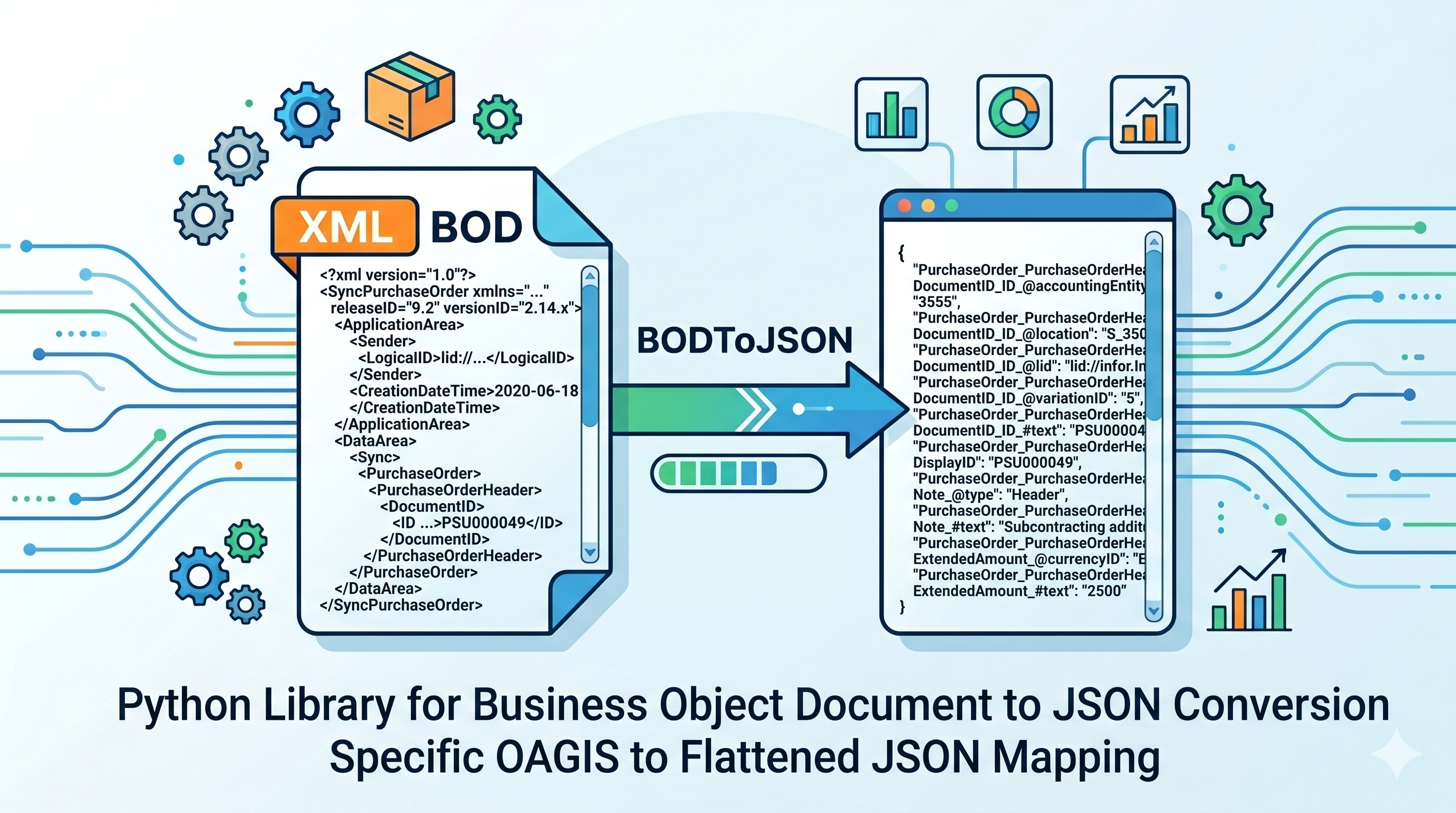
v2.4.0 restores a zero-runtime-dependency core that is safe enough for Infor ION Scripting: XML is parsed with a stdlib-only hardened loader, while to_records() / project(), single-pass flattening, and the optional FastAPI extra stay unchanged.
🚀 What’s New in v2.4.0 (vs. v1.0.0)
-
Zero-Dependency Safe Core: No third-party runtime dependencies. XML is parsed with a stdlib-only hardened loader (
xml.parsers.expat+xml.etree.ElementTree) that rejects DTD/entity declarations, XXE, billion-laughs and quadratic blowup, and enforces size and depth limits. -
Infor ION Scripting Helpers (
to_records&project): Eliminates boilerplate XML namespace parsing,json.loads()line-splitting loops, and manual boolean coercion in ION scripts. CapturesApplicationAreaandDataArea/<Verb>header metadata automatically (include_header=True) and maps records directly into target REST/API JSON schemas. -
Explicit Dual-Pipeline Architecture: Dedicated top-level API methods—
to_jsonandto_ndjson—improve interface predictability and self-documentation. -
Strict NDJSON Linearization: Features compact serialization via
separators=(',', ':')and forced line termination (\n). Multi-noun batch payloads insideDataAreaare automatically unpacked and emitted as individual, single-line text records. -
100% Backward Compatibility: The original
convert()function remains active at the package root, routing toto_json()while emitting a non-breakingDeprecationWarningscheduled for removal in v3.0.0. -
Enterprise REST API Tier (
api.py): Added an optional, high-performance FastAPI microservice layer featuring zero-overhead streaming using rawResponseclasses and/projectschema mapping.
📈 Architectural Comparison
| Feature | Legacy (v1.0.0) | Enterprise Engine (v2.4.0) |
|---|---|---|
| Core Dependencies | Relied on xmltodict |
None (Python stdlib only) |
| Memory & Speed | Double-pass XML $\rightarrow$ Dict $\rightarrow$ Flat Dict | Single-pass ElementTree traversal (~50% lower memory) |
| Data Formats | Standard Structured JSON string | Standard JSON, Strict NDJSON, Native Dicts & Projected Schemas |
| Infor ION Scripting | Manual XML + JSON loop boilerplate | Declarative project() with automatic header context |
| Ingestion Target | Application memory / NoSQL DBs | Data Lakehouses (Snowflake/Databricks), Vector DBs & ION APIs |
| System Delivery | Library imports only | Library + Optional FastAPI Microservice Tier ([api]) |
🛠️ Installation
Core Library (Zero Runtime Dependencies)
Ideal for Infor ION Scripting, data-engineering pipelines, ETL workers, and air-gapped environments. pip install BODtoJSON pulls no third-party packages (pip show BODtoJSON lists no Requires). ION hosts need the CPython stdlib modules xml.etree.ElementTree and xml.parsers.expat (ElementTree is expat-backed on CPython):
pip install BODtoJSON
With Enterprise REST API Tier
Includes fastapi and uvicorn for microservice deployment:
pip install "BODtoJSON[api]"
📂 Project Structure
BODtoJSON/
├── src/
│   └── BODtoJSON/
│       ├── __init__.py      # Package version (2.4.0) & API exports
│       ├── safe_xml.py      # Stdlib-only hardened XML parser
│       ├── mapper.py        # Dual-Pipeline & Projection Engine
│       └── api.py           # Optional FastAPI Microservice Ingestion Layer
├── tests/
│   ├── data/                # Raw OAGIS XML Test Datasets (.xml)
│   ├── config.py            # Test Data Configuration
│   ├── conftest.py          # Pytest Dataset Loader Fixtures
│   ├── test_mapper.py       # Core Engine Unit Tests, ION Projection & Regression Suite
│   └── test_api.py          # API Endpoint Verification
├── scripts/
│   └── inspect_payload.py   # Multi-Profile Business Validation Utility
├── pyproject.toml           # Build, Optional Extras & Pytest Configurations
└── README.md
🧪 Validation & Testing
1. Automated Testing (QA Suite)
Run the standardized pytest execution engine:
python -m pytest -v -p no:cacheprovider
2. Manual Payload Inspection (UAT Engine)
Verify transformation output profiles locally:
python scripts/inspect_payload.py
Toggle the mode parameter within inspect_payload.py between "ndjson", "json", "project", and "legacy" to inspect outputs in output_preview.json.
💻 Code Examples
1. Infor ION Scripting: Declarative Schema Projection (project)
Eliminates manual XML namespace handling, json.loads() loops, and boolean boilerplate.
import json
from BODtoJSON import project

SCHEMA = {
    "externalSystemId": "company[{Sync_AccountingEntityID}];DIMENSION1;{ChartOfAccounts_BaseChartOfAccounts_GLNominalAccount}",
    "isActive": "true",
    "companyId": "company[3100]",
    "dimensionName": "DIMENSION1",
    "usableInPurchase": "true",
}

# Automatically merges DataArea/Sync header context with each flattened Noun record
items = project(input_var, verb="Sync", schema=SCHEMA, include_header=True)
output_var = json.dumps(items)
2. Native Python Records (to_records)
Extracts a Python list[dict] directly with optional ApplicationArea and Verb header context.
from BODtoJSON import to_records

records = to_records(xml_input, verb="Sync", include_header=True)
for rec in records:
    print(rec["Sync_AccountingEntityID"], rec["PurchaseOrder_PurchaseOrderHeader_DisplayID"])
3. Modern Pipeline: Newline Delimited JSON (to_ndjson)
Optimized for Data Lakehouses (Snowflake/Databricks) and Vector Database ingestion.
from BODtoJSON import to_ndjson

xml_input = """<SyncPurchaseOrder>...</SyncPurchaseOrder>"""

# Returns a dense, single-line string per record with zero internal spaces, terminated by \n
linearized_ndjson = to_ndjson(xml_input, verb="Sync")
4. Modern Pipeline: Standard Flattened JSON (to_json)
Optimized for application-level consumption and document-store indexing.
from BODtoJSON import to_json

xml_input = """<SyncPurchaseOrder>...</SyncPurchaseOrder>"""

# Returns a standard flat JSON string
flattened_json = to_json(xml_input, verb="Sync")
5. Legacy Pipeline: Backward-Compatible Conversion (convert)
Maintained for smooth migration of existing production pipelines.
from BODtoJSON import convert

xml_input = """<SyncPurchaseOrder>...</SyncPurchaseOrder>"""

# DEPRECATED: Scheduled for removal in v3.0.0.
# Internally routes to to_json() and emits a DeprecationWarning.
legacy_json = convert(xml_input, verb="Sync")
6. Running the Enterprise API Tier
Launch the microservice locally:
uvicorn BODtoJSON.api:app --reload
Open http://127.0.0.1:8000/docs to test /convert/ndjson, /convert/json, and /project directly via Swagger UI.
🤝 Commercial Value
By normalizing complex ERP structures into safe, flat JSON, streaming NDJSON, and projected API payloads, BODtoJSON v2.4.0 stays at zero third-party runtime dependencies and reduces AI, Lakehouse, and Infor ION integration overhead by up to 90%.
Author: Niraj Kakodkar
License: MIT
🔒 Security (XML parsing)
The core library never calls xml.etree.ElementTree.fromstring. Input is scanned for DOCTYPE / ENTITY declarations (including UTF-16/32 and BOM encodings) and then parsed with xml.parsers.expat handlers that forbid DTDs, entity declarations, and external entity references. Parameter-entity parsing is disabled. A default 10 MiB size cap and a default depth cap of 256 apply; both are configurable on BODConverter.
This is stricter than a default defusedxml.ElementTree.fromstring call (used in 2.3.1 with forbid_dtd=False). Literal <!DOCTYPE or <!ENTITY tokens in comments or CDATA are also rejected. Infor OAGIS BODs do not need DTDs.
The optional API (pip install "BODtoJSON[api]") is unauthenticated and caps request bodies at 10 MiB (HTTP 413). Put it behind your own auth and a reverse-proxy size limit for production.
Known Limitations
- Flattening is lossy and one-way. There is no JSON → BOD reverse mapping.
to_json()returns only the first noun underDataArea. Useto_records()orto_ndjson()to get all nouns.- The optional FastAPI extra is unauthenticated. Deploy it only on a trusted network or behind your own authentication/authorization.
- Mixed content (text + child elements) preserves the direct text as
_#textwhere present; tail text after children is not specially handled beyond ElementTree defaults. - Empty elements flatten to JSON
null. - Documents whose text, comments, or CDATA contain the literal tokens
<!DOCTYPEor<!ENTITYare rejected.
1 maintainer

Metadata
1 maintainer
Release files for BODtoJSON 2.4.0
For a detailed explanation of source distributions (sdists) and built distributions (wheels), please see the package formats documentation.
Source distribution (sdist)
| File | Size | Uploaded | Provenance | Actions |
|---|---|---|---|---|
| bodtojson-2.4.0.tar.gz | 38.2 kB | Without provenance | Details for bodtojson-2.4.0.tar.gz |
Built distribution (wheel)
| File | Interpreter | ABI | Platform | Actions Reset |
|---|---|---|---|---|
| bodtojson-2.4.0-py3-none-any.whl | Python 3 | none | any | Details for bodtojson-2.4.0-py3-none-any.whl |
Total release size: 53.4 kB
Release files / bodtojson-2.4.0.tar.gz
| Download URL | bodtojson-2.4.0.tar.gz |
|---|---|
| Size | 38.2 kB |
| Tags | Source |
|
SHA-256 checksum How to use checksums |
2c91638324d66fe6a67124d26b03925197a24485e1b3adf4af5c012b5e1de02e
|
|
BLAKE2b-256 checksum How to use checksums |
ecc46f22656bf123beddb4d3b94f37ad8fd79fd7af5c8b37d903f9a6aafa8e2f
|
| Upload date | |
|
Uploaded using Trusted Publishing? What is trusted publishing? |
No |
| Uploaded via |
twine/6.2.0 CPython/3.11.9
|
Release files / bodtojson-2.4.0-py3-none-any.whl
| Download URL | bodtojson-2.4.0-py3-none-any.whl |
|---|---|
| Size | 15.2 kB |
| Tags | Python 3 |
|
SHA-256 checksum How to use checksums |
c5746db4709606f413ba7934f0257c438129bf4c5d49c21e2eb410a885827e05
|
|
BLAKE2b-256 checksum How to use checksums |
4172feb995d9fdd91024454d13ee9b4dc9de709b2692dd9b135b364d94b2fbf8
|
| Upload date | |
|
Uploaded using Trusted Publishing? What is trusted publishing? |
No |
| Uploaded via |
twine/6.2.0 CPython/3.11.9
|
Security for BODtoJSON 2.4.0
Provenance
Provenance describes where a file came from. On PyPI, provenance is shared via attestations, which provide a verifiable record of the build or publishing details. View details, limitations and caveats.
No provenance found
None of the files in this release were uploaded with provenance metadata.
A note on package security
PyPI is a repository for distributing packages, not a service for auditing them. While third-party security researchers and our staff do their best to detect and remove malicious packages, PyPI cannot guarantee the quality, security or suitability of any given package.
To learn more about protecting yourself from malicious actors, visit our package security documentation.














