
✉️ Flask-Mailing v3.0.0 🚀






🌟 The Future of Flask Email - Available Today!
Flask-Mailing v3.0.0 represents the pinnacle of modern Python email handling. Built for 2026 and beyond, it combines cutting-edge Python 3.10+ features, Flask 3.1+ compatibility, and enterprise-grade security into one powerful package.
✨ What's Revolutionary in v3.0.0
🎯 Modern Python Excellence
- ✅ Python 3.10+ Required - Modern union syntax (
str | None) and built-in generics - ✅ Python 3.14 Ready - Future-proof architecture
- ✅ Type Safety First - Full type hints with mypy validation
- ✅ Performance Optimized - Built for modern Python performance gains
🛡️ Enterprise Security
- 🔒 Rate Limiting - Prevent abuse with built-in rate limiting
- 🛡️ Email Security Validation - Detect and block disposable/malicious emails
- 🔐 Path Traversal Protection - Enhanced file attachment security
- 🚨 Content Sanitization - Prevent injection attacks
- 🔍 Security Scanning - Automated vulnerability detection
⚡ Next-Gen Architecture
- 🔄 Modern Async Patterns - Proper context managers and error handling
- 📦 Pydantic v2.11+ - Latest validation with enhanced performance
- 🏗️ Modern Build System - Ruff, Black, isort, mypy integration
- 🐳 Container Ready - Docker support with security best practices
📋 Requirements
- Python 3.10+ (3.14 compatible!)
- Flask 3.1+ with async support
- Modern development environment
🔧 Installation
# 2026-Ready Installation (Python 3.10+ required)
pip install flask-mailing>=3.0.0

# With enhanced security features
pip install flask-mailing[email-checking]

# Full development setup
pip install flask-mailing[dev,email-checking]
📦 Development Installation
git clone https://github.com/marktennyson/flask-mailing.git
cd flask-mailing
pip install -e ".[dev,email-checking]"
🚀 Modern Quick Start
Flask 3.1+ with Modern Python Features
from flask import Flask, jsonify
from flask_mailing import Mail, Message

app = Flask(__name__)

# Configuration for Flask 3.x
app.config.update(
    MAIL_USERNAME="your.email@gmail.com",
    MAIL_PASSWORD="your_app_password",
    MAIL_PORT=587,
    MAIL_SERVER="smtp.gmail.com",
    MAIL_USE_TLS=True,
    MAIL_USE_SSL=False,
    USE_CREDENTIALS=True,
    VALIDATE_CERTS=True,
    MAIL_DEFAULT_SENDER="your.email@gmail.com",
    MAIL_FROM_NAME="Your App Name"
)

mail = Mail(app)

@app.post("/send-email")
async def send_email():
    message = Message(
        subject="Flask-Mailing v3.0.0 Test",
        recipients=["recipient@example.com"],
        body="Hello from Flask-Mailing v3.0.0! 🚀\n\nNow with Python 3.10-3.14 and Flask 3.x support!",
        subtype="plain"
    )

    await mail.send_message(message)
    return jsonify({"status": "Email sent successfully!"})

if __name__ == "__main__":
    app.run(debug=True)
HTML Email with Modern Syntax
@app.post("/send-html")
async def send_html():
    html_content = """
    <html>
        <body style="font-family: Arial, sans-serif;">
            <h1 style="color: #2c3e50;">Welcome to Flask-Mailing v3.0.0!</h1>
            <p>This email was sent using the modernized Flask-Mailing library.</p>
            <ul>
                <li>✅ Python 3.10-3.14 compatible</li>
                <li>✅ Flask 3.1+ ready</li>
                <li>✅ Enhanced performance</li>
            </ul>
        </body>
    </html>
    """

    message = Message(
        subject="🚀 Flask-Mailing v3.0.0 - HTML Email",
        recipients=["recipient@example.com"],
        html=html_content,
        subtype="html"
    )

    await mail.send_message(message)
    return jsonify({"status": "HTML email sent!"})
Bulk Email Support
@app.post("/send-bulk")
async def send_bulk():
    email_data = (
        ("Subject 1", "Message 1", ["user1@example.com"]),
        ("Subject 2", "Message 2", ["user2@example.com"]),
        ("Subject 3", "Message 3", ["user3@example.com"]),
    )

    await mail.send_mass_mail(email_data)
    return jsonify({"status": "Bulk emails sent successfully!"})
📖 Documentation
For detailed documentation, examples, and API reference:
🔄 Migration from v0.2.x
Breaking Changes in v3.0.0
- Minimum Python version: 3.10+ (was 3.6+)
- Minimum Flask version: 3.1+ (was 2.0+)
- Pydantic v2: Updated from v1.x to v2.11+
- Email checking utilities: Now optional dependencies
Migration Steps
- Upgrade Python to 3.10+ (recommended: 3.12+)
- Upgrade Flask to 3.1+
- Update requirements.txt:
# Old
flask-mailing>=0.2.3

# New
flask-mailing>=3.0.0
- Test your application - most APIs remain the same
📊 Version Compatibility
| Flask-Mailing | Python | Flask | Pydantic | Status |
|---|---|---|---|---|
| 3.0.0+ | 3.10-3.14 | 3.1+ | 2.11+ | ✅ Active |
| 0.2.x | 3.6+ | 2.0+ | 1.8+ | 🔒 Legacy |
🧪 Testing
# Run tests with Python 3.13
python -m pytest tests/ -v

# Run with multiple Python versions using tox
tox
🤝 Contributing
We welcome contributions! Please see our Contributing Guide for details.
📋 Dependencies
Core Dependencies
aiosmtplib>=4.0.1- Async SMTP clientflask>=3.1.0- Web frameworkpydantic>=2.11.0- Data validationpydantic-settings>=2.9.0- Settings managementemail-validator>=2.3.0- Email validationjinja2>=3.1.6- Template engine
Optional Dependencies
redis>=5.3.0- For email checking featureshttpx>=0.28.1- For HTTP-based email validationdnspython>=2.8.0- For DNS-based validation
📜 License
📊 Stats


🔗 Links
- 🏠 Github
- 📄 Documentation
- 🐍 PyPI
- 🐛 Issues
- 💬 Discussions
Made with ❤️ for the Python & Flask community
Flask-Mailing v3.0.0 - Ready for the future of Python development!
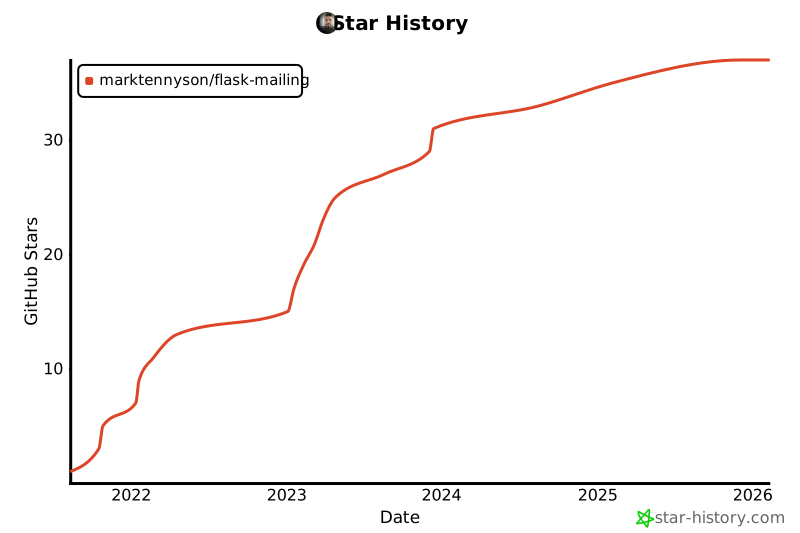
Star History
Key Features ✨
-
🔄 Supports asynchronous email sending using the built-in
asynciolibrary in Python 3.10+. -
🔗 Easily integrates with Flask applications using the provided
Mailextension. -
⚙️ Offers simple and intuitive configuration options for email providers such as SMTP, Sendgrid, and Mailgun.
-
✉️ Supports HTML and plain-text message formats, as well as the option to send both formats in a multi-part message.
-
📎 Provides support for file attachments in emails.
-
🎨 Includes customizable email templates and support for Jinja2 templates.
-
🚀 Offers a simple API for sending email messages, allowing for quick and easy implementation in any Flask project.
-
📧 Supports bulk email sending, allowing for the efficient delivery of messages to large email lists.
-
📑 Provides options for customizing email headers and message priority levels.
-
📈 Supports email tracking through message IDs and delivery status notifications.
-
🔬 Includes a comprehensive testing suite for ensuring the correct configuration and behavior of the email sending functionality.
-
🔒 Supports email encryption and authentication using TLS and SSL protocols.
-
⚠️ Offers error handling and logging functionality for tracking and resolving email sending issues.
-
📖 Provides detailed documentation and active community support for resolving any issues or questions related to the package.
More information on Getting-Started
📥 Downloads

🚑 Package health score by snyk.io

🔗 Important Links
❤️ Github
📄 Documentation
🐍 PYPI
😀 Contributors ✨
Thanks go to these wonderful people ([🚧]):
 Aniket Sarkar 💬 👀 🚧 |
 Joshua Kinslow |
 Alexandre Gramfort |
 ahmetkurukose |
 Sriram |
 CharlesTWood |
This project follows the all-contributors specification. Contributions of any kind are welcome!
Before you start please read CONTRIBUTING
📝 LICENSE
1 maintainer

Metadata
1 maintainer
Release files for Flask-Mailing 3.0.0
For a detailed explanation of source distributions (sdists) and built distributions (wheels), please see the package formats documentation.
Source distribution (sdist)
| File | Size | Uploaded | |
|---|---|---|---|
| flask_mailing-3.0.0.tar.gz | 147.6 kB | Details |
Built distribution (wheel)
| File | Interpreter | ABI | Platform | Reset |
|---|---|---|---|---|
| flask_mailing-3.0.0-py3-none-any.whl | Python 3 | none | any | Details |
Total release size: 178.9 kB
Release files / flask_mailing-3.0.0.tar.gz
| Download URL | flask_mailing-3.0.0.tar.gz |
|---|---|
| Size | 147.6 kB |
| Tags | Source |
|
SHA-256 checksum How to use checksums |
fa6b7a9efded4ce7d3c60afaa595c34771e330aa739673efd65940397f0864c6
|
|
BLAKE2b-256 checksum How to use checksums |
2d162f19b6fca9615a8fef34c7ff42f29948bd92b87e0798bac809ce6543ff3d
|
| Upload date | |
|
Uploaded using Trusted Publishing? What is trusted publishing? |
Yes |
| Uploaded via |
twine/6.1.0 CPython/3.13.7
|
Provenance
Provenance describes where a file came from. On PyPI, provenance is shared via attestations, which provide a verifiable record of the build or publishing details. View details, limitations and caveats.


PyPI Publish Attestation
PyPI verified that this artifact, at this checksum, originated from the publisher listed below.
Signed by GitHub Actions, verified by PyPI on Nov 29, 2025.
Transparency logRelease files / flask_mailing-3.0.0-py3-none-any.whl
| Download URL | flask_mailing-3.0.0-py3-none-any.whl |
|---|---|
| Size | 31.3 kB |
| Tags | Python 3 |
|
SHA-256 checksum How to use checksums |
68a19eec57522c9d6127ddc2acdf831e5fb004a98a48b8bb855b556929d1fd0b
|
|
BLAKE2b-256 checksum How to use checksums |
be81d8ee1a6f5caf04897abd48ece115a72246637b10333501e5a9938c3afb85
|
| Upload date | |
|
Uploaded using Trusted Publishing? What is trusted publishing? |
Yes |
| Uploaded via |
twine/6.1.0 CPython/3.13.7
|
Provenance
Provenance describes where a file came from. On PyPI, provenance is shared via attestations, which provide a verifiable record of the build or publishing details. View details, limitations and caveats.
PyPI Publish Attestation
PyPI verified that this artifact, at this checksum, originated from the publisher listed below.
Signed by GitHub Actions, verified by PyPI on Nov 29, 2025.
Transparency log













