


KRATOS Multiphysics ("Kratos") is a framework for building parallel, multi-disciplinary simulation software, aiming at modularity, extensibility, and high performance. Kratos is written in C++, and counts with an extensive Python interface. More in Overview
Kratos is free under BSD-4 license and can be used even in comercial softwares as it is. Many of its main applications are also free and BSD-4 licensed but each derived application can have its own propietary license.
Main Features
Kratos is multiplatform and available for Windows, Linux (several distros) and macOS.
Kratos is OpenMP and MPI parallel and scalable up to thousands of cores.
Kratos provides a core which defines the common framework and several application which work like plug-ins that can be extended in diverse fields.
Its main applications are:
- DEM for cohesive and non cohesive spheric and non spheric particles simulation
- Fluid Dynamics Provides 2D and 3D incompressible fluids formulation
- Fluid Structure Interaction for solution of different FSI problems
- Structural Mechanics Providing solution for solid, shell and beam structures with linear and nonlinear, static and dynamic behavior
- Contact Structural Mechanics For contact problems used along the Structural Mechanics application
Some main modules are:
Documentation
Here you can find the basic documentation of the project:
Getting Started
- Getting Kratos (Last compiled Release)
- Kratos from
pip: Just simply type on terminalpip install KratosMultiphysics-all - Kratos for GiD
- Kratos from
- Compiling Kratos
Tutorials
- Running an example from GiD
- Kratos input files and I/O
- Data management
- Solving strategies
- Manipulating solution values
- Multiphysics
More documentation
Examples of use
Kratos has been used for simulation of many different problems in a wide variety of disciplines ranging from wind over singular building to granular domain dynamics. Some examples and validation benchmarks simulated by Kratos can be found here
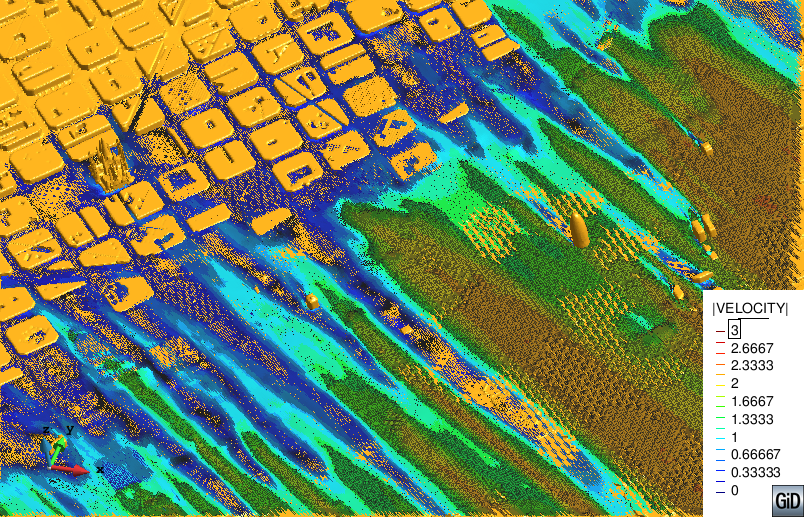 Barcelona Wind Simulation
Contributors
Organizations contributing to Kratos:

International Center for Numerical Methods in Engineering

Chair of Structural Analysis
Technical University of Munich

Altair Engineering

Deltares

Institute of Structural Analysis
Technische Universität Braunschweig

University of Padova, Italy
Our Users
Some users of the technologies developed in Kratos are:

Airbus Defence and Space
Stress Methods & Optimisation Department

Siemens AG
Corporate Technology

ONERA, The French Aerospace Lab
Applied Aerodynamics Department
Looking forward to seeing your logo here!
Special Thanks To
In Kratos Core:
- Boost for ublas
- pybind11 for exposing C++ to python
- GidPost providing output to GiD
- AMGCL for its highly scalable multigrid solver
- JSON JSON for Modern C++
- ZLib The compression library
In applications:
- Eigen For linear solvers used in the LinearSolversApplication
- Trilinos for MPI linear algebra and solvers used in TrilinosApplication
- METIS for partitioning in MetisApplication
- CoSimIO for performing coupled simulations with external solvers within the CoSimulationApplication. The CoSimIO in Kratos uses the following libraries:
- Boost for the
intrusive_ptr - filesystem Header-only single-file std::filesystem compatible helper library, based on the C++17 specs
- asio for socket based interprocess communication
- Boost for the
How to cite Kratos?
Please, use the following references when citing Kratos in your work.
- Dadvand, P., Rossi, R. & Oñate, E. An Object-oriented Environment for Developing Finite Element Codes for Multi-disciplinary Applications. Arch Computat Methods Eng 17, 253–297 (2010). https://doi.org/10.1007/s11831-010-9045-2
- Dadvand, P., Rossi, R., Gil, M., Martorell, X., Cotela, J., Juanpere, E., Idelsohn, S., Oñate, E. (2013). Migration of a generic multi-physics framework to HPC environments. Computers & Fluids. 80. 301–309. 10.1016/j.compfluid.2012.02.004.
- Vicente Mataix Ferrándiz, Philipp Bucher, Rubén Zorrilla, Riccardo Rossi, Jordi Cotela, Alejandro Cornejo Velázquez, Miguel Angel Celigueta, Josep Maria, Tobias Teschemacher, Carlos Roig, Miguel Maso, Guillermo Casas, Suneth Warnakulasuriya, Marc Núñez, Pooyan Dadvand, Salva Latorre, Ignasi de Pouplana, Joaquín Irazábal González, Ferran Arrufat, … Javi Gárate. (2022). KratosMultiphysics/Kratos: Release 9.2 (v9.2). Zenodo. https://doi.org/10.5281/zenodo.3234644
1 maintainer

Metadata
1 maintainer
Release files for KratosMultiphysics-all 9.4.1
For a detailed explanation of source distributions (sdists) and built distributions (wheels), please see the package formats documentation.
Built distribution (wheel)
| File | Interpreter | ABI | Platform | Actions Reset |
|---|---|---|---|---|
| KratosMultiphysics_all-9.4.1-py3-none-any.whl | Python 3 | none | any | Details for KratosMultiphysics_all-9.4.1-py3-none-any.whl |
Release files / KratosMultiphysics_all-9.4.1-py3-none-any.whl
| Download URL | KratosMultiphysics_all-9.4.1-py3-none-any.whl |
|---|---|
| Size | 5.2 kB |
| Tags | Python 3 |
|
SHA-256 checksum How to use checksums |
26292dd3a9158e67f4ced1a7aa9c558ea82b35bdad1ffc6802cb6d9576efc647
|
|
BLAKE2b-256 checksum How to use checksums |
9079878ffc758b3f073b0091a75a2edf2b2bd1de2864d34ed194211b5034db31
|
| Upload date | |
|
Uploaded using Trusted Publishing? What is trusted publishing? |
No |
| Uploaded via |
twine/3.8.0 pkginfo/1.8.2 readme-renderer/34.0 requests/2.31.0 requests-toolbelt/0.9.1 urllib3/1.26.9 tqdm/4.63.1 importlib-metadata/6.8.0 keyring/23.5.0 rfc3986/2.0.0 colorama/0.4.4 CPython/3.9.11
|
Security for KratosMultiphysics-all 9.4.1
Provenance
Provenance describes where a file came from. On PyPI, provenance is shared via attestations, which provide a verifiable record of the build or publishing details. View details, limitations and caveats.
No provenance found
None of the files in this release were uploaded with provenance metadata.
A note on package security
PyPI is a repository for distributing packages, not a service for auditing them. While third-party security researchers and our staff do their best to detect and remove malicious packages, PyPI cannot guarantee the quality, security or suitability of any given package.
To learn more about protecting yourself from malicious actors, visit our package security documentation.














