
This project has been archived by its maintainers, and is no longer receiving any updates.
# MDCatch ## Still in development, but you are welcome to try! A simple PyQt5 app to fetch metadata from EPU or SerialEM. It parses the first found EPU xml and SerialEM mdoc file associated with a data collection session. In case of SerialEM you need to enable saving mdoc file for each movie.
- ### Prerequisites / installation:
Python 3 and PyQt5. If you don’t have PyQt5 module in your system python3 then create a virtual environment: ` python3 -m venv venv source venv/bin/activate pip install PyQt5 `
Relion 3.1 or Scipion 3.0 sourced in your PATH (at the moment Scipion 3 is not ready!)
Preprocessing templates: Schedules folder for Relion, template.json for Scipion
Edit config.py to adjust it to your settings
- ### Running
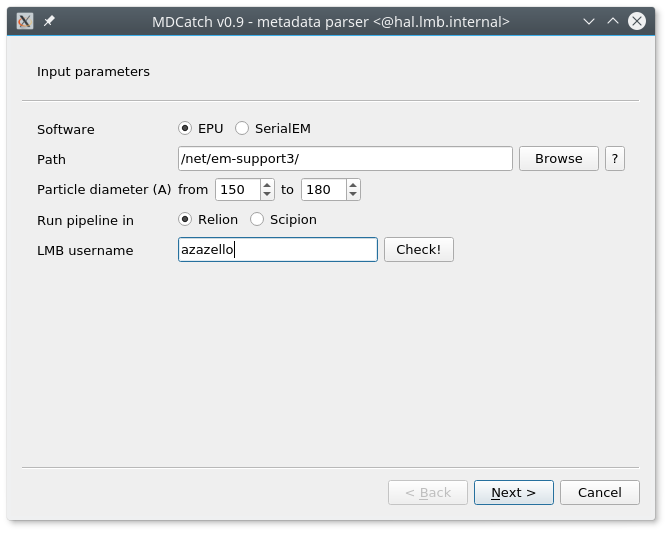
- Simply python3 run.py. User only needs to provide:
path to EPU session folder or path to folder with SerialEM movies/mdoc files
particle size (A)
username
### Working principle The idea is to launch the app on a separate OTF machine as soon as EPU/SerialEM starts data collection and the first movie is acquired.
check if username exists in the NIS database (ypmatch username passwd)
find and parse the first xml/mdoc file, getting all acquisition metadata
create a Relion/Scipion project folder username_microscope_date_time inside PROJECT_PATH (or inside Scipion default projects folder)
create symlinks for movies, gain reference, defects file, MTF in the project folder
modify existing Relion Schedules/Scipion templates then launch Relion/Scipion on-the-fly processing
### Screenshots
- ### TODO
beam tilt is parsed but not used since we parse only a single xml/mdoc for the whole session
SerialEM conversions: gain ref dm4->mrc, defects SerialEM->Relion
K3 EPU 2.6.1 gain file is a rubbish tif, to be fixed by TFS
use GAIN_DICT from config
1 maintainer

Metadata
1 maintainer
Release files for MDCatch 0.9.3
For a detailed explanation of source distributions (sdists) and built distributions (wheels), please see the package formats documentation.
Source distribution (sdist)
| File | Size | Uploaded | Provenance | Actions |
|---|---|---|---|---|
| MDCatch-0.9.3.tar.gz | 42.0 kB | Without provenance | Details for MDCatch-0.9.3.tar.gz |
Release files / MDCatch-0.9.3.tar.gz
| Download URL | MDCatch-0.9.3.tar.gz |
|---|---|
| Size | 42.0 kB |
| Tags | Source |
|
SHA-256 checksum How to use checksums |
d920081862e02982a45d6926a2f85aaa121118ce0c581c430bb985c11512fc45
|
|
BLAKE2b-256 checksum How to use checksums |
505d71b09bfb08feb57eb73023994813b7af3b3a29f58facb4681af4047ca290
|
| Upload date | |
|
Uploaded using Trusted Publishing? What is trusted publishing? |
No |
| Uploaded via |
twine/3.1.1 pkginfo/1.5.0.1 requests/2.23.0 setuptools/46.1.3 requests-toolbelt/0.9.1 tqdm/4.41.0 CPython/3.8.2
|
Security for MDCatch 0.9.3
Provenance
Provenance describes where a file came from. On PyPI, provenance is shared via attestations, which provide a verifiable record of the build or publishing details. View details, limitations and caveats.
No provenance found
None of the files in this release were uploaded with provenance metadata.
A note on package security
PyPI is a repository for distributing packages, not a service for auditing them. While third-party security researchers and our staff do their best to detect and remove malicious packages, PyPI cannot guarantee the quality, security or suitability of any given package.
To learn more about protecting yourself from malicious actors, visit our package security documentation.
















