
This project has been archived by its maintainers, and is no longer receiving any updates.
MDCatch
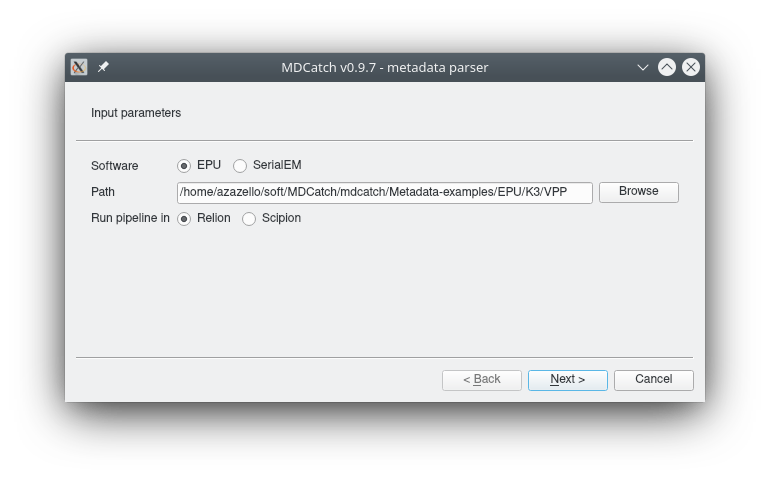
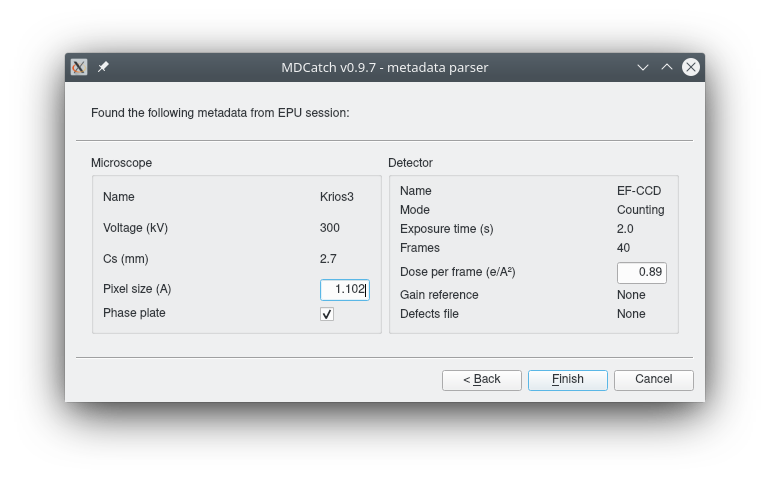
A simple app to fetch acquisition metadata from a running EPU session or SerialEM. It parses the first found xml/mrc (EPU) or mdoc file (SerialEM) associated with a data collection session and launches Relion or Scipion pipeline. In case of SerialEM you need to enable saving mdoc file for each movie.
Dependencies
Dependencies are installed from pip automatically:
pyqt5 (GUI)
numpy (to parse MRC headers)
emtable (for some Relion schedules scripts)
watchdog (watch folder when running in daemon mode)
Installation
You can install either using pip or from sources.
from pypi (recommended): pip install MDCatch
from sources - you have two options:
create python virtualenv:
python3 -m venv mdcatch
source mdcatch/bin/activate
git clone https://github.com/azazellochg/MDCatch.git
cd MDCatch
pip install -e .
create conda virtualenv (requires conda installed):
conda create -n mdcatch python=3.8
conda activate mdcatch
git clone https://github.com/azazellochg/MDCatch.git
cd MDCatch
pip install -e .
Configuration
Relion 3.1 or Scipion 3.0 is in in your PATH
Preprocessing templates: Schedules folder for Relion, template.json for Scipion
Edit config.py to adjust it to your setup
Running
To run with a GUI simply type mdcatch. If you want to run in daemon mode, run mdcatch –watch (or better setup a daily cron job)
Working principle
GUI mode (default)
The idea is to run the app on a processing server once EPU/SerialEM starts data collection and the first movie is acquired. The server has to have access to both EPU session folder and movies folder, or to SerialEM movie folder.
find and parse the first xml/mdoc file, getting all acquisition metadata
create a Relion/Scipion project folder username_microscope_date_time inside PROJECT_PATH (or inside Scipion default projects folder)
create symlink for movies folder; copy gain reference, defects file, MTF into the project folder
modify existing Relion Schedules/Scipion templates then launch Relion/Scipion on-the-fly processing
setfacl -R -m u:uid:rwx is executed for the project folder, where uid is obtained from DEF_USER
Daemon mode
From version 0.9.7 onwards it’s possible to run the app in fully automatic mode. It will run in the background recursively watching for new directories (directory name should start with PREFIX, e.g. lmb_username_myEpuSession) inside METADATA_PATH. Once an xml (EPU) or a mdoc (SerialEM) file is created in such folder, the default pipeline will launch. All subsequent steps are equivalent to the GUI mode.
Make sure you have set in config.py: DEF_USER, DEF_SOFTWARE, DEF_PIPELINE, DEF_PREFIX, METATADA_PATH.
It’s probably useful to setup a daily cron job for mdcatch –watch to detect new EPU/SerialEM sessions.
Screenshots
1 maintainer

Metadata
1 maintainer
Release files for MDCatch 0.9.7
For a detailed explanation of source distributions (sdists) and built distributions (wheels), please see the package formats documentation.
Source distribution (sdist)
| File | Size | Uploaded | Provenance | Actions |
|---|---|---|---|---|
| MDCatch-0.9.7.tar.gz | 54.1 kB | Without provenance | Details for MDCatch-0.9.7.tar.gz |
Release files / MDCatch-0.9.7.tar.gz
| Download URL | MDCatch-0.9.7.tar.gz |
|---|---|
| Size | 54.1 kB |
| Tags | Source |
|
SHA-256 checksum How to use checksums |
74d51a1c9fd9cc89758ae2f0c6e848d35c68dd3043f203862028642730e4efd1
|
|
BLAKE2b-256 checksum How to use checksums |
35a16e6a9c4cf1034fd6d2c0bc771e2cb6251aafbe6589bbd92d1c555b81d2b0
|
| Upload date | |
|
Uploaded using Trusted Publishing? What is trusted publishing? |
No |
| Uploaded via |
twine/3.1.1 pkginfo/1.5.0.1 requests/2.24.0 setuptools/46.1.3 requests-toolbelt/0.9.1 tqdm/4.41.0 CPython/3.8.5
|
Security for MDCatch 0.9.7
Provenance
Provenance describes where a file came from. On PyPI, provenance is shared via attestations, which provide a verifiable record of the build or publishing details. View details, limitations and caveats.
No provenance found
None of the files in this release were uploaded with provenance metadata.
A note on package security
PyPI is a repository for distributing packages, not a service for auditing them. While third-party security researchers and our staff do their best to detect and remove malicious packages, PyPI cannot guarantee the quality, security or suitability of any given package.
To learn more about protecting yourself from malicious actors, visit our package security documentation.














