
Mesa: Agent-based modeling in Python 3+


Mesa is an Apache2 licensed agent-based modeling (or ABM) framework in Python.
It allows users to quickly create agent-based models using built-in core components (such as spatial grids and agent schedulers) or customized implementations; visualize them using a browser-based interface; and analyze their results using Python’s data analysis tools. Its goal is to be the Python 3-based alternative to NetLogo, Repast, or MASON.
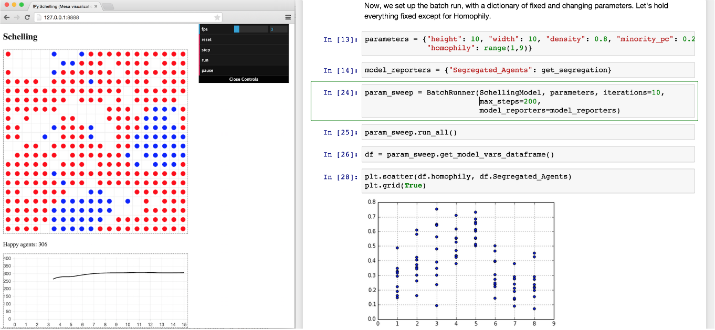
Above: A Mesa implementation of the Schelling segregation model, being visualized in a browser window and analyzed in an IPython notebook.
Features
Modular components
Browser-based visualization
Built-in tools for analysis
Using Mesa
Getting started quickly:
$ pip install mesaYou can also use pip to install the github version:
$ pip install git+https://github.com/projectmesa/mesaFor more help on using Mesa, check out the following resources:
Contributing back to Mesa
If you run into an issue, please file a ticket for us to discuss. If possible, follow up with a pull request.
If you would like to add a feature, please reach out via ticket or the email list for discussion. A feature is most likely to be added if you build it!


Release files for Mesa 0.8.0
For a detailed explanation of source distributions (sdists) and built distributions (wheels), please see the package formats documentation.
Source distribution (sdist)
| File | Size | Uploaded | Provenance | Actions |
|---|---|---|---|---|
| Mesa-0.8.0.tar.gz | 84.2 kB | Without provenance | Details for Mesa-0.8.0.tar.gz |
Release files / Mesa-0.8.0.tar.gz
| Download URL | Mesa-0.8.0.tar.gz |
|---|---|
| Size | 84.2 kB |
| Tags | Source |
|
SHA-256 checksum How to use checksums |
3e3be625e3e0e15bc57530cd5af7a7656c5aa83bb2731372df7242180b4d9037
|
|
BLAKE2b-256 checksum How to use checksums |
15ebea6a5fead6c0a14ebc96f18e332a60834301177da20d27b156beb5a13de3
|
| Upload date | |
|
Uploaded using Trusted Publishing? What is trusted publishing? |
No |
Security for Mesa 0.8.0
Provenance
Provenance describes where a file came from. On PyPI, provenance is shared via attestations, which provide a verifiable record of the build or publishing details. View details, limitations and caveats.
No provenance found
None of the files in this release were uploaded with provenance metadata.
A note on package security
PyPI is a repository for distributing packages, not a service for auditing them. While third-party security researchers and our staff do their best to detect and remove malicious packages, PyPI cannot guarantee the quality, security or suitability of any given package.
To learn more about protecting yourself from malicious actors, visit our package security documentation.














