
Rummikub Console
A Rummikub solver console supporting multiple games and persistence, written in Python.
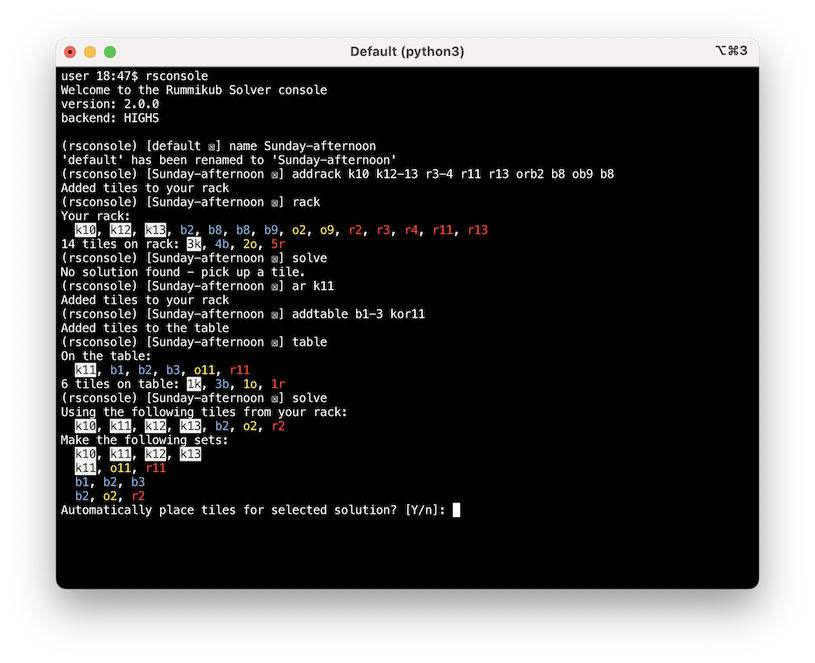
The algorithm used builds on the approach described by D. Den Hertog, P. B. Hulshof (2006), "Solving Rummikub Problems by Integer Linear Programming", The Computer Journal, 49(6), 665-669 (DOI 10.1093/comjnl/bxl033).
Features
- Can track multiple games, letting you switch between named games
- Saves tracked games automatically
- Can work with different Rummikub rules, letting you adjust the number of colours, tiles, and other aspects
- You can freely adjust what tiles are on the rack or on the table, within the limits of what tiles are available according to the current rules
- Can be used with any of the Mixed-Integer Linear Programming (MILP) solvers supported by cvxpy.
Solver improvements
The original models described by Den Hertog and Hulshof assume that all possible sets that meet the minimum length requirements and can't be split up are desirable outcomes.
However, any group set (tiles with the same number but with different colours) containing at least one joker, but which is longer than the minimal run, in effect contains a redundant joker, something you wouldn't want to leave on the table for the next player to use. The same applies to run sets (tiles of the same colour but with consecutive numbers), that are longer than the minimal set length but start or end with a joker. In this implementation, such sets are omitted from the possible options.
The implementation also includes a solver for the initial move, where you can only use tiles from your own rack and must place a minimum amount of points before you can use tiles already on the table. This solver is a variant of the original solver that maximizes tiles placed, but is constrained by the minimal point amount and disregards jokers (which means jokers are only used for the opening meld if that is the only option available).
Install
You can install this project the usual way:
$ pip install RummikubConsole
or use a tool like pipx or uv to help you manage command-line tool installations like these:
Using pipx:
$ pipx install RummikubConsole
Using uv:
uv tool install RummikubConsole
or, running the console directly:
uvx --from RummikubConsole rsconsole
Picking an alternative solver backend
This program uses the rummikub-solver library to model the Rummikub game, and this library can work with different backends. See the library documentation on what backends can be installed.
You can install additional backends with uv by adding --with rummikub-solver[EXTRA_NAME] to the uv tool command-line.
You can then use the --solver-backend switch to pick an alternative backend; when you run rsconsole --help, provided there are extra backends available, those that are installed will be listed:
$ rsconsole --help
  ...
  --solver-backend [glpk_mi|highs|scip|scipy]
                                  Mixed-Integer solver to use.
When HiGHS is installed, it is automatically used as the default solver.
Usage
Run the rsconsole command-line tool to open the console, or run rsconsole --help to see how you can adjust the Rummikub rules (you can adjust tile count, colours, joker count, the minimum number of tiles to make a set and the minimum score for the initial placement).
You then enter the console command loop. Enter ? or h or help to list the available commands, and help <command> to get help on what each command does.
Development
The source code for this project can be found on GitHub.
When running locally, install uv, then run:
uv run rsconsole
to run the console solver.
Credits
The initial version of the solver and console were written by Ollie Hooper.
This version is a complete rewrite by Martijn Pieters, with new console implementation, expansion of the solver to improve performance and address shortcomings in the original paper, as well as multi-game, game state tracking and persistence support. The solver part has since been spun off into a standalone library.
1 maintainer

Metadata
1 maintainer
Release files for RummikubConsole 2.0.0
For a detailed explanation of source distributions (sdists) and built distributions (wheels), please see the package formats documentation.
Source distribution (sdist)
| File | Size | Uploaded | |
|---|---|---|---|
| rummikubconsole-2.0.0.tar.gz | 260.7 kB | Details |
Built distribution (wheel)
| File | Interpreter | ABI | Platform | Reset |
|---|---|---|---|---|
| rummikubconsole-2.0.0-py3-none-any.whl | Python 3 | none | any | Details |
Total release size: 278.2 kB
Release files / rummikubconsole-2.0.0.tar.gz
| Download URL | rummikubconsole-2.0.0.tar.gz |
|---|---|
| Size | 260.7 kB |
| Tags | Source |
|
SHA-256 checksum How to use checksums |
29409490ac33825a0c8c40e002142716c0e41ca66170548477cdad1f4aa65803
|
|
BLAKE2b-256 checksum How to use checksums |
14219cec52e3dfc464fc6f2fb19b92fc700cdc18b6c80242a2a7f23b5918ee85
|
| Upload date | |
|
Uploaded using Trusted Publishing? What is trusted publishing? |
Yes |
| Uploaded via |
twine/6.1.0 CPython/3.12.9
|
Provenance
Provenance describes where a file came from. On PyPI, provenance is shared via attestations, which provide a verifiable record of the build or publishing details. View details, limitations and caveats.


PyPI Publish Attestation
PyPI verified that this artifact, at this checksum, originated from the publisher listed below.
Signed by GitHub Actions, verified by PyPI on Jun 28, 2025.
Transparency logRelease files / rummikubconsole-2.0.0-py3-none-any.whl
| Download URL | rummikubconsole-2.0.0-py3-none-any.whl |
|---|---|
| Size | 17.5 kB |
| Tags | Python 3 |
|
SHA-256 checksum How to use checksums |
7119d5a1144555488710a0372ae8e7db5dafa5910f56b9d286f6b6f91ac22a9f
|
|
BLAKE2b-256 checksum How to use checksums |
60f727e0f05e917332741b8849b89a097df399bf8942e15a8f0deb220435aec8
|
| Upload date | |
|
Uploaded using Trusted Publishing? What is trusted publishing? |
Yes |
| Uploaded via |
twine/6.1.0 CPython/3.12.9
|
Provenance
Provenance describes where a file came from. On PyPI, provenance is shared via attestations, which provide a verifiable record of the build or publishing details. View details, limitations and caveats.
PyPI Publish Attestation
PyPI verified that this artifact, at this checksum, originated from the publisher listed below.
Signed by GitHub Actions, verified by PyPI on Jun 28, 2025.
Transparency log













