
SpatialDM: Spatial Direct Messaging Detected by bivariate Moran
About
SpatialDM (Spatial Direct Messaging, or Spatial co-expressed ligand and receptor Detected by Moran’s bivariant extension), a statistical model and toolbox to identify the spatial co-expression (i.e., spatial association) between a pair of ligand and receptor.
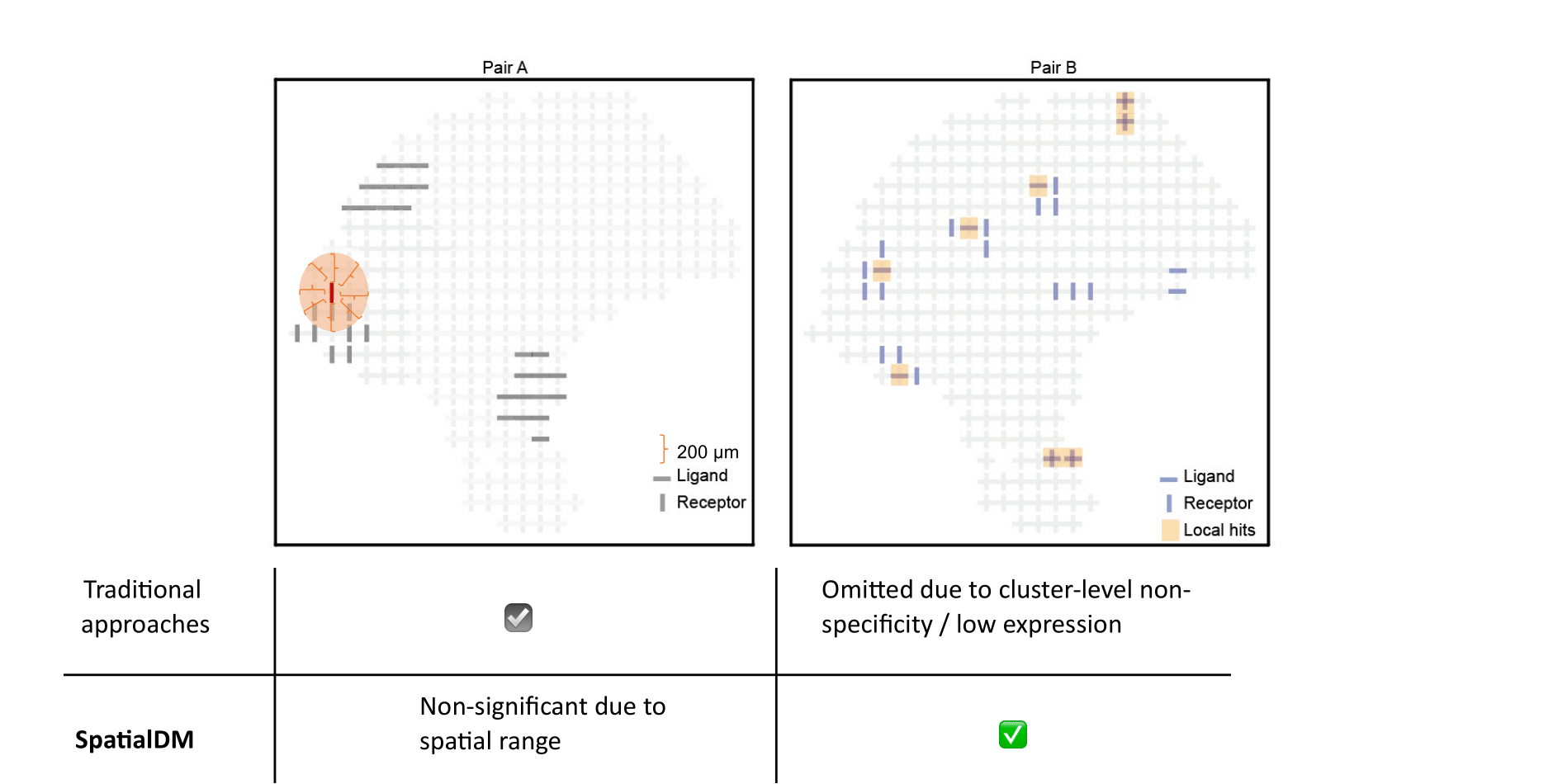
Uniquely, SpatialDM can distinguish co-expressed ligand and receptor pairs from spatially separating pairs, and identify the spots of interaction.
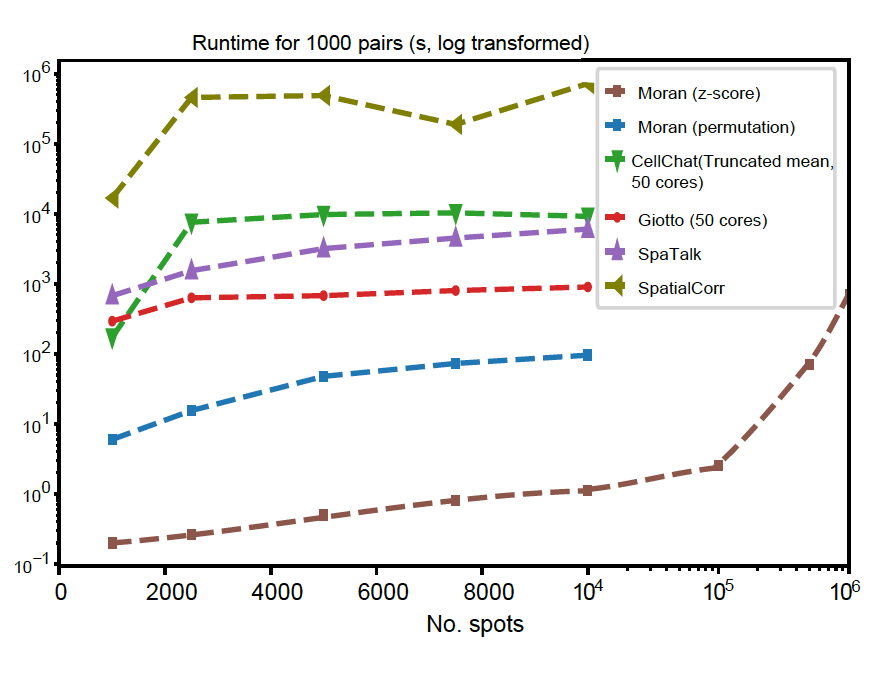
With the analytical testing method, SpatialDM is scalable to 1 million spots within 12 min with only one core.
It comprises two main steps: 1) global selection spatialdm_global to identify significantly interacting LR pairs; 2) local selection spatialdm_local to identify local spots for each interaction.
Installation
SpatialDM is available through PyPI. To install, type the following command line and add -U for updates:
pip install -U SpatialDMAlternatively, you can install from this GitHub repository for latest (often development) version by the following command line:
pip install -U git+https://github.com/StatBiomed/SpatialDMInstallation time: < 1 min
Quick example
Using the build-in melanoma dataset as an example, the following Python script will compute the p-value indicating whether a certain Ligand-Receptor is spatially co-expressed.
import spatialdm as sdm
adata = sdm.datasets.dataset.melanoma()
sdm.weight_matrix(adata, l=1.2, cutoff=0.2, single_cell=False) # weight_matrix by rbf kernel
sdm.extract_lr(adata, 'human', min_cell=3)      # find overlapping LRs from CellChatDB
sdm.spatialdm_global(adata, 1000, specified_ind=None, method='both', nproc=1)     # global Moran selection
sdm.sig_pairs(adata, method='permutation', fdr=True, threshold=0.1)     # select significant pairs
sdm.spatialdm_local(adata, n_perm=1000, method='both', specified_ind=None, nproc=1)     # local spot selection
sdm.sig_spots(adata, method='permutation', fdr=False, threshold=0.1)     # significant local spots

# visualize global and local pairs
import spatialdm.plottings as pl
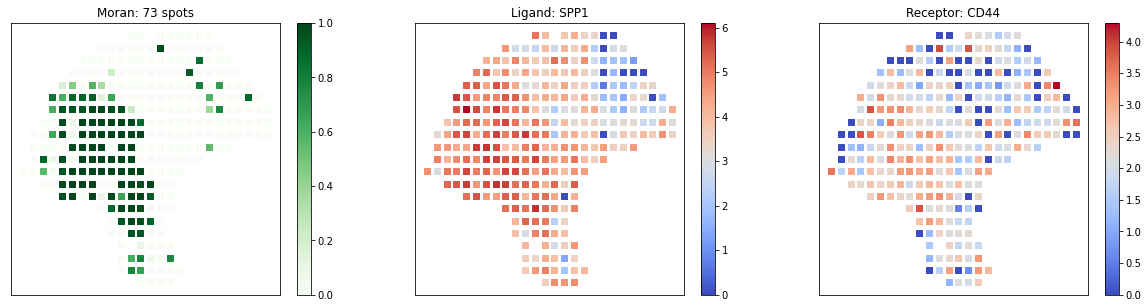
pl.global_plot(adata, pairs=['SPP1_CD44'])
pl.plot_pairs(adata, ['SPP1_CD44'], marker='s')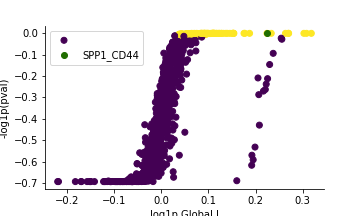
Detailed Manual
The full manual is at https://spatialdm.readthedocs.io, including:
References
2 maintainers


Metadata
2 maintainers
Release files for SpatialDM 0.3.1
For a detailed explanation of source distributions (sdists) and built distributions (wheels), please see the package formats documentation.
Source distribution (sdist)
| File | Size | Uploaded | |
|---|---|---|---|
| spatialdm-0.3.1.tar.gz | 5.7 MB | Details |
Release files / spatialdm-0.3.1.tar.gz
| Download URL | spatialdm-0.3.1.tar.gz |
|---|---|
| Size | 5.7 MB |
| Tags | Source |
|
SHA-256 checksum How to use checksums |
2445eeec8fca557cf9b86d0af03a6658287796a37dc3e7e9117461176cc0892f
|
|
BLAKE2b-256 checksum How to use checksums |
9f10792b87e5f9a6cbf8bbc04486231a54ca200b48744bd1cfaa2af531af38c9
|
| Upload date | |
|
Uploaded using Trusted Publishing? What is trusted publishing? |
No |
| Uploaded via |
twine/5.0.0 CPython/3.11.3
|














