
TurboGears



TurboGears is a hybrid web framework able to act both as a Full Stack framework or as a Microframework. TurboGears helps you get going fast and gets out of your way when you want it!
TurboGears can be used both as a full stack framework or as a microframework in single file mode.
The following content covers examples in minimal mode, to see an example for full stack capabilities take a look at tg.devtools
Get Started
To try TurboGears just get pip if you don’t already have it:
$ curl -O 'https://bootstrap.pypa.io/get-pip.py'
$ python get-pip.py
And install Turbogears:
$ pip install TurboGears2
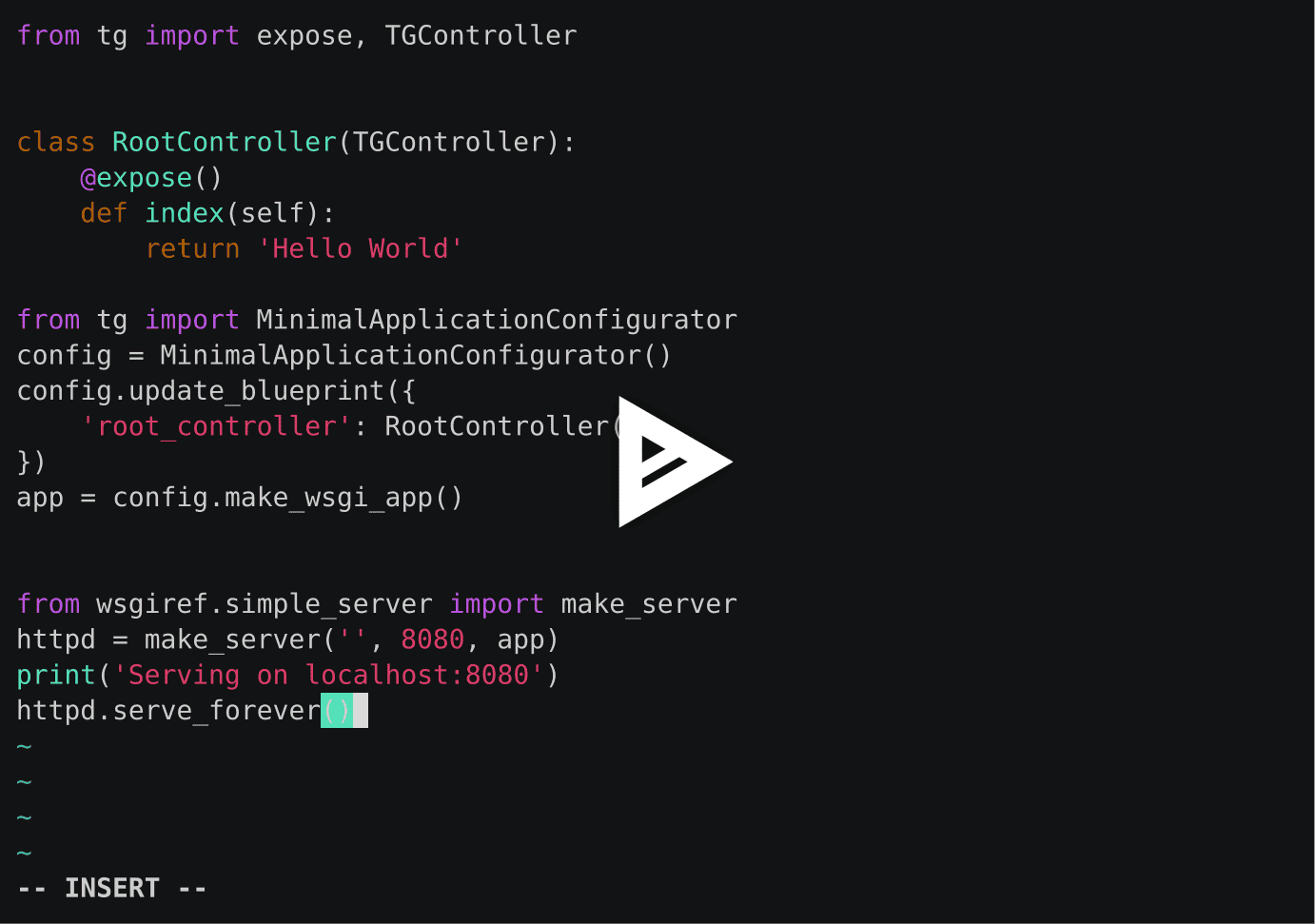
Then serving a TurboGears web application is as simple as making a webapp.py file with your application:
from wsgiref.simple_server import make_server
from tg import MinimalApplicationConfigurator
from tg import expose, TGController

# RootController of our web app, in charge of serving content for /
class RootController(TGController):
    @expose(content_type="text/plain")
    def index(self):
        return 'Hello World'

# Configure a new minimal application with our root controller.
config = MinimalApplicationConfigurator()
config.update_blueprint({
    'root_controller': RootController()
})

# Serve the newly configured web application.
print("Serving on port 8080...")
httpd = make_server('', 8080, config.make_wsgi_app())
httpd.serve_forever()
Start it with python webapp.py and open your browser at http://localhost:8080/
Want to play further with TurboGears? Try the TurboGears Tutorials:
Support and Documentation
Visit TurboGears Documentation for complete documentation and tutorials.
See the TurboGears website to get a quick overview of the framework and look for support.
License
TurboGears is licensed under an MIT-style license (see LICENSE.txt). Other incorporated projects may be licensed under different licenses. All licenses allow for non-commercial and commercial use.


Release files for TurboGears2 2.5.1
For a detailed explanation of source distributions (sdists) and built distributions (wheels), please see the package formats documentation.
Source distribution (sdist)
| File | Size | Uploaded | Provenance | Actions |
|---|---|---|---|---|
| turbogears2-2.5.1.tar.gz | 165.6 kB | Without provenance | Details for turbogears2-2.5.1.tar.gz |
Built distribution (wheel)
| File | Interpreter | ABI | Platform | Actions Reset |
|---|---|---|---|---|
| turbogears2-2.5.1-py3-none-any.whl | Python 3 | none | any | Details for turbogears2-2.5.1-py3-none-any.whl |
Total release size: 321.4 kB
Release files / turbogears2-2.5.1.tar.gz
| Download URL | turbogears2-2.5.1.tar.gz |
|---|---|
| Size | 165.6 kB |
| Tags | Source |
|
SHA-256 checksum How to use checksums |
50fa27e3bcf23cf1ca67260a7b32237779bded1f764a5e326cb6fe00ed922448
|
|
BLAKE2b-256 checksum How to use checksums |
e0ec797d433e3c585d7528d9a894ddeaaeacc118ab893af59c6195857efa6be2
|
| Upload date | |
|
Uploaded using Trusted Publishing? What is trusted publishing? |
No |
| Uploaded via |
twine/6.1.0 CPython/3.8.20
|
Release files / turbogears2-2.5.1-py3-none-any.whl
| Download URL | turbogears2-2.5.1-py3-none-any.whl |
|---|---|
| Size | 155.7 kB |
| Tags | Python 3 |
|
SHA-256 checksum How to use checksums |
a741ccf1a0b84213520cb2ba23608306e76432c0888cbbcb8aecd9dd23e6c652
|
|
BLAKE2b-256 checksum How to use checksums |
bd7203baf9c25d2454b5209bfce6f482b1fc2c64952f06be2bd7f66c896df856
|
| Upload date | |
|
Uploaded using Trusted Publishing? What is trusted publishing? |
No |
| Uploaded via |
twine/6.1.0 CPython/3.8.20
|
Security for TurboGears2 2.5.1
Provenance
Provenance describes where a file came from. On PyPI, provenance is shared via attestations, which provide a verifiable record of the build or publishing details. View details, limitations and caveats.
No provenance found
None of the files in this release were uploaded with provenance metadata.
A note on package security
PyPI is a repository for distributing packages, not a service for auditing them. While third-party security researchers and our staff do their best to detect and remove malicious packages, PyPI cannot guarantee the quality, security or suitability of any given package.
To learn more about protecting yourself from malicious actors, visit our package security documentation.














