
Physiologically Inspired Framework for Complex System Integration
Introduction
In this study, inspired by the physiological operation of the human body, an efficient and resilient software framework was developed to aid in the integration of mature AI technologies, allowing them to coordinate with one another to accomplish more advanced goals. A navigation system for the visually impaired was then developed to validate the framework, with promising experimental results. This framework can be applied to other types of AI systems.
Instruction
- Install the required packages.
pip install -r requirements.txt
- Create config.py, rewite the MQTT settings.
cp config.sample.py config.py
- Start the framework.
python start.py
Class Diagram
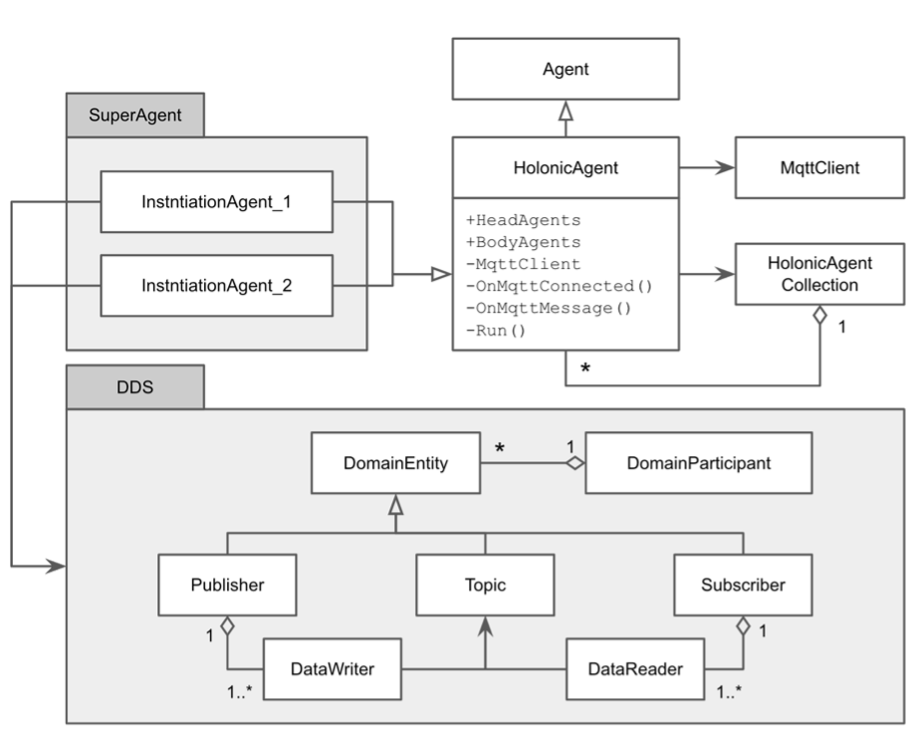
The class diagram of the integration of agents and coordination. HolonicAgent represents the core, and HeadAgents and BodyAgents represent the collection of head agents and subagents, respectively. MQTT is the fundamental communication protocol for agents in the global circulation system, and MqttClient is a private member of HolonicAgent, which allows the agent to have built-in MQTT connection and reception capabilities.
All agents inherit from HolonicAgent to form a hierarchical structure, and they use the DDS to achieve neural message transmission depending on their specific behavior. Each super-agent is a DDS domain that publishes or subscribes to related topics with the required QoS, such as the DEADLINE policy to confirm the date of the data or the TRANSPORT_PRIORITY policy to define the transmission priority order, in order to achieve the purpose of a specific agent.
Sequence Diagram
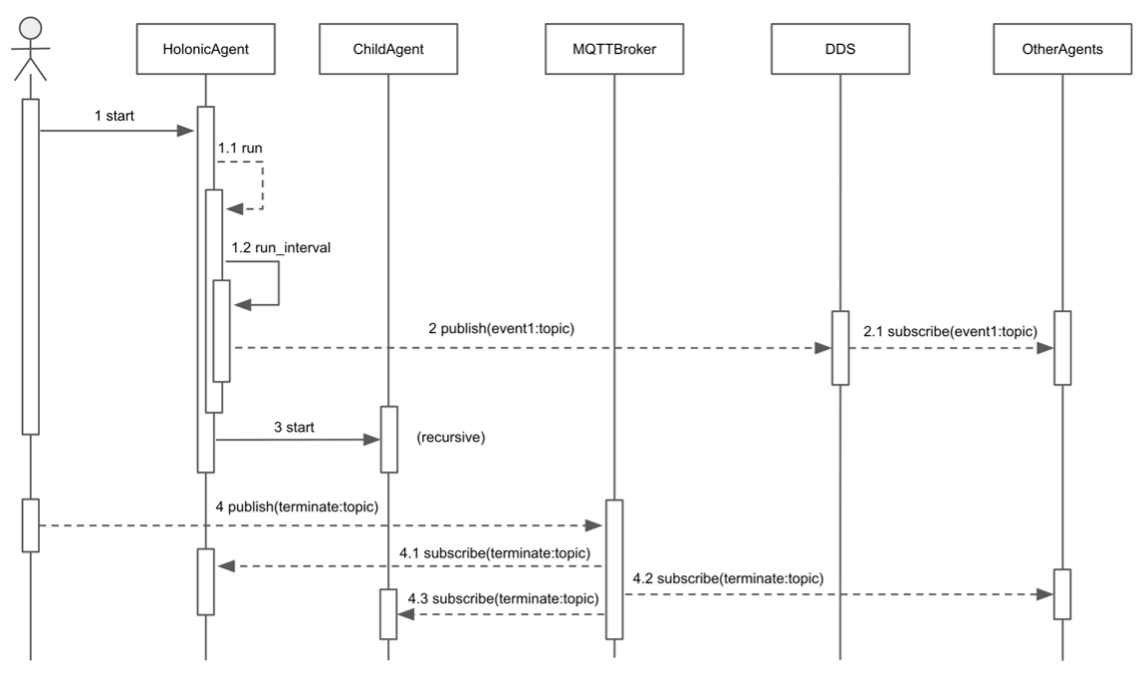
According to the sequence diagram depicted in below, the DDS and MQTT serve to transmit messages for the agents. Action 1 entails generating an independent process immediately after the root agent is initialized. Action 2 entails subscribing to or publishing relevant topics within the QoS constraints. Action 3 entails recursively calling all the subagents to initiate the action. The agent main action is performed in a separate process of Action 2 until it is notified of its termination. Finally, Action 4 entails generating a global broadcast with MQTT, with a system termination notification serving as an example in this study.
1 maintainer

Metadata
1 maintainer
Release files for agent-bdi 2.5.2
For a detailed explanation of source distributions (sdists) and built distributions (wheels), please see the package formats documentation.
Source distribution (sdist)
| File | Size | Uploaded | Provenance | Actions |
|---|---|---|---|---|
| agent-bdi-2.5.2.tar.gz | 14.0 kB | Without provenance | Details for agent-bdi-2.5.2.tar.gz |
Built distribution (wheel)
| File | Interpreter | ABI | Platform | Actions Reset |
|---|---|---|---|---|
| agent_bdi-2.5.2-py3-none-any.whl | Python 3 | none | any | Details for agent_bdi-2.5.2-py3-none-any.whl |
Total release size: 36.3 kB
Release files / agent-bdi-2.5.2.tar.gz
| Download URL | agent-bdi-2.5.2.tar.gz |
|---|---|
| Size | 14.0 kB |
| Tags | Source |
|
SHA-256 checksum How to use checksums |
9891a47915ea2ec4924f819d1afd7355798c176fa9f51e576a9d9baf0954321f
|
|
BLAKE2b-256 checksum How to use checksums |
3c61ee461a96ef898799d82e541f24abfca7ff8a028b4e6b28171093fdb44445
|
| Upload date | |
|
Uploaded using Trusted Publishing? What is trusted publishing? |
No |
| Uploaded via |
twine/4.0.2 CPython/3.10.13
|
Release files / agent_bdi-2.5.2-py3-none-any.whl
| Download URL | agent_bdi-2.5.2-py3-none-any.whl |
|---|---|
| Size | 22.3 kB |
| Tags | Python 3 |
|
SHA-256 checksum How to use checksums |
61aed23123ddfd33b9439ef3a17f72862950fb7c7b94e37af549e2ceb6dca681
|
|
BLAKE2b-256 checksum How to use checksums |
597e627c86a34bf5b10c6b750ccc2e015b6595c434d883d843b633d07cb37a44
|
| Upload date | |
|
Uploaded using Trusted Publishing? What is trusted publishing? |
No |
| Uploaded via |
twine/4.0.2 CPython/3.10.13
|
Security for agent-bdi 2.5.2
Provenance
Provenance describes where a file came from. On PyPI, provenance is shared via attestations, which provide a verifiable record of the build or publishing details. View details, limitations and caveats.
No provenance found
None of the files in this release were uploaded with provenance metadata.
A note on package security
PyPI is a repository for distributing packages, not a service for auditing them. While third-party security researchers and our staff do their best to detect and remove malicious packages, PyPI cannot guarantee the quality, security or suitability of any given package.
To learn more about protecting yourself from malicious actors, visit our package security documentation.














