



📚 Documentation
Technical Overview
What is it?
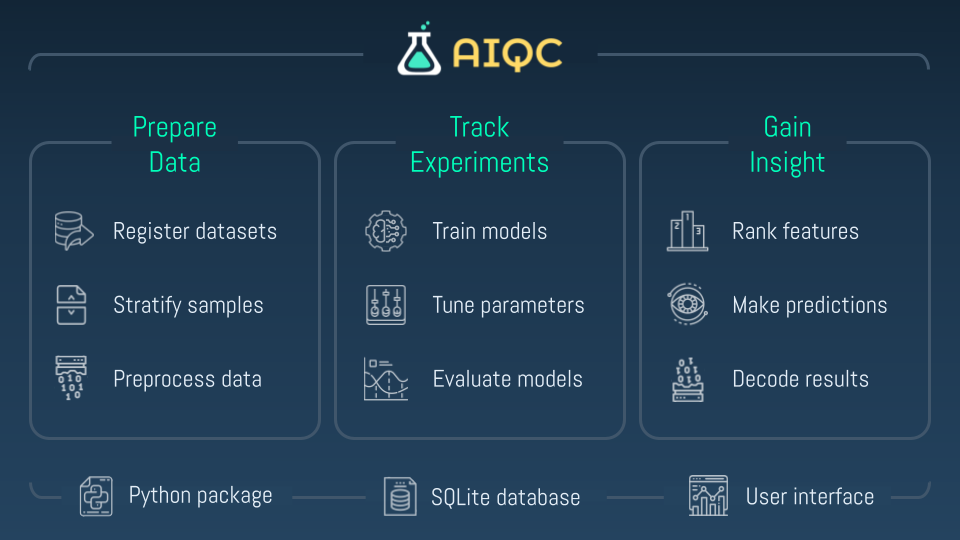
AIQC is an open source Python package that provides a declarative API for end-to-end MLOps (dataset registration, preprocessing, experiment tracking, model evaluation, inference, post-processing, etc) in order to make deep learning more accessible to researchers.
How does it work?
The backend is a SQLite object-relational model (ORM) for machine learning objects (Dataset, Feature, Label, Splits, Algorithm, Job, etc). The high-level API stacks these building blocks into standardized workflows for various: analyses (classify, regress, generate), data types (tabular, sequence, image), and libraries (TensorFlow, PyTorch). The benefits of this approach are:
- ⏱️ 90% reduction in data wrangling via automation of highly conditional and repetitive tasks that vary for each type of dataset and analysis (e.g. model evaluation, metrics, and charts for every split of every model).
- 💾 Reproducibility, not only because the workflow is persisted (e.g. encoder metadata) but also because it provides standardized classes as opposed to open-ended scripting (e.g. 'X_train, y_test').
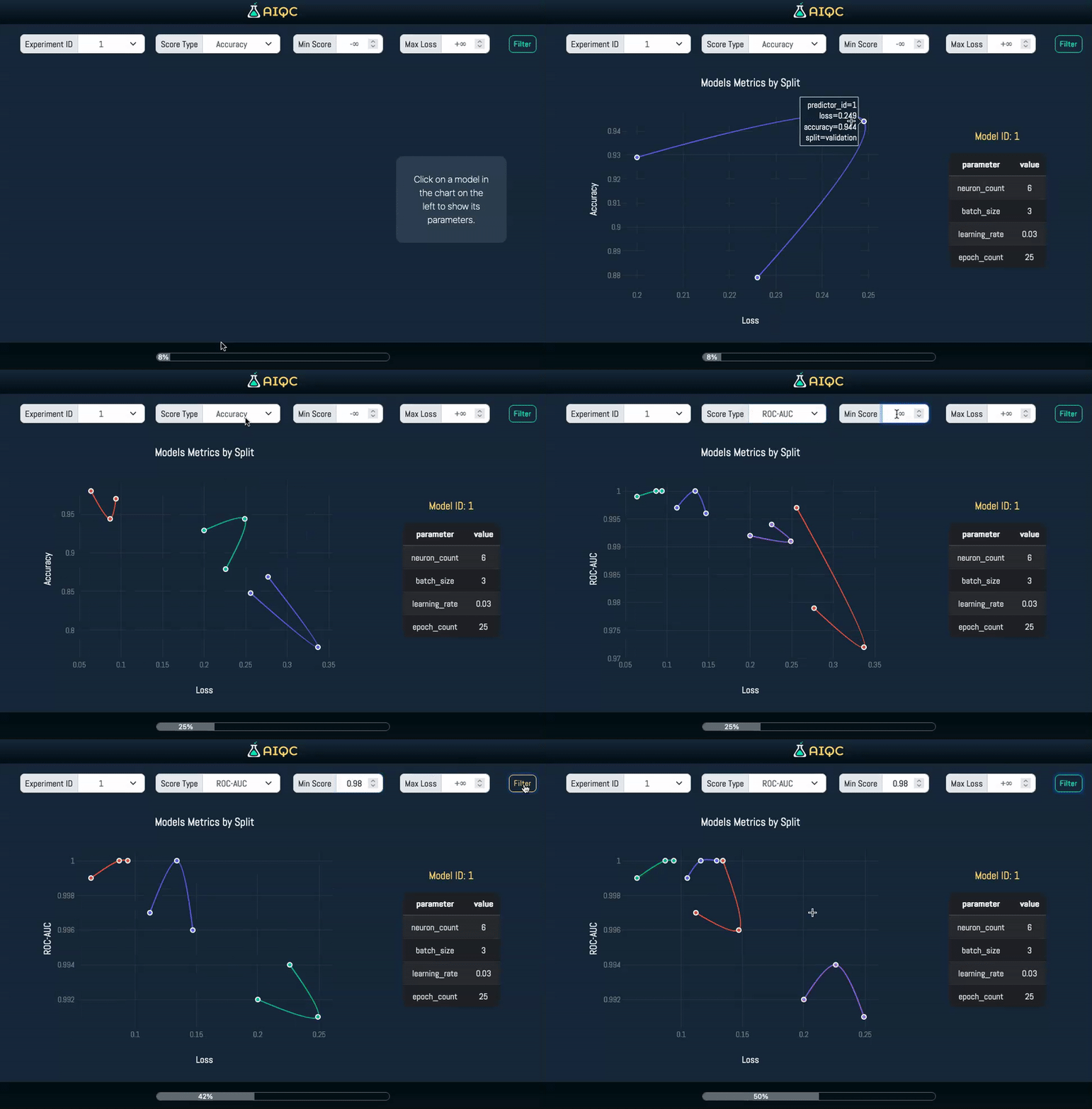
- 🎛️ No need to install and maintain application and database servers for experiment tracking. SQLite is just a highly-performant and portable file that is automatically configured by `aiqc.setup()`. AIQC is just a pip-installable Python package that works great in Jupyter (or any IDE/shell), and provides a Dash-Plotly user interface (UI) for a real-time experiment tracking.
What's on the roadmap?
- 🖥️ Expand the UI (e.g. dataset registration and model design) to make it even more approachable for less technical users.
- ☁️ Schedule parallel training of models in the cloud.
📚 Documentation
Experiment Tracker
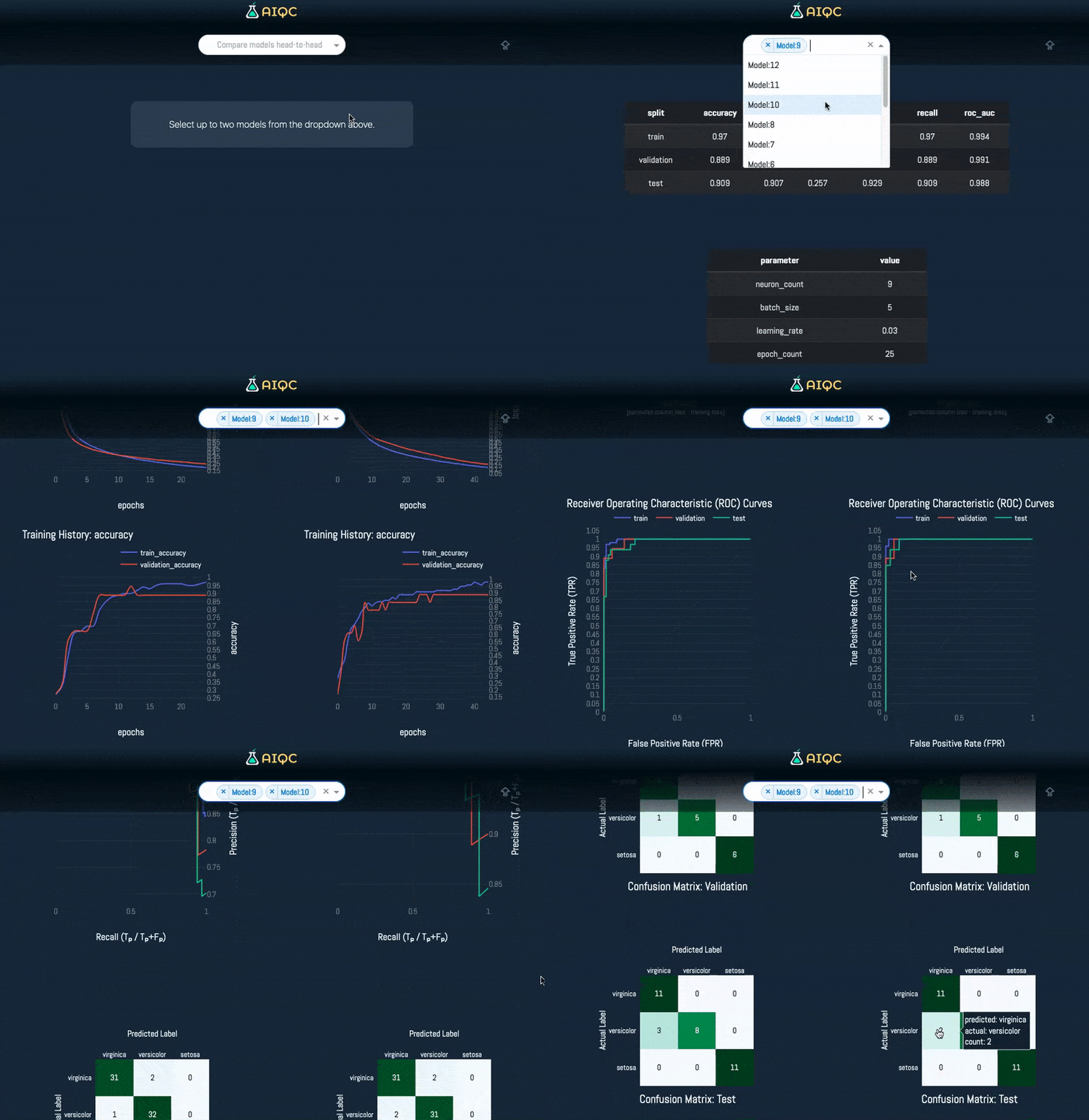
Compare Models
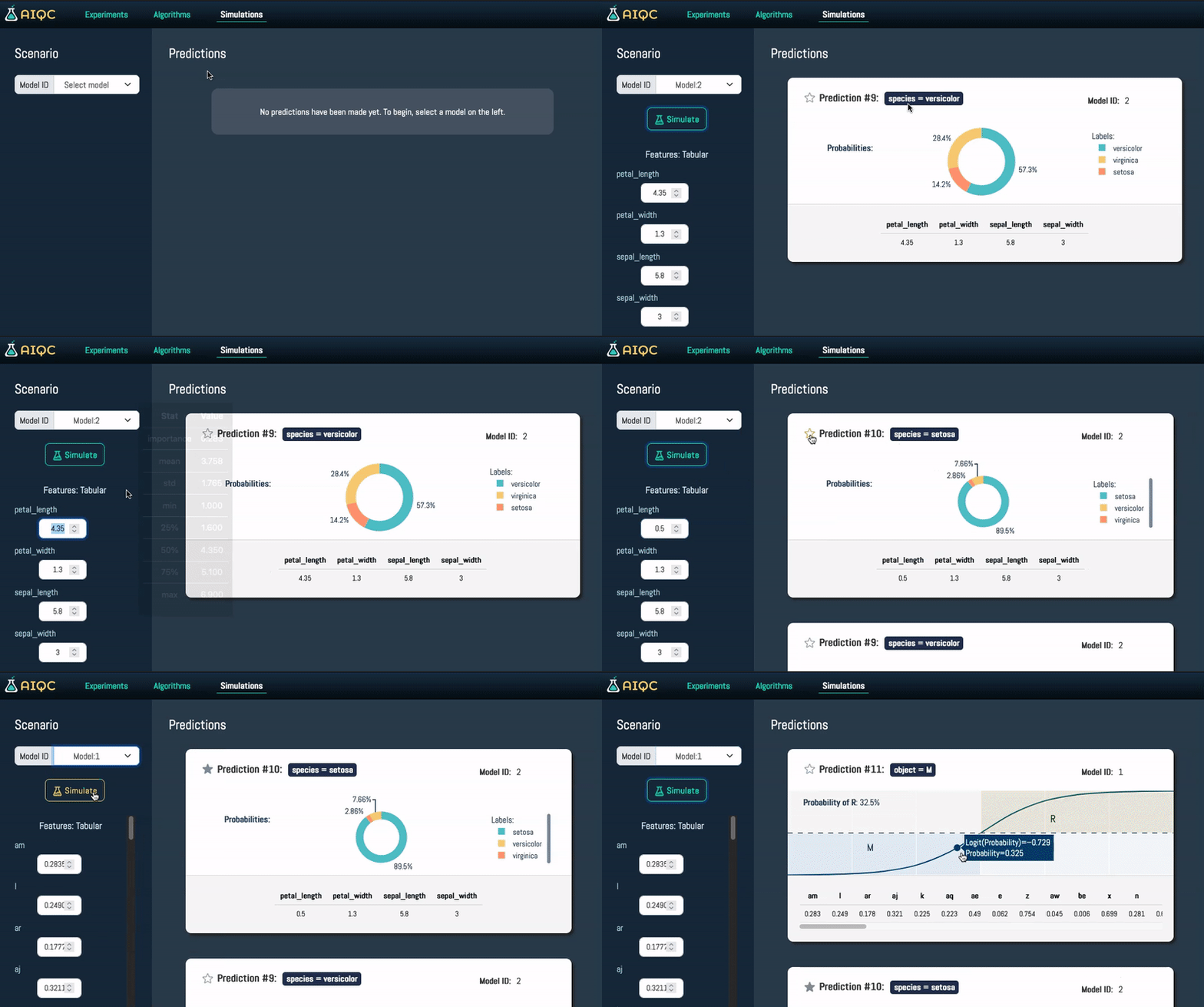
What if?
Usage
# Built on Python 3.7.12 to mirror Google Colab
$ pip install --upgrade pip
$ pip install --upgrade wheel
$ pip install --upgrade aiqc

# Monitor and evaluate models (from CLI)
$ python -m aiqc.ui.app
# High-level API
from aiqc import mlops

# Declare preprocessing steps
mlops.Pipeline()

# Define, train, & evaluate models
mlops.Experiment().run_jobs()

# Infer using original Pipeline
mlops.Inference()
Official Installation Documentation:
https://aiqc.readthedocs.io/en/latest/notebooks/installation.html
📚 Documentation
1 maintainer

Metadata
1 maintainer
Release files for aiqc 7.1.5
For a detailed explanation of source distributions (sdists) and built distributions (wheels), please see the package formats documentation.
Source distribution (sdist)
| File | Size | Uploaded | Provenance | Actions |
|---|---|---|---|---|
| aiqc-7.1.5.tar.gz | 606.9 kB | Without provenance | Details for aiqc-7.1.5.tar.gz |
Built distribution (wheel)
| File | Interpreter | ABI | Platform | Actions Reset |
|---|---|---|---|---|
| aiqc-7.1.5-py3-none-any.whl | Python 3 | none | any | Details for aiqc-7.1.5-py3-none-any.whl |
Total release size: 1.2 MB
Release files / aiqc-7.1.5.tar.gz
| Download URL | aiqc-7.1.5.tar.gz |
|---|---|
| Size | 606.9 kB |
| Tags | Source |
|
SHA-256 checksum How to use checksums |
ac16a09db3cceea63f87e7c12e239731cc8bfee47e1c611372772af75aa1283b
|
|
BLAKE2b-256 checksum How to use checksums |
c4fcda8908989d5eefc9c9f85b650a96e04aba33c05c21d79f4a97894b225873
|
| Upload date | |
|
Uploaded using Trusted Publishing? What is trusted publishing? |
No |
| Uploaded via |
twine/4.0.2 CPython/3.7.16
|
Release files / aiqc-7.1.5-py3-none-any.whl
| Download URL | aiqc-7.1.5-py3-none-any.whl |
|---|---|
| Size | 620.9 kB |
| Tags | Python 3 |
|
SHA-256 checksum How to use checksums |
12e3b8d8d4cca311a8c1c94847d29ac6aefc9621612c5d7e999e166045da5df2
|
|
BLAKE2b-256 checksum How to use checksums |
1cae12827d858327d88b5690f6dca38b47be9e7b0597325d621a7f002e0ab09b
|
| Upload date | |
|
Uploaded using Trusted Publishing? What is trusted publishing? |
No |
| Uploaded via |
twine/4.0.2 CPython/3.7.16
|
Security for aiqc 7.1.5
Provenance
Provenance describes where a file came from. On PyPI, provenance is shared via attestations, which provide a verifiable record of the build or publishing details. View details, limitations and caveats.
No provenance found
None of the files in this release were uploaded with provenance metadata.
A note on package security
PyPI is a repository for distributing packages, not a service for auditing them. While third-party security researchers and our staff do their best to detect and remove malicious packages, PyPI cannot guarantee the quality, security or suitability of any given package.
To learn more about protecting yourself from malicious actors, visit our package security documentation.














