
alicat
TCP/Serial driver and command line tool for Alicat Laminar DP and BASIS mass flow devices.
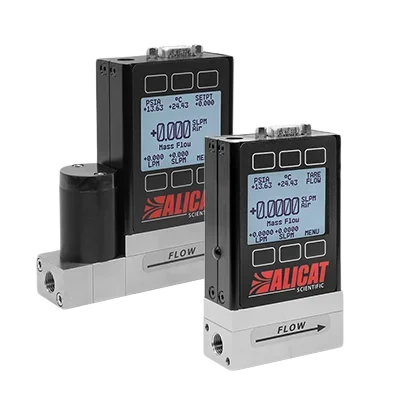
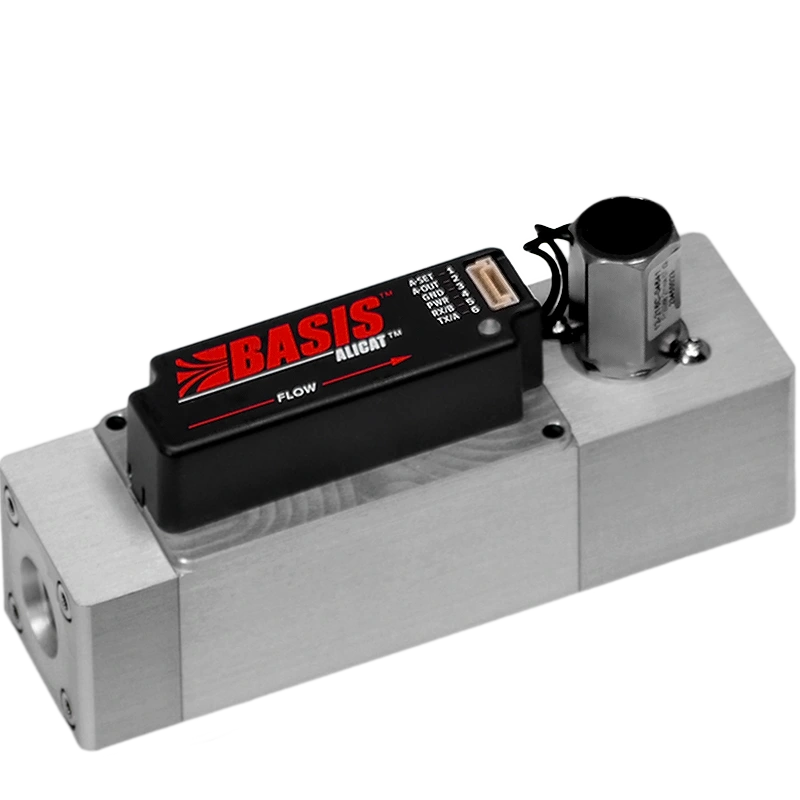
If you are using Analyt-MTC flow controllers, go to this repository for more info. This driver does not currently support CODA devices.
Example Connections
| Type | Usage |
|---|---|
The standard DB9 cable connected directly to a computer (unix: /dev/ttyS0, windows: COM1). |
Good with older computers that still have the connector. |
The cable connected to a computer through a USB converter (unix: /dev/ttyUSB0, windows: COM1). |
Good for newer computers and maker boards such as Raspberry Pis. |
Multiple cables connected to one port via a splitter and Alicat's addressing (A-Z). |
Good when number of ports is limited. |
Cables routed through a TCP device server (192.168.1.100:23). |
Installation
pip install alicat
Usage
Command Line
For basic tasks, this driver includes a command-line interface. Read the help for more.
alicat --help
Python
This uses Python ≥3.5's async/await syntax to asynchronously communicate with an Alicat. For example:
import asyncio
from alicat import FlowController

async def get():
    async with FlowController(address = "com_port", unit = "unit_id") as flow_controller:
        print(await flow_controller.get())

asyncio.run(get())
#  If there is already an event loop (e.g. Jupyter), replace the above line with:
#  sawait get()
A similar format can be used to communicate with a BASIS device.
import asyncio
from alicat.basis import BasisController

async def get():
    async with BasisController(address = "com_port", unit = "unit_id") as basis_controller:
        print(await basis_controller.get())

asyncio.run(get())
If the flow controller is communicating on the specified port, this should return a dictionary of the form:
## Standard Devices
{
  'setpoint': 0.0,         # Setpoint, either mass flow rate or pressure
  'control_point': 'flow', # Either 'flow' or 'pressure'
  'gas': 'Air',            # Can be any option in `flow_controller.gases`
  'mass_flow': 0.0,        # Mass flow (in units specified at time of purchase)
  'pressure': 25.46,       # Pressure (normally in psia)
  'temperature': 23.62,    # Temperature (normally in C)
  'total_flow': 0.0,       # Optional. If totalizer function purchased, will be included
  'volumetric_flow': 0.0   # Volumetric flow (in units specified at time of purchase)
}

## BASIS Devices
{
  'setpoint': 0.0,         # Mass Flow Setpoint
  'gas': 'Air',            # Can be Air, Ar, CO2, N2, O2, N2O, H2, He, CH4
  'mass_flow': 0.0,        # Mass flow (in SCCM or SLPM)
  'temperature': 23.62,    # Temperature (normally in C)
  'volumetric_flow': 0.0   # Volumetric flow (in CCM or LPM)
}
On flow controllers, you can set the flow or pressure setpoints.
await flow_controller.set_flow_rate(1.0)
await flow_controller.set_pressure(20)
Gas Type
You can set the gas type by name or by index. For more on setting by index, see the gas table in your Alicat's manual.
await flow_controller.set_gas('N2')
await flow_controller.set_gas(8)
For firmware 5v and greater, you can create and set gas mixes. Mixes can contain up to five gases and are stored in gas indices 236-255.
await flow_controller.create_mix(mix_no=236, name="Mix1", gases={'N2': 50, 'O2': 30, 'CO2': 20})
await flow_controller.set_gas(236)
await flow_controller.delete_mix(236)
PID Parameters
For flow controllers, read and write PID loop settings for device tuning.
await flow_controller.set_pid(p=4000, i=4000, d=10, loop_type='PD2I')
print(await flow_controller.get_pid())
{
    'loop_type': 'PD2I',
    'P': '4000',
    'I': '4000',
    'D': '10',
}
Other Features
Additional features include override commands to increase device functionality.
await flow_controller.lock()            # Lock the front display.
await flow_controller.unlock()          # Unlock the front display.
await flow_controller.hold()            # Hold the valve in its current position.
await flow_controller.cancel_hold()     # Cancel the valve hold.
await flow_controller.tare_volumetric() # Tare volumetric flow.
await flow_controller.tare_pressure()   # Tare pressure.
await flow_controller.reset_totalizer() # Reset totalizer, if totalizer functionality included.
Addressing
You can have multiple controllers on the same port by using Alicat's A-Z addresses
and an RS-232 splitter.
flow_controller_1 = FlowController(address='A')
flow_controller_2 = FlowController(address='B')

await flow_controller_1.set_flow_rate(1.0)
await flow_controller_2.set_flow_rate(0.5)

await flow_controller_1.close() # /dev/ttyUSB0 is still open!
await flow_controller_2.close()
Breaking changes
0.5.0
- Support only
asyncio. The last version with synchronous code was0.4.1. - Rename
address/-atounit/-uto match Alicat's documentation - Rename
-uto-ul(for--unlock)
0.4.1
Remove TCP support. Use pip install alicat==0.3.1 if needed
4 maintainers


Metadata
4 maintainers
Release files for alicat 0.9.0
For a detailed explanation of source distributions (sdists) and built distributions (wheels), please see the package formats documentation.
Source distribution (sdist)
| File | Size | Uploaded | |
|---|---|---|---|
| alicat-0.9.0.tar.gz | 27.2 kB | Details |
Built distribution (wheel)
| File | Interpreter | ABI | Platform | Reset |
|---|---|---|---|---|
| alicat-0.9.0-py3-none-any.whl | Python 3 | none | any | Details |
Total release size: 53.8 kB
Release files / alicat-0.9.0.tar.gz
| Download URL | alicat-0.9.0.tar.gz |
|---|---|
| Size | 27.2 kB |
| Tags | Source |
|
SHA-256 checksum How to use checksums |
40c109df0cc19e9a623048cffd2c38d598434315f1d35f60892057357e79f1ec
|
|
BLAKE2b-256 checksum How to use checksums |
3716de9e867cad27a1802d2b7d99be865026500d85467654b7a0f9a3bc061440
|
| Upload date | |
|
Uploaded using Trusted Publishing? What is trusted publishing? |
No |
| Uploaded via |
twine/5.0.0 CPython/3.12.3
|
Release files / alicat-0.9.0-py3-none-any.whl
| Download URL | alicat-0.9.0-py3-none-any.whl |
|---|---|
| Size | 26.6 kB |
| Tags | Python 3 |
|
SHA-256 checksum How to use checksums |
a0769cb1c3289572078e4899abe39561ca3ca730b071b9cf89d6bbe87d353f80
|
|
BLAKE2b-256 checksum How to use checksums |
256878adb2d1e9e14689da6caedee78b2b713c6290832cfe7919fdd5404cb09d
|
| Upload date | |
|
Uploaded using Trusted Publishing? What is trusted publishing? |
No |
| Uploaded via |
twine/5.0.0 CPython/3.12.3
|














