






alv: a command-line alignment viewer
View your DNA or protein multiple-sequence alignments right at your command line. No need to launch a GUI!
Note: alv requires Python v3.6 or later. Earlier versions may also work, but this has not been
tested.
Latest feature additions
-
If you have more than one alignment in your input file, then the first alignment is output unless you use the --alignment-index (-ai) option to choose another.
-
alvis now adapted for use in Python notebooks (tested on Jupyter) through two convenience functions 'view' and 'glimpse'. Both functions take a BioPython alignment object and outputs a view of the alignment.Writing
from Bio import AlignIO
msa = AlignIO.read('PF00005.fa', 'fasta')
import alv
alv.view(msa)
in a Jupyter notebook cell and evaluating will yield a colored alignment in the
alvstyle.For large alignments, the glimpse function is convenient since a subset of the alignment, selected as an easily detected conserved region, is shown.
alv.glimpse(msa)Look for more usage information view
help(alv.view)in a notebook cell.
Features
- Command-line based, no GUI, so easy to script viewing of many (typically small) MSAs.
- Reads alignments in FASTA, Clustal, PHYLIP, NEXUS, and Stockholm formats, from file or
stdin. - Output is formatted to suit your terminal. You can also set the alignment width with option
-w. - Can color alignments of coding DNA by codon's translations to amino acids.
- Guesses sequence type (DNA/RNA/AA/coding) by default. You can override with option
-t. - Order sequence explicitly, alphabetically, or by sequence similarity.
- Restrict coloring to where you don't have indels or where there is a lot of conservation.
- Focus on variable columns with the options
--only-variableand--only-variable-excluding-indels, contributed by nikostr, that constrains coloring to columns with variation and variation not counting indels. - The command
alv -g huge_msa.fadisplays cut-out of the MSA, guaranteed to fit one terminal page without scrolling or MSA line breaking, that is supposed to give you an idea of alignment quality and contents. - Write
alv -r 20 huge_msa.fato get a view of the MSA containing only 20 randomly selected sequences.
Install
Recommended installation is:
pip install --upgrade pip
pip install alv
BioPython is a dependency and will only get installed automatically with pip install alv
if you are using Python v3.6 or later, because BioPython was apparently not on PyPi before that.
Install the commandline tool system-wide
If you would like to install the alv commandline tool system-wide, so that it
is accessible regardless of which python environment you have loaded, or if you
have loaded one at all, one way to do this is using the
pipx installer.
After installing pipx using it's official installation
instructions you
can install alv with:
pipx install alv
After this, alv should be available as a command regardless of Python
environment.
(Note that this only works for installing the alv commandline tool, not the
Python library!)
Examples
Quick viewing of a small alignment:
alv msa.fa
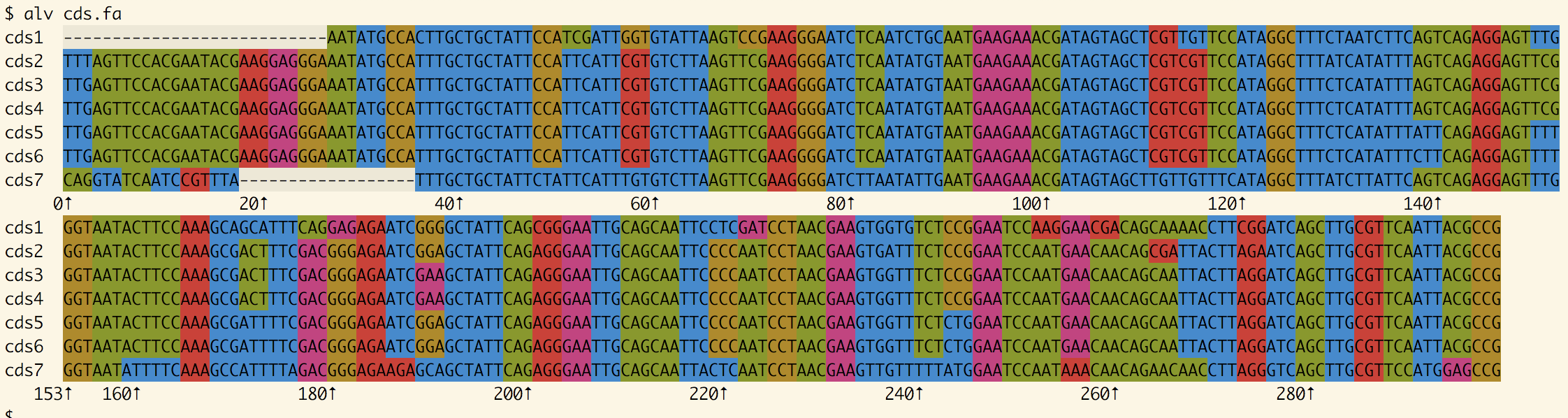
This autodetects sequence type (AA, DNA, RNA, coding DNA), colors the sequences, and formats the
alignment for easy viewing in your terminal.
When applying alv to an alignment of coding DNA, the coding property is autodetected and colors are therefore applied to codons instead
of nucleotides.
View three sequences, accessions a, b, and c, from an alignment:
alv -so a,b,c msa.fa
Feed alignment to less, for paging support.
alv -k msa.fa | less -R
The -k option ensures that alv keeps coloring the alignment (by default, piping
and redirection removes colors), and the -R option instructs less to interpret color codes.
Choose to view a sub-alignment:
alv -sa 30 60 msa.fa
This selects and views columns 30 to 59 of msa.fa, keeping track of the "original" columns indexes in the output.
Colors
A number of color schemes are available and more will be added. Use "--list-colors" (or the abbreviation "-lc" (previously used for "--list-codes", which is probably less used)) to see what is offered.
Consider using "-c okabe-ito" if you are color blind. This is a scheme suggested by Okabe and Ito (2008).
If you are not happy with the suggested defaults, or simply need, the Hello Kitty option, consider setting up an alias:
alias alv="alv -c hellokitty"
This ensures that alv is run with the desired option. Note that, if you temporarily want to use another
scheme, the aliased call alv -c stockholm dna.fa effectively means alv -c hellokitty -c stockholm dna.fa
which ignores the -c hellokitty part in favor of the latest choice (here: stockholm).
- Okabe, M. & Ito, K. (2008). Color Universal Design (CUD): How to make figures and presentations that are friendly to colorblind people. Joint Research Center for Science Education*, Tokyo. https://jfly.uni-koeln.de/color/
For developers
- Run
pip install -e .to get an "editable" install, while coding. - Run
python -m buildto prepare a distributable file. - Run
python -m unittest discoverto run unit tests.
Screenshots
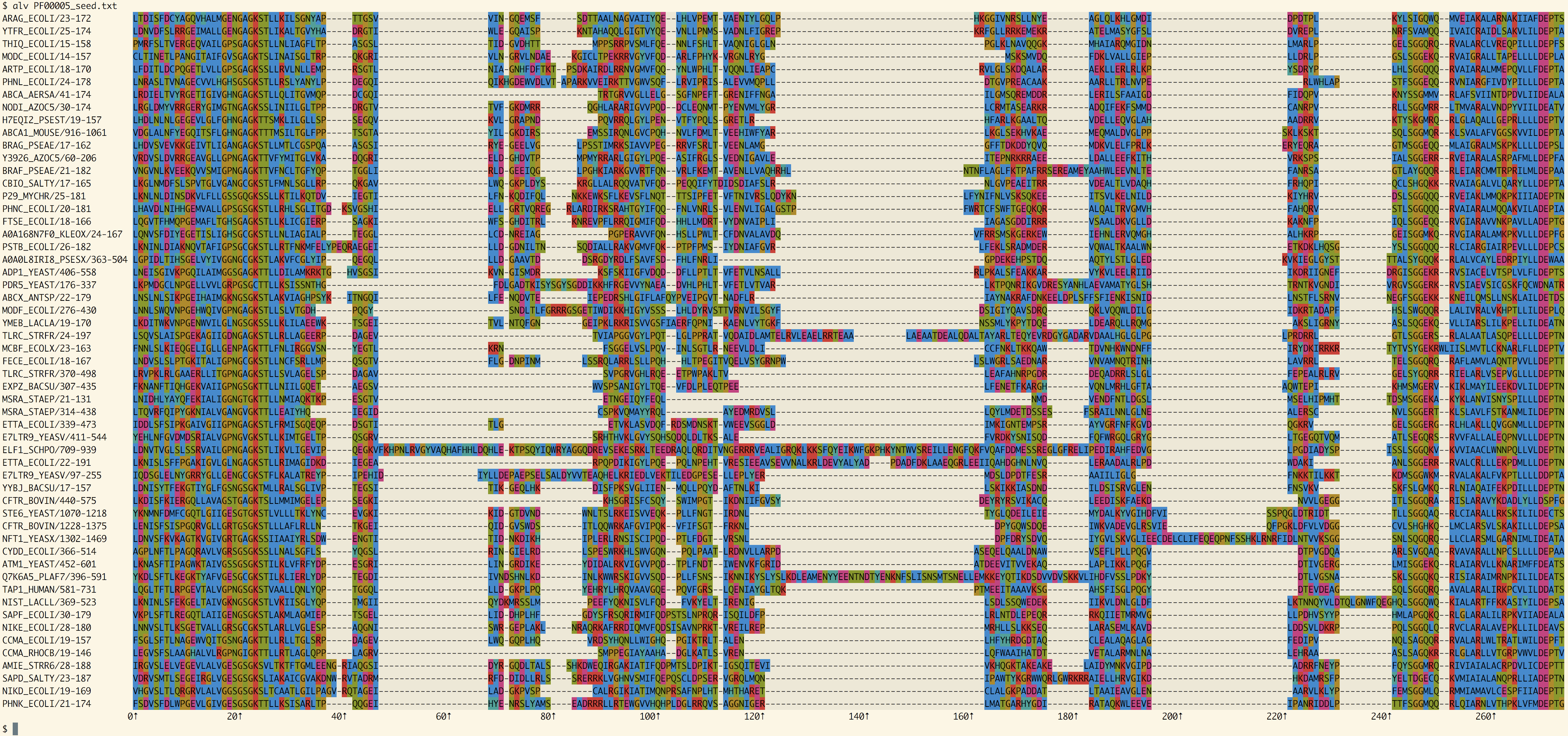
Full PFAM domain
All of the sequences in PFAM's seed alignment for PF00005
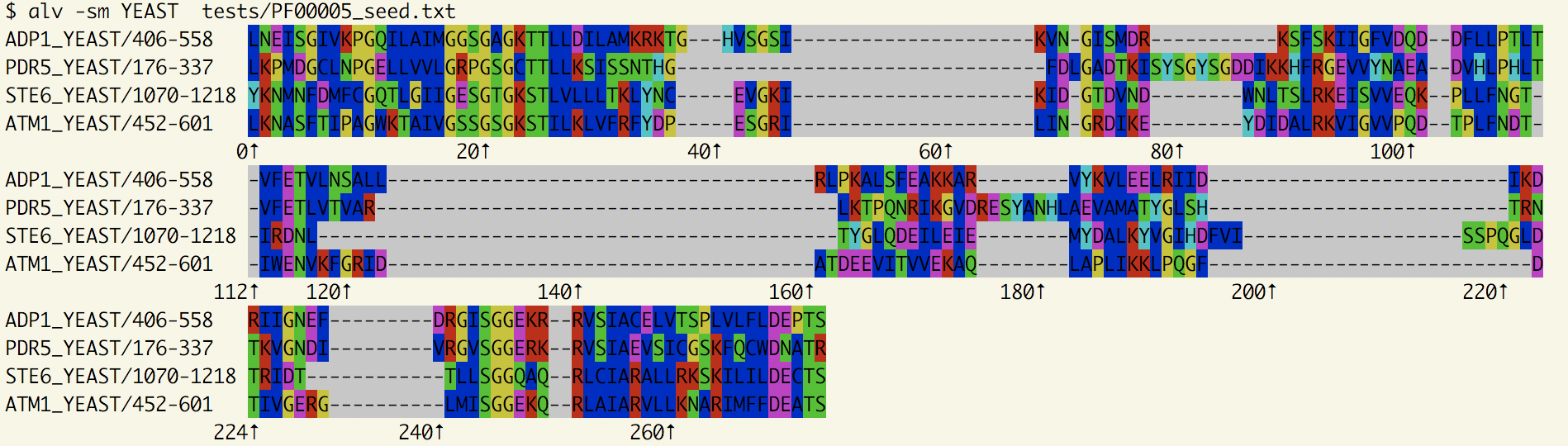
Yeast sequences from PF00005
Using the option -sm YEAST, we reduce the alignment to the ones with a matching accession.
1 maintainer

Release files for alv 1.8.3
For a detailed explanation of source distributions (sdists) and built distributions (wheels), please see the package formats documentation.
Source distribution (sdist)
| File | Size | Uploaded | |
|---|---|---|---|
| alv-1.8.3.tar.gz | 39.8 kB | Details |
Built distribution (wheel)
| File | Interpreter | ABI | Platform | Reset |
|---|---|---|---|---|
| alv-1.8.3-py3-none-any.whl | Python 3 | none | any | Details |
Total release size:76.2 kB
Release files / alv-1.8.3.tar.gz
| Download URL | alv-1.8.3.tar.gz |
|---|---|
| Size | 39.8 kB |
| Tags | Source |
|
SHA-256 checksum How to use checksums |
8f19648a53dada8be8664c4ec985b047a046e5997413936de97a70c0c5d65935
|
|
BLAKE2b-256 checksum How to use checksums |
c9aba091eff95824018b04bd96a920fe616bd6618b1bfd7dfebdd96e28cd35f8
|
| Upload date | |
|
Uploaded using Trusted Publishing? What is trusted publishing? |
No |
| Uploaded via |
twine/6.2.0 CPython/3.10.19
|
Release files / alv-1.8.3-py3-none-any.whl
| Download URL | alv-1.8.3-py3-none-any.whl |
|---|---|
| Size | 36.4 kB |
| Tags | Python 3 |
|
SHA-256 checksum How to use checksums |
03e33a826cde7131e549ed836bb75689f2a31ae2f64be014fea40640c4b7b675
|
|
BLAKE2b-256 checksum How to use checksums |
5b224dd18373fa45d49949a8b46df242d27debdfcdeaa3129d00fa539815733c
|
| Upload date | |
|
Uploaded using Trusted Publishing? What is trusted publishing? |
No |
| Uploaded via |
twine/6.2.0 CPython/3.10.19
|














