





anac
Python Async NetBox API Client, based on httpx and pydantic
Documentation
https://timeforplanb123.github.io/anac
Features
- Minimalistic interface
- Async only
- Python interpreter autocompletion
- Supports NetBox 2.x, 3.x
- Flexibility. All the objects are coroutines or coroutine iterators
- Simple integration with parsers (TextFSM, TTP)
Quick Start
Install
Please, at first, check the dependencies in pyproject.toml and create new virtual environment if necessary and then:
with pip:
pip install anac
with git:
git clone https://github.com/timeforplanb123/anac.git
cd anac
pip install .
# or
poetry install
Simple Examples
Api Instantiating
from anac import api

a = api(
    "https://demo.netbox.dev",
    token="cf1dc7b04de5f27cfc93aba9e3f537d2ad6fdf8c",
)
# get openapi spec and create attributes/endpoints
await a.openapi()
get some device and patch it
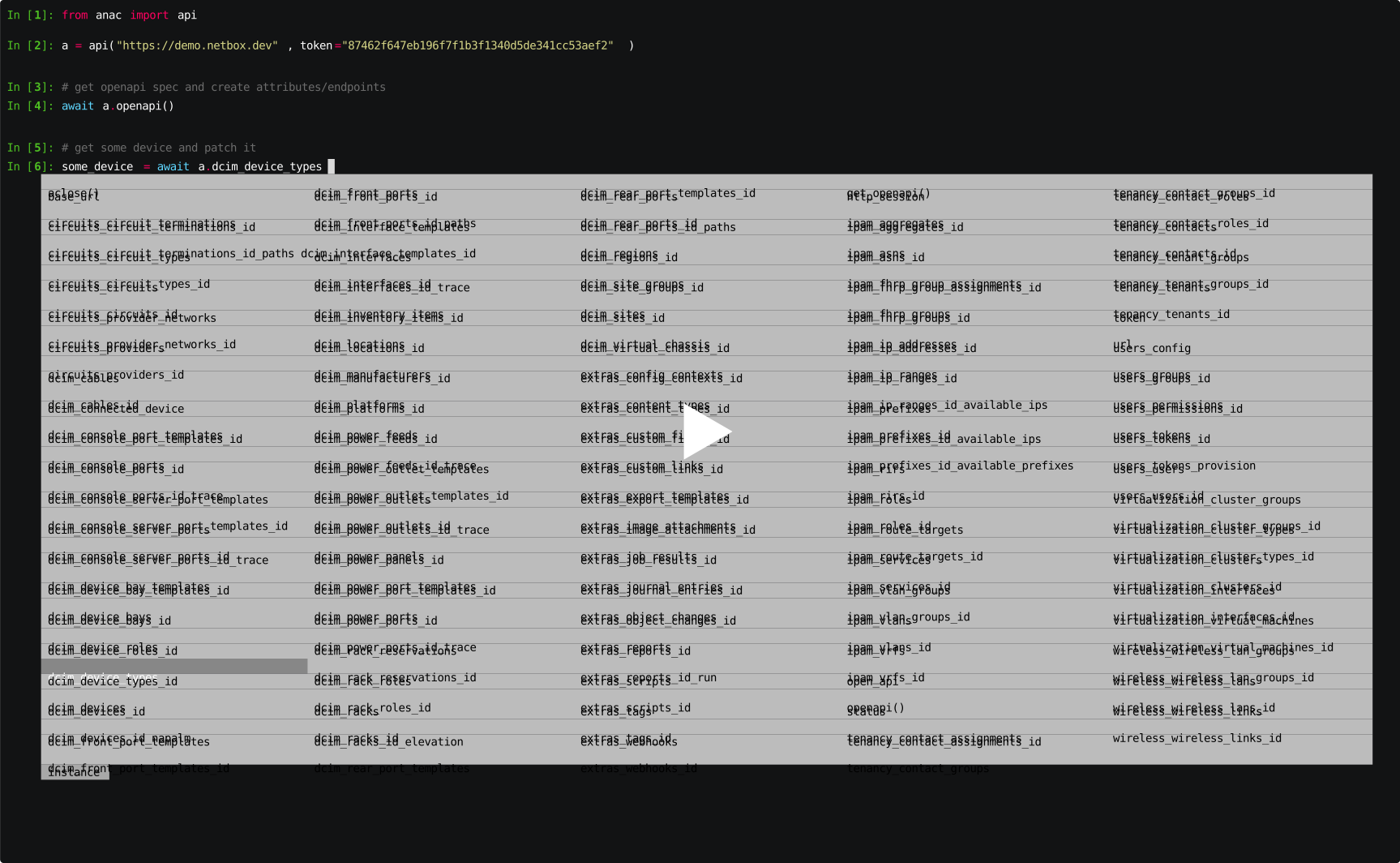
In [1]: some_device = await a.dcim_devices(get={"name": "dmi01-rochster-sw01"})

In [2]: some_device.name
Out[2]: 'dmi01-rochster-sw01'

In [3]: some_device.device_type
Out[3]:
{'id': 7,
 'url': 'https://demo.netbox.dev/api/dcim/device-types/7/',
 'display': 'C9200-48P',
 'manufacturer': {'id': 3,
  'url': 'https://demo.netbox.dev/api/dcim/manufacturers/3/',
  'display': 'Cisco',
  'name': 'Cisco',
  'slug': 'cisco'},
 'model': 'C9200-48P',
 'slug': 'c9200-48p'}

In [4]: some_device.status
Out[4]: {'value': 'active', 'label': 'Active'}

In [5]: some_device = await some_device(patch={"status": "failed"})

In [6]: some_device.status
Out[6]: {'value': 'failed', 'label': 'Failed'}
get some 2 devices and put + patch them
In [7]: some_devices = await a.dcim_devices(
    ...:     get=[{"name": "dmi01-rochster-sw01"}, {"name": "dmi01-rochester-rtr01"}]
    ...: )

# EndpointAsIterator is a coroutine iterator with 2 coroutines
In [8]: some_devices
Out[8]: EndpointAsIterator(api=Api, url='https://demo.netbox.dev/api', endpoint='/dcim/devices/')

In [9]: import asyncio

# run 2 coroutines in the event loop
In [10]: some_devices = await asyncio.gather(*some_devices)

# EndpointId is a NetBox '/dcim/devices/' object and coroutine
In [11]: some_devices
Out[11]:
[EndpointId(api=Api, url='https://demo.netbox.dev/api/dcim/devices/21/', endpoint='/dcim/devices/'),
 EndpointId(api=Api, url='https://demo.netbox.dev/api/dcim/devices/8/', endpoint='/dcim/devices/')]

In [12]: patch_some_devices = [coro(patch={"status": "failed"}) for coro in some_devices]

# run 2 coroutines in the event loop
In [13]: patch_some_devices = await asyncio.gather(*patch_some_devices)

# EndpointId is a coroutine, again
In [14]: patch_some_devices
Out[14]:
[EndpointId(api=Api, url='https://demo.netbox.dev/api/dcim/devices/21/', endpoint='/dcim/devices/{id}/'),
 EndpointId(api=Api, url='https://demo.netbox.dev/api/dcim/devices/8/', endpoint='/dcim/devices/{id}/')]

In [15]: patch_some_devices[0].name
Out[15]: 'dmi01-rochster-sw01'

In [16]: patch_some_devices[0].status
Out[16]: {'value': 'failed', 'label': 'Failed'}

In [17]: patch_some_devices[1].name
Out[17]: 'dmi01-rochester-rtr01'

In [18]: patch_some_devices[1].status
Out[18]: {'value': 'failed', 'label': 'Failed'}
get all devices
In [19]: all_devices = await a.dcim_devices(get={})
# or
In [20]: all_devices = await a.dcim_devices()

# EndpointIdIterator is an coroutine iterator with EndpointId objects
In [21]: all_devices
Out[21]: EndpointIdIterator(api=Api, url='https://demo.netbox.dev/api', endpoint='/dcim/devices/')

In [22]: len(all_devices)
Out[22]: 50

In [23]: all_devices[49]
Out[23]: EndpointId(api=Api, url='https://demo.netbox.dev/api/dcim/devices/95/', endpoint='/dcim/devices/')

In [24]: all_devices[49].name
Out[24]: 'ncsu118-distswitch1'

# by default, 'limit' parameter = 50, but you can run 'get' request with custom 'limit'
In [25]: all_devices = await a.dcim_devices(get={"limit": 100})

In [26]: len(all_devices)
Out[26]: 75

In [27]: all_devices[74]
Out[27]: EndpointId(api=Api, url='https://demo.netbox.dev/api/dcim/devices/106/', endpoint='/dcim/devices/')

In [28]: all_devices[74].id
Out[28]: 106
get all devices and post 2 new devices
In [29]: all_test = await a.dcim_devices(
    ...:     get={},
    ...:     post=[
    ...:         {
    ...:             "name": "test1",
    ...:             "device_role": 1,
    ...:             "site": 1,
    ...:             "device_type": 1,
    ...:             "status": "planned",
    ...:         },
    ...:         {
    ...:             "name": "test2",
    ...:             "device_role": 1,
    ...:             "site": 1,
    ...:             "device_type": 1,
    ...:             "status": "planned",
    ...:         },
    ...:     ],
    ...: )

# run 3 coroutines in the event loop
In [30]: all_test = await asyncio.gather(*all_test)

# EndpointIdIterator is an coroutine iterator with EndpointId objects
# EndpointId is a NetBox '/dcim/devices/' object and coroutine
In [31]: all_test
Out[31]:
[EndpointIdIterator(api=Api, url='https://demo.netbox.dev/api', endpoint='/dcim/devices/'),
 EndpointId(api=Api, url='https://demo.netbox.dev/api/dcim/devices/110/', endpoint='/dcim/devices/'),
 EndpointId(api=Api, url='https://demo.netbox.dev/api/dcim/devices/111/', endpoint='/dcim/devices/')]

In [32]: all_test[0][49].name
Out[32]: 'ncsu118-distswitch1'

In [33]: all_test[1].name
Out[34]: 'test1'

In [35]: all_test[2].name
Out[35]: 'test2'

# httpx.Response is available with .response attribute
In [36]: all_test[1].response.json()
Out[36]:
{'id': 110,
 'url': 'https://demo.netbox.dev/api/dcim/devices/110/',
 'display': 'test1',
 'name': 'test1',
 'device_type': {'id': 1,
  'url': 'https://demo.netbox.dev/api/dcim/device-types/1/',
  'display': 'MX480',
  'manufacturer': {'id': 7,
  ...
}
1 maintainer

Metadata
1 maintainer
Release files for anac 0.1.2
For a detailed explanation of source distributions (sdists) and built distributions (wheels), please see the package formats documentation.
Source distribution (sdist)
| File | Size | Uploaded | Provenance | Actions |
|---|---|---|---|---|
| anac-0.1.2.tar.gz | 15.8 kB | Without provenance | Details for anac-0.1.2.tar.gz |
Built distribution (wheel)
| File | Interpreter | ABI | Platform | Actions Reset |
|---|---|---|---|---|
| anac-0.1.2-py3-none-any.whl | Python 3 | none | any | Details for anac-0.1.2-py3-none-any.whl |
Total release size: 30.4 kB
Release files / anac-0.1.2.tar.gz
| Download URL | anac-0.1.2.tar.gz |
|---|---|
| Size | 15.8 kB |
| Tags | Source |
|
SHA-256 checksum How to use checksums |
1c570617569880036fc2a58a8cb1ab92c6858c2d71462cddb0534d97be5ea392
|
|
BLAKE2b-256 checksum How to use checksums |
a6c3fc706edf556c63719f1d510a90c42f8d9725278ecec797ac10c2e8e8a9aa
|
| Upload date | |
|
Uploaded using Trusted Publishing? What is trusted publishing? |
No |
| Uploaded via |
poetry/1.1.13 CPython/3.9.13 Linux/5.13.0-1029-azure
|
Release files / anac-0.1.2-py3-none-any.whl
| Download URL | anac-0.1.2-py3-none-any.whl |
|---|---|
| Size | 14.7 kB |
| Tags | Python 3 |
|
SHA-256 checksum How to use checksums |
3808b12809bdc343e297a8f0913b393caffd6763886d1bb7c2ac2e4e2cf50fdf
|
|
BLAKE2b-256 checksum How to use checksums |
cc38881648b898ff635ac354a300ef8646b2fbed5bc98d9221ac03e97fb7b9b0
|
| Upload date | |
|
Uploaded using Trusted Publishing? What is trusted publishing? |
No |
| Uploaded via |
poetry/1.1.13 CPython/3.9.13 Linux/5.13.0-1029-azure
|
Security for anac 0.1.2
Provenance
Provenance describes where a file came from. On PyPI, provenance is shared via attestations, which provide a verifiable record of the build or publishing details. View details, limitations and caveats.
No provenance found
None of the files in this release were uploaded with provenance metadata.
A note on package security
PyPI is a repository for distributing packages, not a service for auditing them. While third-party security researchers and our staff do their best to detect and remove malicious packages, PyPI cannot guarantee the quality, security or suitability of any given package.
To learn more about protecting yourself from malicious actors, visit our package security documentation.














