
ANDES
Python Software for Symbolic Power System Modeling and Numerical Analysis.
| Latest | Stable | |
|---|---|---|
| Documentation |  |
 |
| Badges | ||
|---|---|---|
| Downloads |  |
 |
| Try on Binder |  |
|
| Code Quality |  |
 |
| Build Status |  |
 |
Why ANDES
This software could be of interest to you if you are working on DAE modeling, simulation, and control for power systems. It has features that may be useful if you are applying deep (reinforcement) learning to such systems.
ANDES is by far easier to use for developing differential-algebraic equation (DAE) based models for power system dynamic simulation than other tools such as PSAT, Dome and PST, while maintaining high numerical efficiency.
ANDES comes with a rich set of commercial-grade dynamic models with all details implemented, including limiters, saturation, and zeroing out time constants.
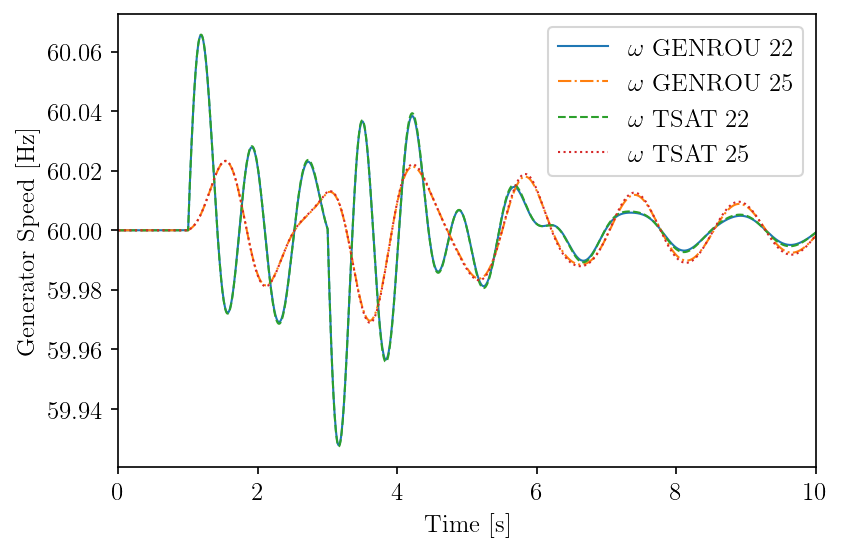
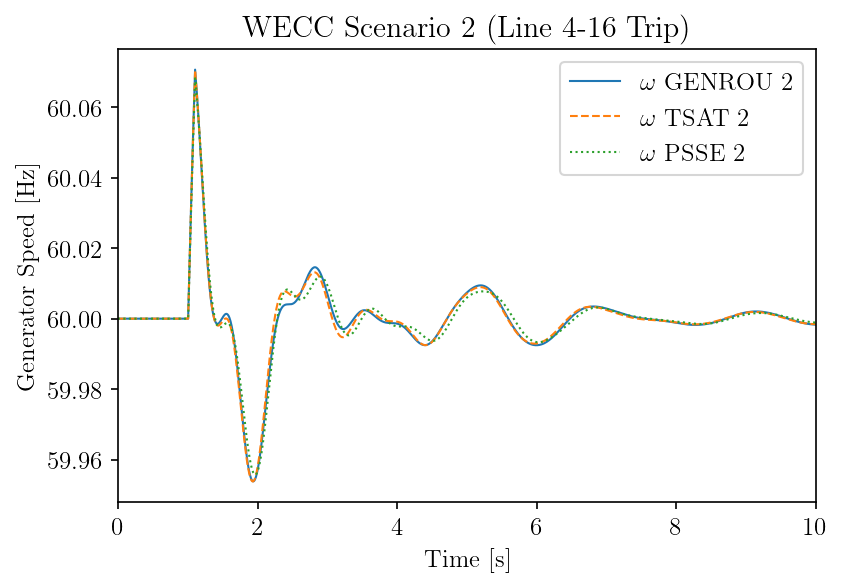
ANDES produces credible simulation results. The following table shows that
-
For the Northeast Power Coordinating Council (NPCC) 140-bus system (with GENROU, GENCLS, TGOV1 and IEEEX1), ANDES results match perfectly with that from TSAT.
-
For the Western Electricity Coordinating Council (WECC) 179-bus system (with GENROU, IEEEG1, EXST1, ESST3A, ESDC2A, IEEEST and ST2CUT), ANDES results match closely with those from TSAT and PSS/E. Note that TSAT and PSS/E results are not identical, either.
| NPCC Case Study | WECC Case Study |
|---|---|
 |
 |
ANDES provides a descriptive modeling framework in a scripting environment. Modeling DAE-based devices is as simple as describing the mathematical equations. Numerical code will be automatically generated for fast simulation.
| Controller Model and Equation | ANDES Code |
|---|---|
Diagram:  Write into DAEs:  |
 |
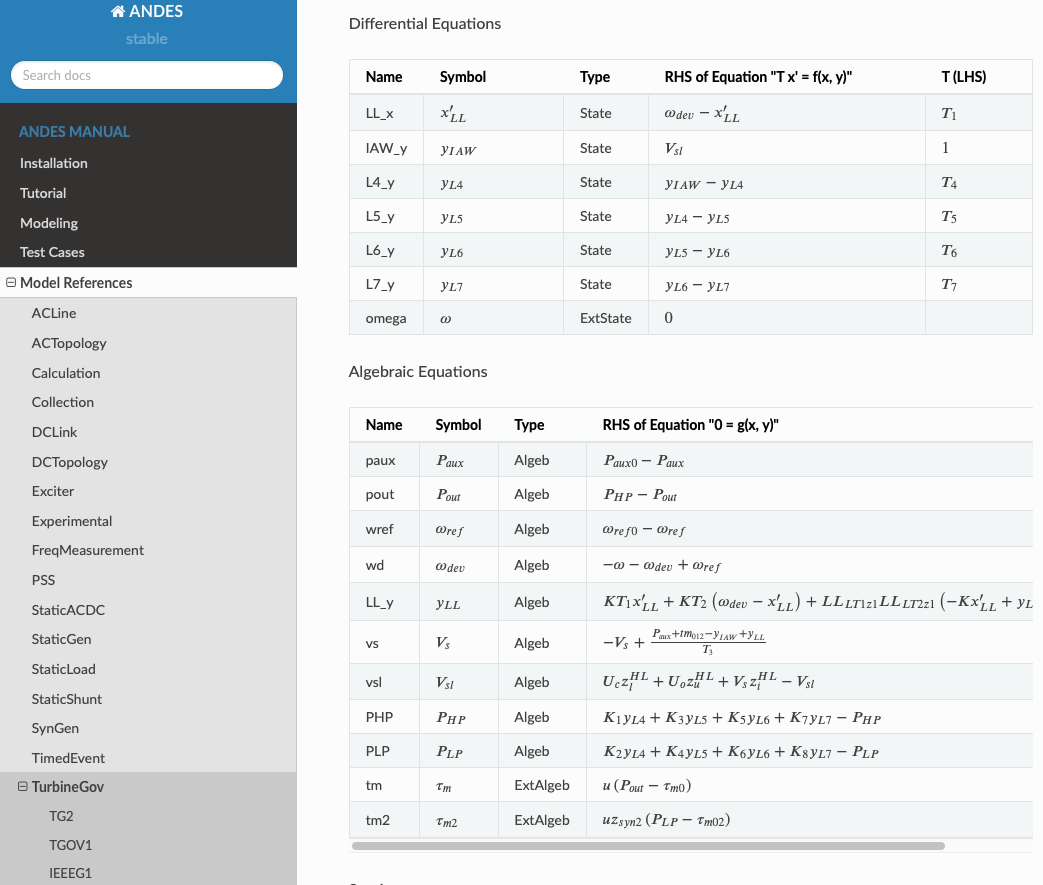
In ANDES, what you simulate is what you document. ANDES automatically generates model documentation, and the docs always stay up to date. The screenshot below is the generated documentation for the implemented IEEEG1 model.
In addition, ANDES features
- a rich library of transfer functions and discontinuous components (including limiters, deadbands, and saturation functions) available for model prototyping and system analysis.
- industry-grade second-generation renewable models (solar PV, type 3 and type 4 wind), distributed PV and energy storage model.
- routines including Newton method for power flow calculation, implicit trapezoidal method for time-domain simulation, and full eigenvalue analysis.
- developed with performance in mind. While written in Python, ANDES can finish a 20-second transient simulation of a 2000-bus system in a few seconds on a typical desktop computer.
- out-of-the-box PSS/E raw and dyr data support for available models. Once a model is developed, inputs from a dyr file can be immediately supported.
ANDES is currently under active development. Use the following resources to get involved.
- Start from the documentation for installation and tutorial.
- Check out examples in the examples folder
- Read the model verification results in the examples/verification folder
- Try in Jupyter Notebook on Binder
- Report bugs or issues by submitting a GitHub issue
- Submit contributions using pull requests
- Read release notes highlighted here
- Check out and and cite our paper
Citing ANDES
If you use ANDES for research or consulting, please cite the following paper in your publication that uses ANDES
H. Cui, F. Li and K. Tomsovic, "Hybrid Symbolic-Numeric Framework for Power System Modeling and Analysis," in IEEE Transactions on Power Systems, vol. 36, no. 2, pp. 1373-1384, March 2021, doi: 10.1109/TPWRS.2020.3017019.
Who is Using ANDES?
Please let us know if you are using ANDES for research or projects. We kindly request you to cite our paper if you find ANDES useful.





Sponsors and Contributors
This work was supported in part by the Engineering Research Center Program of the National Science Foundation and the Department of Energy under NSF Award Number EEC-1041877 and the CURENT Industry Partnership Program.
See GitHub contributors for the contributor list.
License
ANDES is licensed under the GPL v3 License.
1 maintainer

Metadata
1 maintainer
Release files for andes 1.3.6
For a detailed explanation of source distributions (sdists) and built distributions (wheels), please see the package formats documentation.
Source distribution (sdist)
| File | Size | Uploaded | Provenance | Actions |
|---|---|---|---|---|
| andes-1.3.6.tar.gz | 6.5 MB | Without provenance | Details for andes-1.3.6.tar.gz |
Release files / andes-1.3.6.tar.gz
| Download URL | andes-1.3.6.tar.gz |
|---|---|
| Size | 6.5 MB |
| Tags | Source |
|
SHA-256 checksum How to use checksums |
37803859841938415d81350073c6dcfc2aaace57809590fe1ccba6910899ef86
|
|
BLAKE2b-256 checksum How to use checksums |
f03e93ac86214dd37d5ba2bca999321345e5b83f4d9271b85c733fc261a54872
|
| Upload date | |
|
Uploaded using Trusted Publishing? What is trusted publishing? |
No |
| Uploaded via |
twine/3.4.1 importlib_metadata/4.0.1 pkginfo/1.7.0 requests/2.25.1 requests-toolbelt/0.9.1 tqdm/4.60.0 CPython/3.9.4
|
Security for andes 1.3.6
Provenance
Provenance describes where a file came from. On PyPI, provenance is shared via attestations, which provide a verifiable record of the build or publishing details. View details, limitations and caveats.
No provenance found
None of the files in this release were uploaded with provenance metadata.
A note on package security
PyPI is a repository for distributing packages, not a service for auditing them. While third-party security researchers and our staff do their best to detect and remove malicious packages, PyPI cannot guarantee the quality, security or suitability of any given package.
To learn more about protecting yourself from malicious actors, visit our package security documentation.














