

Screenshots
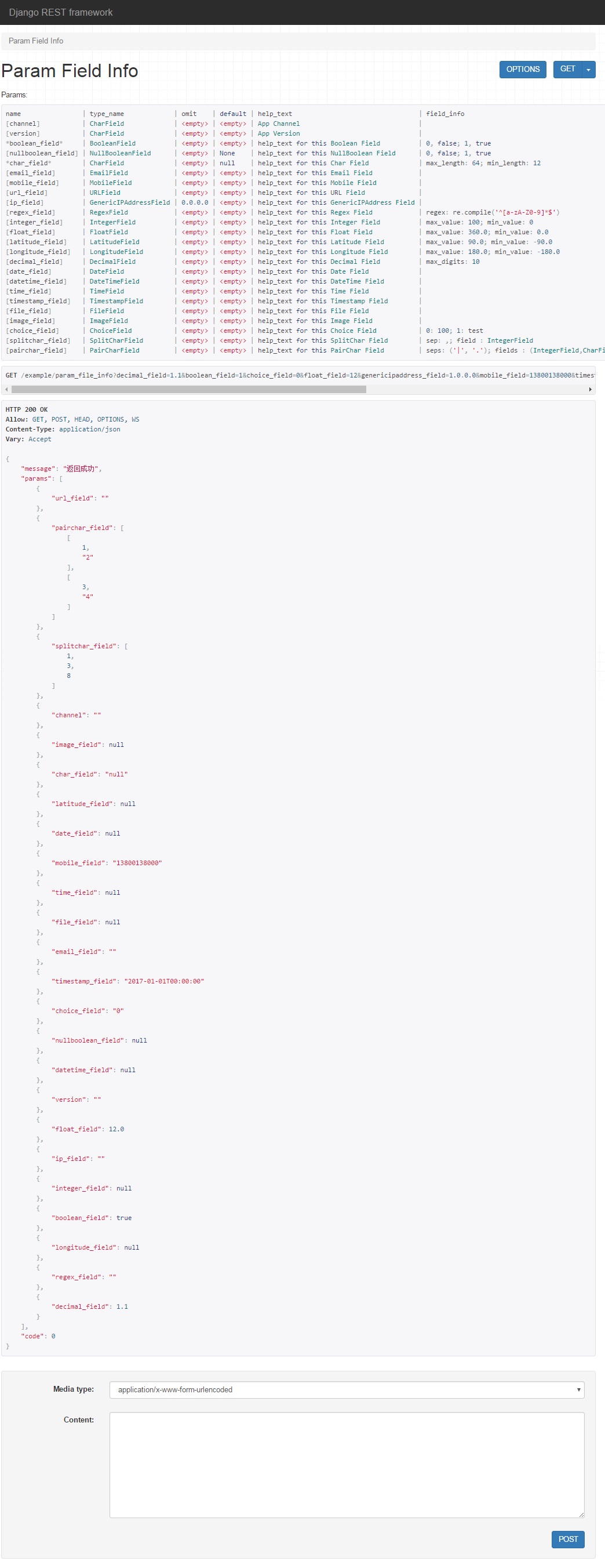
Use in your app
Install using pip:
pip install django_restframework_apiview
Add ‘apiview’ to your INSTALLED_APPS setting:
INSTALLED_APPS = (
    ...
    'apiview',
)
JSONP Renderer And debug apiview with paramslist:
REST_FRAMEWORK = {
    ...
    'DEFAULT_RENDERER_CLASSES': [
        ...
        'apiview.renderers.JSONPRenderer',
    ],
}
if DEBUG:
    REST_FRAMEWORK['DEFAULT_RENDERER_CLASSES'].append('apiview.renderers.BrowsableAPIRenderer')
Add error code to settings.py:
ERROR_CODE_DEFINE = (
    ('ERR_AUTH_NOLOGIN',            10001,  'No login'),
    ('ERR_AUTH_USER_EXISTS',        10002,  'User name has exists'),
    ('ERR_AUTH_USER_NOT_EXISTS',    10003,  'User not exists'),
    ('ERR_AUTH_PASSWORD',           10005,  'Password error'),
)
edit myapp/views.py:
#! usr/bin/env python
# encoding: utf-8
from __future__ import absolute_import, unicode_literals

from django.db import IntegrityError, transaction
from django.contrib.auth import authenticate, login
from django.contrib.auth.models import User
from apiview.err_code import ErrCode
from apiview.exceptions import CustomError
from apiview.view import APIView
from apiview.views import ViewSite
from apiview.views import fields


site = ViewSite(name='base', app_name='base')


class APIBase(APIView):

    class Meta:
        path = '/'
        param_fields = (
            ('channel', fields.CharField(help_text='App Channel', required=False)),
            ('version', fields.CharField(help_text='App Version', required=False)),
        )


class UserAPIBase(APIBase):

    def check_user_permission(self, request):
        user = request.user
        if not user.is_authenticated() or not isinstance(user, User):
            raise CustomError(ErrCode.ERR_AUTH_NOLOGIN)

    def view(self, request, *args, **kwargs):
        self.check_user_permission(request)
        return super(APIBase, self).view(request, *args, **kwargs)

    class Meta:
        path = '/user'


@site
class Login(APIBase):

    name = '用户登陆'

    def get_context(self, request, *args, **kwargs):
        user = authenticate(username=request.params.username, password=request.params.password)
        if user is None:
            raise CustomError(ErrCode.ERR_AUTH_PASSWORD)
        login(request, user)
        return self.get_default_context(user_info={'username':request.user.username, 'email':request.user.email})

    class Meta:
        path = 'user/login'
        param_fields = (
            ('username', fields.CharField(help_text='用户名')),
            ('password', fields.CharField(help_text='密码')),
        )


@site
class Register(APIBase):

    name = '用户注册'

    def get_context(self, request, *args, **kwargs):
        try:
            user = User.objects.create_user(request.params.username, request.params.email, request.params.password)
        except IntegrityError:
            raise CustomError(ErrCode.ERR_AUTH_USER_EXISTS)
        return self.get_default_context()

    class Meta:
        path = 'user/register'
        param_fields = (
            ('username', fields.RegexField(help_text='用户名', regex=r'^[a-zA-Z0-9_]{3,10}$')),
            ('password', fields.CharField(help_text='密码')),
            ('email', fields.EmailField(help_text='Email')),
        )

@site
class Info(UserAPIBase):

    name = '用户信息'

    def get_context(self, request, *args, **kwargs):
        user_info = {'username':request.user.username, 'email':request.user.email}

        return self.get_default_context(user_info=user_info)


@site
class Logout(UserAPIBase):

    name = '退出登陆'

    def get_context(self, request, *args, **kwargs):
        logout(request)

        return self.get_default_context()

urlpatterns = site.urlpatterns
add to urls.py end:
urlpatterns.append(url(r’^test/’, include(“myapp.views”)))
Example
run example:
git clone https://github.com/007gzs/django_restframework_apiview.git
cd django_restframework_apiview/example
pip install -r requirements.txt
python manage.py makemigrations
python manage.py migrate
python manage.py runserver
open http://127.0.0.1:8000/example.html in browser
1 maintainer

Metadata
1 maintainer
Release files for apiview 1.3.25
For a detailed explanation of source distributions (sdists) and built distributions (wheels), please see the package formats documentation.
Source distribution (sdist)
| File | Size | Uploaded | |
|---|---|---|---|
| apiview-1.3.25.tar.gz | 60.9 kB | Details |
Release files / apiview-1.3.25.tar.gz
| Download URL | apiview-1.3.25.tar.gz |
|---|---|
| Size | 60.9 kB |
| Tags | Source |
|
SHA-256 checksum How to use checksums |
1b5445f16fbc5fbe83da5ef355d2251d1e19abee44d35824d90ccc8b67bc387c
|
|
BLAKE2b-256 checksum How to use checksums |
dfb5c3555e1fdabc4c424a3e1b36fe706007ef61f672063ef1f8f6e5d8b67d8d
|
| Upload date | |
|
Uploaded using Trusted Publishing? What is trusted publishing? |
No |
| Uploaded via |
twine/3.1.1 pkginfo/1.5.0.1 requests/2.22.0 setuptools/42.0.2 requests-toolbelt/0.9.1 tqdm/4.40.2 CPython/3.7.4
|














