
This release is a pre-release and may not be stable for production use.
ASDL: Automatic Second-order Differentiation Library
ASDL is an extension library of PyTorch to easily perform gradient preconditioning using second-order information (e.g., Hessian, Fisher information) for deep neural networks.
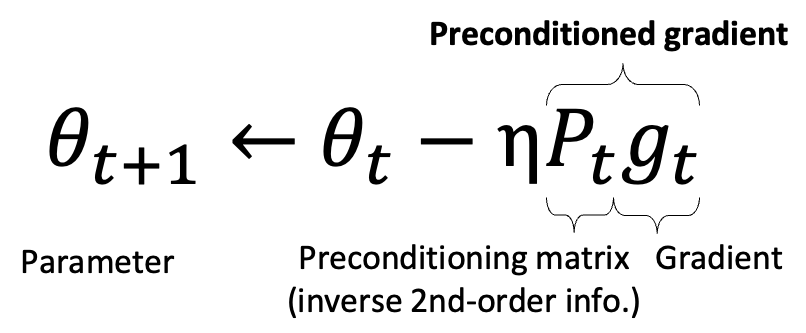
ASDL provides various implementations and a unified interface (GradientMaker) for gradient preconditioning for deep neural networks. For example, to train your model with gradient preconditioning by K-FAC algorithm, you can replace a <Standard> gradient calculation procedure (i.e., a forward pass followed by a backward pass) with one by <ASDL> with KfacGradientMaker like the following:
from asdl.precondition import PreconditioningConfig, KfacGradientMaker

# Initialize model
model = Net()

# Initialize optimizer (SGD is recommended)
optimizer = torch.optim.SGD(model.parameters(), lr=0.1)

# Initialize KfacGradientMaker
config = PreconditioningConfig(data_size=batch_size, damping=0.01)
gm = KfacGradientMaker(model, config)

# Training loop
for x, t in data_loader:
  optimizer.zero_grad()

  # <Standard> (gradient calculation)
  # y = model(x)
  # loss = loss_fn(y, t)
  # loss.backward()

  # <ASDL> ('preconditioned' gradient calculation)
  dummy_y = gm.setup_model_call(model, x)
  gm.setup_loss_call(loss_fn, dummy_y, t)
  y, loss = gm.forward_and_backward()

  optimizer.step()
You can apply a different gradient preconditioning algorithm by replacing gm with another XXXGradientMaker(model, config) (XXX: algorithm name, e.g., ShampooGradientMaker for Shampoo algorithm) with the same interface.
This enables a flexible switching/comparison of a range of gradient preconditioning algorithms.
Installation
You can install the latest version of ASDL by running:
$ pip install asdfghjkl
ASDL is tested with Python 3.7 and is compatible with PyTorch 1.13.
Example
The training script for training MLPs, CNNs, or ResNets using varous types of gradient preconditionig methods (which reproduces the results in the ASDL paper).
Resource
- ASDL paper
- ASDL poster @ HOOML2022 workshop at NeurIPS 2022
1 maintainer

Metadata
1 maintainer
Release files for asdfghjkl 0.1a5
For a detailed explanation of source distributions (sdists) and built distributions (wheels), please see the package formats documentation.
Source distribution (sdist)
| File | Size | Uploaded | Provenance | Actions |
|---|---|---|---|---|
| asdfghjkl-0.1a5.tar.gz | 75.7 kB | Without provenance | Details for asdfghjkl-0.1a5.tar.gz |
Built distribution (wheel)
| File | Interpreter | ABI | Platform | Actions Reset |
|---|---|---|---|---|
| asdfghjkl-0.1a5-py3-none-any.whl | Python 3 | none | any | Details for asdfghjkl-0.1a5-py3-none-any.whl |
Total release size: 165.3 kB
Release files / asdfghjkl-0.1a5.tar.gz
| Download URL | asdfghjkl-0.1a5.tar.gz |
|---|---|
| Size | 75.7 kB |
| Tags | Source |
|
SHA-256 checksum How to use checksums |
02d268093bfa804132b9405266f2c3b27ffda27000b47251b31de299b13d0da8
|
|
BLAKE2b-256 checksum How to use checksums |
460097a16b4a9c0ec0f971e7033187043cff4d854bd8e84dc6b03e3b74d8931a
|
| Upload date | |
|
Uploaded using Trusted Publishing? What is trusted publishing? |
No |
| Uploaded via |
twine/5.1.1 CPython/3.9.4
|
Release files / asdfghjkl-0.1a5-py3-none-any.whl
| Download URL | asdfghjkl-0.1a5-py3-none-any.whl |
|---|---|
| Size | 89.6 kB |
| Tags | Python 3 |
|
SHA-256 checksum How to use checksums |
b84d6755f0e7a47ef71a6ba88c81e8fe123b8cbd234eb20cde5790eebb4d5198
|
|
BLAKE2b-256 checksum How to use checksums |
1f9c0d320fa42c3a965e1f2ba20ada993737da049ab2545cf55199deb5e50d99
|
| Upload date | |
|
Uploaded using Trusted Publishing? What is trusted publishing? |
No |
| Uploaded via |
twine/5.1.1 CPython/3.9.4
|
Security for asdfghjkl 0.1a5
Provenance
Provenance describes where a file came from. On PyPI, provenance is shared via attestations, which provide a verifiable record of the build or publishing details. View details, limitations and caveats.
No provenance found
None of the files in this release were uploaded with provenance metadata.
A note on package security
PyPI is a repository for distributing packages, not a service for auditing them. While third-party security researchers and our staff do their best to detect and remove malicious packages, PyPI cannot guarantee the quality, security or suitability of any given package.
To learn more about protecting yourself from malicious actors, visit our package security documentation.














