
AutoPrognosis - A system for automating the design of predictive modeling pipelines tailored for clinical prognosis.





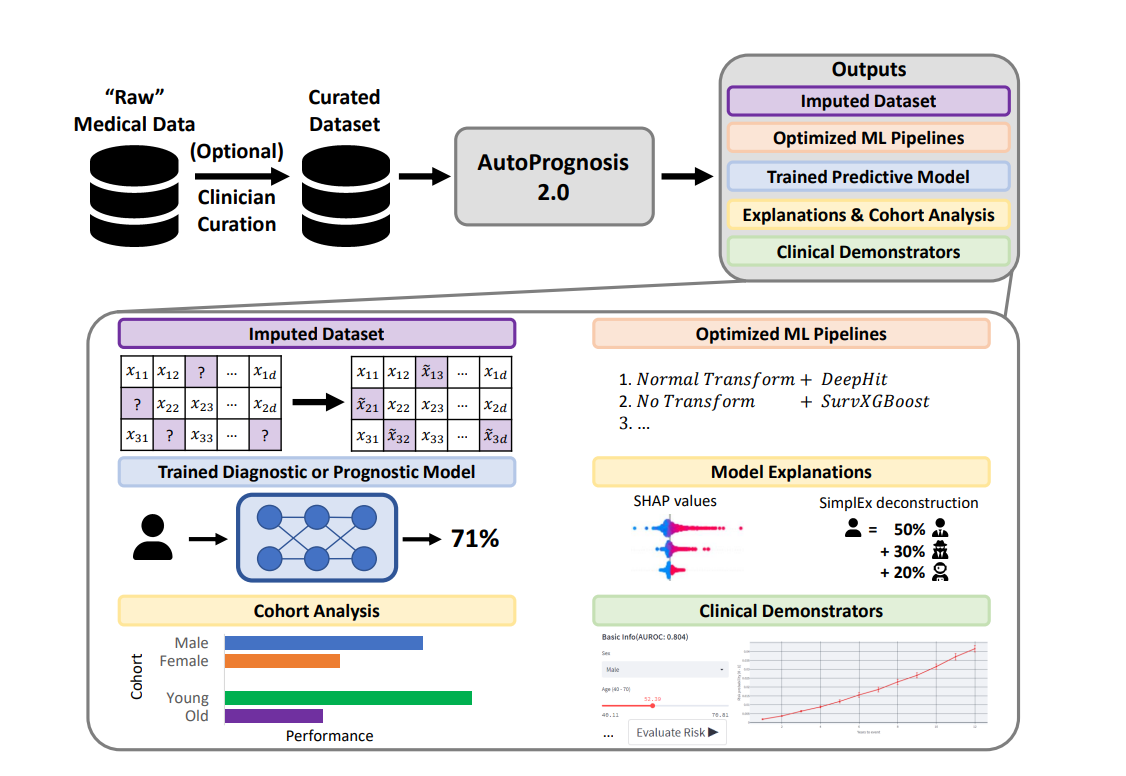
🔑 Features
- 🚀Automatically learns ensembles of pipelines for classification or survival analysis.
- 🌀 Easy to extend pluginable architecture.
- 🔥 Interpretability tools.
🚀Installation
Using pip
The library can be installed from PyPI using
$ pip install autoprognosis
or from source, using
$ pip install .
Redis (Optional, but recommended)
AutoPrognosis can use Redis as a backend to improve the performance and quality of the searches.
For that, install the redis-server package following the steps described on the official site.
💥 Sample Usage
More advanced use cases can be found on our tutorials section.
List the available classifiers
from autoprognosis.plugins.prediction.classifiers import Classifiers
print(Classifiers().list_available())
Create a study for classifiers
from pathlib import Path

from sklearn.datasets import load_breast_cancer

from autoprognosis.studies.classifiers import ClassifierStudy
from autoprognosis.utils.serialization import load_model_from_file
from autoprognosis.utils.tester import evaluate_estimator


X, Y = load_breast_cancer(return_X_y=True, as_frame=True)

df = X.copy()
df["target"] = Y

workspace = Path("workspace")
study_name = "example"

study = ClassifierStudy(
    study_name=study_name,
    dataset=df,  # pandas DataFrame
    target="target",  # the label column in the dataset
    num_iter=100,  # how many trials to do for each candidate
    timeout=60,  # seconds
    classifiers=["logistic_regression", "lda", "qda"],
    workspace=workspace,
)

study.run()

output = workspace / study_name / "model.p"
model = load_model_from_file(output)

metrics = evaluate_estimator(model, X, Y)

print(f"model {model.name()} -> {metrics['clf']}")
List available survival analysis estimators
from autoprognosis.plugins.prediction.risk_estimation import RiskEstimation
print(RiskEstimation().list_available())
Survival analysis study
# stdlib
import os
from pathlib import Path

# third party
import numpy as np
from pycox import datasets

# autoprognosis absolute
from autoprognosis.studies.risk_estimation import RiskEstimationStudy
from autoprognosis.utils.serialization import load_model_from_file
from autoprognosis.utils.tester import evaluate_survival_estimator

df = datasets.gbsg.read_df()
df = df[df["duration"] > 0]

X = df.drop(columns = ["duration"])
T = df["duration"]
Y = df["event"]

eval_time_horizons = np.linspace(T.min(), T.max(), 5)[1:-1]

workspace = Path("workspace")
study_name = "example_risks"

study = RiskEstimationStudy(
    study_name=study_name,
    dataset=df,
    target="event",
    time_to_event="duration",
    time_horizons=eval_time_horizons,
    num_iter=10,
    num_study_iter=1,
    timeout=10,
    risk_estimators=["cox_ph", "survival_xgboost"],
    score_threshold=0.5,
    workspace=workspace,
)

study.run()

output = workspace / study_name / "model.p"

model = load_model_from_file(output)
metrics = evaluate_survival_estimator(model, X, T, Y, eval_time_horizons)

print(f"Model {model.name()} score: {metrics['clf']}")
🔆 Tutorials
Plugins
AutoML
Classification tasks
Building a demonstrator
⚡ Plugins
Imputation methods
from autoprognosis.plugins.imputers import  Imputers

imputer = Imputers().get(<NAME>)
| Name | Description |
|---|---|
| hyperimpute | Iterative imputer using both regression and classification methods based on linear models, trees, XGBoost, CatBoost and neural nets |
| mean | Replace the missing values using the mean along each column with SimpleImputer |
| median | Replace the missing values using the median along each column with SimpleImputer |
| most_frequent | Replace the missing values using the most frequent value along each column with SimpleImputer |
| missforest | Iterative imputation method based on Random Forests using IterativeImputer and ExtraTreesRegressor |
| ice | Iterative imputation method based on regularized linear regression using IterativeImputer and BayesianRidge |
| mice | Multiple imputations based on ICE using IterativeImputer and BayesianRidge |
| softimpute | Low-rank matrix approximation via nuclear-norm regularization |
| EM | Iterative procedure which uses other variables to impute a value (Expectation), then checks whether that is the value most likely (Maximization) - EM imputation algorithm |
| gain | GAIN: Missing Data Imputation using Generative Adversarial Nets |
Preprocessing methods
from autoprognosis.plugins.preprocessors import Preprocessors

preprocessor = Preprocessors().get(<NAME>)
| Name | Description |
|---|---|
| maxabs_scaler | Scale each feature by its maximum absolute value. MaxAbsScaler |
| scaler | Standardize features by removing the mean and scaling to unit variance. - StandardScaler |
| feature_normalizer | Normalize samples individually to unit norm. Normalizer |
| normal_transform | Transform features using quantiles information.QuantileTransformer |
| uniform_transform | Transform features using quantiles information.QuantileTransformer |
| minmax_scaler | Transform features by scaling each feature to a given range.MinMaxScaler |
Classification
from autoprognosis.plugins.prediction.classifiers import Classifiers

classifier = Classifiers().get(<NAME>)
| Name | Description |
|---|---|
| neural_nets | PyTorch based neural net classifier. |
| logistic_regression | LogisticRegression |
| catboost | Gradient boosting on decision trees - CatBoost |
| random_forest | A random forest classifier. RandomForestClassifier |
| tabnet | TabNet : Attentive Interpretable Tabular Learning |
| xgboost | XGBoostClassifier |
Survival Analysis
from autoprognosis.plugins.prediction.risk_estimation import RiskEstimation

predictor = RiskEstimation().get(<NAME>)
| Name | Description |
|---|---|
| survival_xgboost | XGBoost Survival Embeddings |
| loglogistic_aft | Log-Logistic AFT model |
| deephit | DeepHit: A Deep Learning Approach to Survival Analysis with Competing Risks |
| cox_ph | Cox’s proportional hazard model |
| weibull_aft | Weibull AFT model. |
| lognormal_aft | Log-Normal AFT model |
| coxnet | CoxNet is a Cox proportional hazards model also referred to as DeepSurv |
Regression
from autoprognosis.plugins.prediction.regression import Regression

regressor = Regression().get(<NAME>)
| Name | Description |
|---|---|
| tabnet_regressor | TabNet : Attentive Interpretable Tabular Learning |
| catboost_regressor | Gradient boosting on decision trees - CatBoost |
| random_forest_regressor | RandomForestRegressor |
| xgboost_regressor | XGBoostClassifier |
| neural_nets_regression | PyTorch-based neural net regressor. |
| linear_regression | LinearRegression |
Explainers
from autoprognosis.plugins.explainers import Explainers

explainer = Explainers().get(<NAME>)
| Name | Description |
|---|---|
| risk_effect_size | Feature importance using Cohen's distance between probabilities |
| lime | Lime: Explaining the predictions of any machine learning classifier |
| symbolic_pursuit | [Symbolic Pursuit](Learning outside the black-box: at the pursuit of interpretable models) |
| shap_permutation_sampler | SHAP Permutation Sampler |
| kernel_shap | SHAP KernelExplainer |
| invase | INVASE: Instance-wise Variable Selection |
Uncertainty
from autoprognosis.plugins.uncertainty import UncertaintyQuantification
model = UncertaintyQuantification().get(<NAME>)
| Name | Description |
|---|---|
| cohort_explainer | |
| conformal_prediction | |
| jackknife |
🔨 Test
After installing the library, the tests can be executed using pytest
$ pip install .[testing]
$ pytest -vxs -m "not slow"
Citing
If you use this code, please cite the associated paper:
TODO
References
- AutoPrognosis: Automated Clinical Prognostic Modeling via Bayesian Optimization with Structured Kernel Learning
- Prognostication and Risk Factors for Cystic Fibrosis via Automated Machine Learning
- Cardiovascular Disease Risk Prediction using Automated Machine Learning: A Prospective Study of 423,604 UK Biobank Participants
2 maintainers


Metadata
2 maintainers
Release files for autoprognosis 0.1.2
For a detailed explanation of source distributions (sdists) and built distributions (wheels), please see the package formats documentation.
Built distributions (wheels)
| File | Interpreter | ABI | Platform | Actions Reset |
|---|---|---|---|---|
| autoprognosis-0.1.2-py2.py3-none-macosx_10_14_x86_64.whl | Python 3, Python 2 | none | macOS 10.14+ x86-64 | Details for autoprognosis-0.1.2-py2.py3-none-macosx_10_14_x86_64.whl |
| autoprognosis-0.1.2-py2.py3-none-any.whl | Python 2, Python 3 | none | any | Details for autoprognosis-0.1.2-py2.py3-none-any.whl |
Total release size: 467.3 kB
Release files / autoprognosis-0.1.2-py2.py3-none-macosx_10_14_x86_64.whl
| Download URL | autoprognosis-0.1.2-py2.py3-none-macosx_10_14_x86_64.whl |
|---|---|
| Size | 232.5 kB |
| Tags | Python 2 Python 3 macOS 10.14+ x86-64 |
|
SHA-256 checksum How to use checksums |
ee5f9086ab36c2ad5957cd699736a94f23baa84454d0788a65aa91037960f2eb
|
|
BLAKE2b-256 checksum How to use checksums |
b738520172f953d08555e28f332730cc9fafeb47d58bde42c1825718e79623fe
|
| Upload date | |
|
Uploaded using Trusted Publishing? What is trusted publishing? |
No |
| Uploaded via |
twine/4.0.1 CPython/3.8.14
|
Release files / autoprognosis-0.1.2-py2.py3-none-any.whl
| Download URL | autoprognosis-0.1.2-py2.py3-none-any.whl |
|---|---|
| Size | 234.8 kB |
| Tags | Python 2 Python 3 |
|
SHA-256 checksum How to use checksums |
f3099f960f05c197a1fb36e72c5183513a00c2402312ab38ea4d51f3b9e14ce1
|
|
BLAKE2b-256 checksum How to use checksums |
8cbdcd9e273bfc477d64c61948d5c000fe56f13489f02d4eb552589ceb475f98
|
| Upload date | |
|
Uploaded using Trusted Publishing? What is trusted publishing? |
No |
| Uploaded via |
twine/4.0.1 CPython/3.8.10
|
Security for autoprognosis 0.1.2
Provenance
Provenance describes where a file came from. On PyPI, provenance is shared via attestations, which provide a verifiable record of the build or publishing details. View details, limitations and caveats.
No provenance found
None of the files in this release were uploaded with provenance metadata.
A note on package security
PyPI is a repository for distributing packages, not a service for auditing them. While third-party security researchers and our staff do their best to detect and remove malicious packages, PyPI cannot guarantee the quality, security or suitability of any given package.
To learn more about protecting yourself from malicious actors, visit our package security documentation.














