autoreject





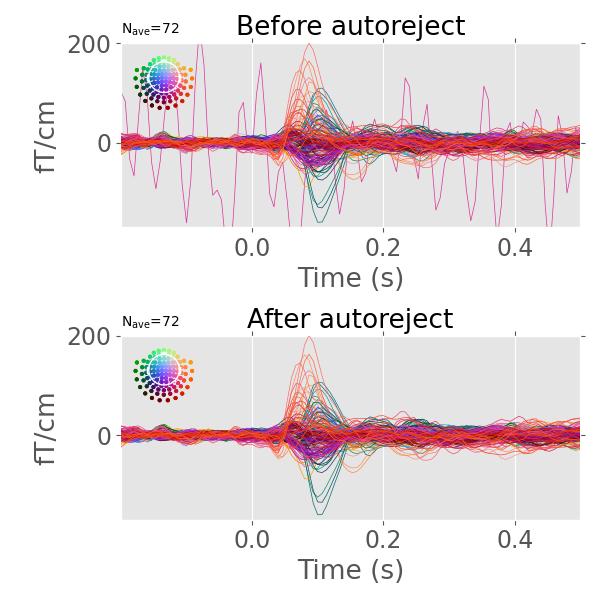
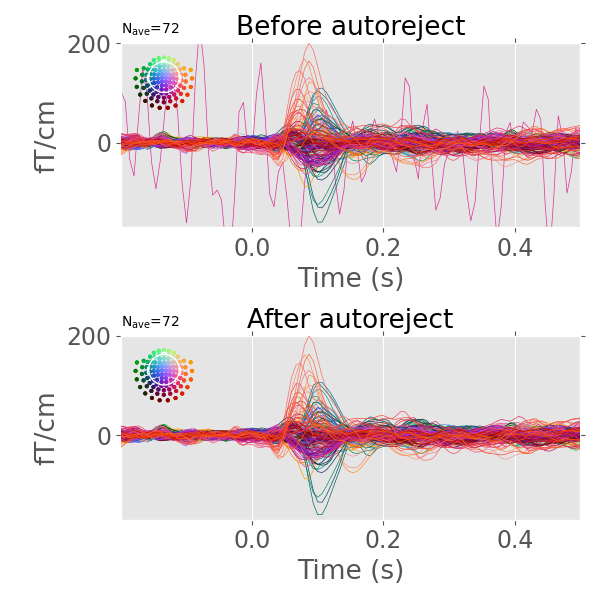
This is a library to automatically reject bad trials and repair bad sensors in magneto-/electroencephalography (M/EEG) data.
The documentation can be found under the following links:
for the stable release
for the latest (development) version
Installation
We recommend the Anaconda Python distribution and a Python version >= 3.11. We furthermore recommend that you install autoreject into an isolated Python environment. To obtain the stable release of autoreject, you can use pip:
pip install -U autoreject
Or conda:
conda install -c conda-forge autoreject
If you want the latest (development) version of autoreject, use:
pip install https://github.com/autoreject/autoreject/archive/refs/heads/main.zip
To check if everything worked fine, you can do:
python -c 'import autoreject'
and it should not give any error messages.
Below, we list the dependencies for autoreject. All required dependencies are installed automatically when you install autoreject.
mne (>=1.5.0)
numpy (>=1.21.2)
scipy (>=1.7.1)
scikit-learn (>=1.0.0)
joblib
matplotlib (>=3.5.0)
Optional dependencies are:
openneuro-py (>= 2021.10.1, for fetching data from OpenNeuro.org)
Quickstart
The easiest way to get started is to copy the following three lines of code in your script:
>>> from autoreject import AutoReject
>>> ar = AutoReject()
>>> epochs_clean = ar.fit_transform(epochs)  # doctest: +SKIP
This will automatically clean an epochs object read in using MNE-Python. To get the rejection dictionary, simply do:
>>> from autoreject import get_rejection_threshold
>>> reject = get_rejection_threshold(epochs)  # doctest: +SKIP
We also implement RANSAC from the PREP pipeline (see PyPREP for a full implementation of the PREP pipeline). The API is the same:
>>> from autoreject import Ransac
>>> rsc = Ransac()
>>> epochs_clean = rsc.fit_transform(epochs)  # doctest: +SKIP
For more details check out the example to automatically detect and repair bad epochs.
Bug reports
Please use the GitHub issue tracker to report bugs.
Cite
[1] Mainak Jas, Denis Engemann, Federico Raimondo, Yousra Bekhti, and Alexandre Gramfort, “Automated rejection and repair of bad trials in MEG/EEG”. In 6th International Workshop on Pattern Recognition in Neuroimaging (PRNI), 2016.
[2] Mainak Jas, Denis Engemann, Yousra Bekhti, Federico Raimondo, and Alexandre Gramfort. 2017. “Autoreject: Automated artifact rejection for MEG and EEG data”. NeuroImage, 159, 417-429.
3 maintainers


Metadata
3 maintainers
Release files for autoreject 0.5.1
For a detailed explanation of source distributions (sdists) and built distributions (wheels), please see the package formats documentation.
Source distribution (sdist)
| File | Size | Uploaded | |
|---|---|---|---|
| autoreject-0.5.1.tar.gz | 27.8 kB | Details |
Built distribution (wheel)
| File | Interpreter | ABI | Platform | Reset |
|---|---|---|---|---|
| autoreject-0.5.1-py3-none-any.whl | Python 3 | none | any | Details |
Total release size: 57.9 kB
Release files / autoreject-0.5.1.tar.gz
| Download URL | autoreject-0.5.1.tar.gz |
|---|---|
| Size | 27.8 kB |
| Tags | Source |
|
SHA-256 checksum How to use checksums |
202d4904e31ddce022c47bca4f7a78f83d92644039750cdb6a56b9b76539e41d
|
|
BLAKE2b-256 checksum How to use checksums |
b23ae358ec35cef6df521120c40a38a230ac049a6196c04a003bb1dbefa6c24d
|
| Upload date | |
|
Uploaded using Trusted Publishing? What is trusted publishing? |
No |
| Uploaded via |
twine/7.0.0 CPython/3.14.7
|
Release files / autoreject-0.5.1-py3-none-any.whl
| Download URL | autoreject-0.5.1-py3-none-any.whl |
|---|---|
| Size | 30.1 kB |
| Tags | Python 3 |
|
SHA-256 checksum How to use checksums |
f259d19d3458794555ab6f996e4b4eb5adebc69dcab97c7e50655ca9fa3865ad
|
|
BLAKE2b-256 checksum How to use checksums |
c137e7e2758d4dc5d11d168ed69655e9ed4497b5d9146073a36c4c386fa74ec5
|
| Upload date | |
|
Uploaded using Trusted Publishing? What is trusted publishing? |
No |
| Uploaded via |
twine/7.0.0 CPython/3.14.7
|