
Aviary -- NASA's aircraft design tool
Aviary is an aircraft analysis, design, and optimization tool built on top of the Python-based optimization framework OpenMDAO. Aviary incorporates aircraft sizing equations from its predecessors GASP (General Aviation Synthesis Program) and FLOPS (Flight Optimization System). There are two options for the mission analysis portion of this code, a two-degrees-of-freedom (2DOF) approach, and an energy-state approach. The user can select which type of mission analysis to use, as well as whether to use the FLOPS-based code or the GASP-based code for the weight, sizing, and aerodynamic relations. Aviary provides a flexible and user-friendly optimization platform for conceptual aircraft design. This tool is being used by college level senior design courses, NASA internally, a industry partners. Aviary is under active development! While the base features of the code are relatively stable, new releases may make changes that require users on the bleeding-edge to update their models.
If you are using Aviary, please Cite us!
Documentation
Overview Slide Slow is a great place to get started if you are wondering what Aviary is at a high level.
Overview Video gives a 5 minute introduction to Aviary.
Paper by Gratz et al. describing aviaries capabilities in detail.
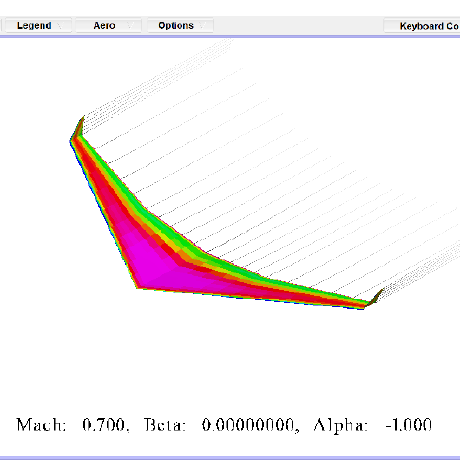
How NASA uses aviary to model Aircraft by Aretskin-Hariton et al. describes how aviary was applied to model a Transonic Truss-Braced Wing (TTBW) aircraft.
Installation
Pip Install
The simplest installation method for users is to install via pip:
pip install aviary
Please see the installation doc page for more detailed instructions. The minimum supported Python version for Aviary is 3.9.
Docker Install
You can also install aviary as a package/image using docker:
docker pull ghcr.io/openmdao/aviary:latest
Validation
This code has been validated using output and data from the GASP and FLOPS codes themselves. The GASP-based weight calculations in this code include in their comments which versions of the GASP standalone weights module were used in validation. The aero and EOM subsystem validations were based on runs of the entire GASP and FLOPS code as they stood in the summer of 2021 and the summer of 2022 respectively.
Quick testing
The repository installation can be tested using the command testflo . at the top-level Aviary folder. If you have both SNOPT and IPOPT installed the output should look something like this:
    OK

    Passed:  706
    Failed:  0
    Skipped: 3


    Ran 709 tests using 16 processes
    Wall clock time:   00:00:16.97
Full testing
In addition to all of the quicker tests, we include multiple integration tests within Aviary.
These have also been known as "benchmarks".
Due to their length, these tests are not run when using the above command.
Instead, you can use the run_all_benchmarks.py file in the Aviary/aviary folder, which is just a light wrapper around the testflo call.
This will run all of the longer tests in parallel using all of your available CPU cores.
Package versions
Information on the versions of the packages required for Aviary can be found in the most recent GitHub Actions runs.
We have also provided a static version of the environment.yml at the top level of the Aviary repo.
Contact Us
Get in touch with the Aviary team at agency-aviary@mail.nasa.gov or the GitHub discussions page
Citing Aviary
If you use Aviary in your research, please cite:
Gratz, J., Kirk, J., Recine, C., Jasa, J., Aretskin-Hariton, E., Moore, K., & Marfatia, K. (2024). Aviary: An Open-Source Multidisciplinary Design, Analysis, and Optimization Tool for Modeling Aircraft With Analytic Gradients. AIAA AVIATION FORUM AND ASCEND 2024. https://doi.org/10.2514/6.2024-4219
BibTeX
@inbook{doi:10.2514/6.2024-4219,
author = {Jennifer Gratz and Jason Kirk and Carl Recine and John Jasa and Eliot Aretskin-Hariton and Kenneth Moore and Kiran Marfatia},
title = {Aviary: An Open-Source Multidisciplinary Design, Analysis, and Optimization Tool for Modeling Aircraft With Analytic Gradients},
booktitle = {AIAA AVIATION FORUM AND ASCEND 2024},
doi = {10.2514/6.2024-4219},
URL = {https://arc.aiaa.org/doi/abs/10.2514/6.2024-4219},
year = {2024},
}
Contributors ✨

Thanks goes to these wonderful people (emoji key):















This project follows the all-contributors specification. Contributions of any kind welcome!
1 maintainer

Metadata
1 maintainer
Release files for aviary 1.0.1
For a detailed explanation of source distributions (sdists) and built distributions (wheels), please see the package formats documentation.
Source distribution (sdist)
| File | Size | Uploaded | Provenance | Actions |
|---|---|---|---|---|
| aviary-1.0.1.tar.gz | 11.8 MB | With provenance | Details for aviary-1.0.1.tar.gz |
Built distribution (wheel)
| File | Interpreter | ABI | Platform | Actions Reset |
|---|---|---|---|---|
| aviary-1.0.1-py2.py3-none-any.whl | Python 3, Python 2 | none | any | Details for aviary-1.0.1-py2.py3-none-any.whl |
Total release size: 24.1 MB
Release files / aviary-1.0.1.tar.gz
| Download URL | aviary-1.0.1.tar.gz |
|---|---|
| Size | 11.8 MB |
| Tags | Source |
|
SHA-256 checksum How to use checksums |
fc60c9d6259873d0b5b7c8cd69a2f71d7ab1733128ecac51d937b38596fdb8f3
|
|
BLAKE2b-256 checksum How to use checksums |
83e2735d6de051eec84551bbd3f34037da391891c3a8170baa118d7e6d7ea492
|
| Upload date | |
|
Uploaded using Trusted Publishing? What is trusted publishing? |
Yes |
| Uploaded via |
twine/6.1.0 CPython/3.12.9
|
Provenance
Provenance describes where a file came from. On PyPI, provenance is shared via attestations, which provide a verifiable record of the build or publishing details. View details, limitations and caveats.


PyPI Publish Attestation
PyPI verified that this artifact, at this checksum, originated from the publisher listed below.
Signed by GitHub Actions, verified by PyPI on Jul 2, 2026.
Transparency logRelease files / aviary-1.0.1-py2.py3-none-any.whl
| Download URL | aviary-1.0.1-py2.py3-none-any.whl |
|---|---|
| Size | 12.3 MB |
| Tags | Python 2 Python 3 |
|
SHA-256 checksum How to use checksums |
7a4d6e10227470c09b1df4acc7a04a345369208bfda0e30f90b115d3e3787007
|
|
BLAKE2b-256 checksum How to use checksums |
fd378f4bbbe09b6c07921b981886208393dbab008e24c8d1f11e9621ff8f6660
|
| Upload date | |
|
Uploaded using Trusted Publishing? What is trusted publishing? |
Yes |
| Uploaded via |
twine/6.1.0 CPython/3.12.9
|
Provenance
Provenance describes where a file came from. On PyPI, provenance is shared via attestations, which provide a verifiable record of the build or publishing details. View details, limitations and caveats.
PyPI Publish Attestation
PyPI verified that this artifact, at this checksum, originated from the publisher listed below.
Signed by GitHub Actions, verified by PyPI on Jul 2, 2026.
Transparency logSecurity for aviary 1.0.1
Provenance
Provenance describes where a file came from. On PyPI, provenance is shared via attestations, which provide a verifiable record of the build or publishing details. View details, limitations and caveats.
Full provenance
Both files in this release have been uploaded with provenance metadata.
Attestation for aviary-1.0.1.tar.gz
PyPI Publish Attestation
PyPI verified that this artifact, at this checksum, originated from the publisher listed below.
Signed by GitHub Actions, verified by PyPI on Jul 2, 2026.
Transparency logA note on package security
PyPI is a repository for distributing packages, not a service for auditing them. While third-party security researchers and our staff do their best to detect and remove malicious packages, PyPI cannot guarantee the quality, security or suitability of any given package.
To learn more about protecting yourself from malicious actors, visit our package security documentation.














