
basic-image-eda
A simple multiprocessing EDA tool to check basic information of images under a directory(images are found recursively). This tool was made to quickly check info and prevent mistakes on reading, resizing, and normalizing images as inputs for neural networks. It can be used when first joining an image competition or training CNNs with images!
Notes:
- All images are converted to 3-channel(rgb) images. When images that have various channels are mixed, some results can be misleading.
- uint8 and uint16 data types are supported. If different data types are mixed, error occurs.
- Supported extensions: jpg, jpeg, jpe, png, tif, tiff, bmp, ppm, pbm, pgm, sr, ras, webp
Installation
pip install basic-image-eda
or (latest version)
pip install git+https://github.com/Soongja/basic-image-eda
prerequisites:
- opencv-python
- numpy
- matplotlib
- skimage.io
- tifffile
- tqdm
Usage(CLI/Code)
CLI
simple one line command!
basic-image-eda <data_dir>
or
basic-image-eda <data_dir> -e png tiff -t 12 --dimension_plot --channel_hist --nonzero --hw_division_factor 2.0 > eda.txt

Options:
  -e --extensions          target image extensions. if none, all supported extensions are included.(default=None)
  -t --threads             number of multiprocessing threads. if 0, automatically count max threads.(default=0)
  -d --dimension_plot      show dimension(height/width) scatter plot.(default=False)
  -c --channel_hist        show channelwise pixel value histogram. takes longer time.(default=False)
  -n --nonzero             calculate values only from non-zero pixels of the images.(default=False)
  -f --hw_division_factor  divide height,width of the images by this factor to make pixel value calculation faster.
                           Information on height, width are not changed and will be printed correctly.(default=1.0)
  -V --version             show version.
Code
from basic_image_eda import BasicImageEDA

if __name__ == "__main__":  # for multiprocessing
    data_dir = "./data"
    BasicImageEDA.explore(data_dir)

    # or

    extensions = ['png', 'jpg', 'jpeg']
    threads = 0
    dimension_plot = True
    channel_hist = True
    nonzero = False
    hw_division_factor = 1.0

    BasicImageEDA.explore(data_dir, extensions, threads, dimension_plot, channel_hist, nonzero, hw_division_factor)
Results
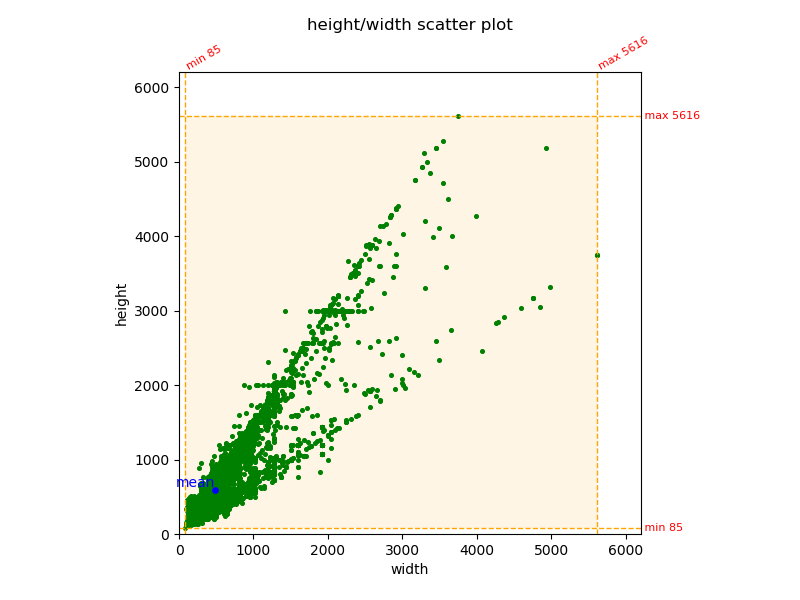
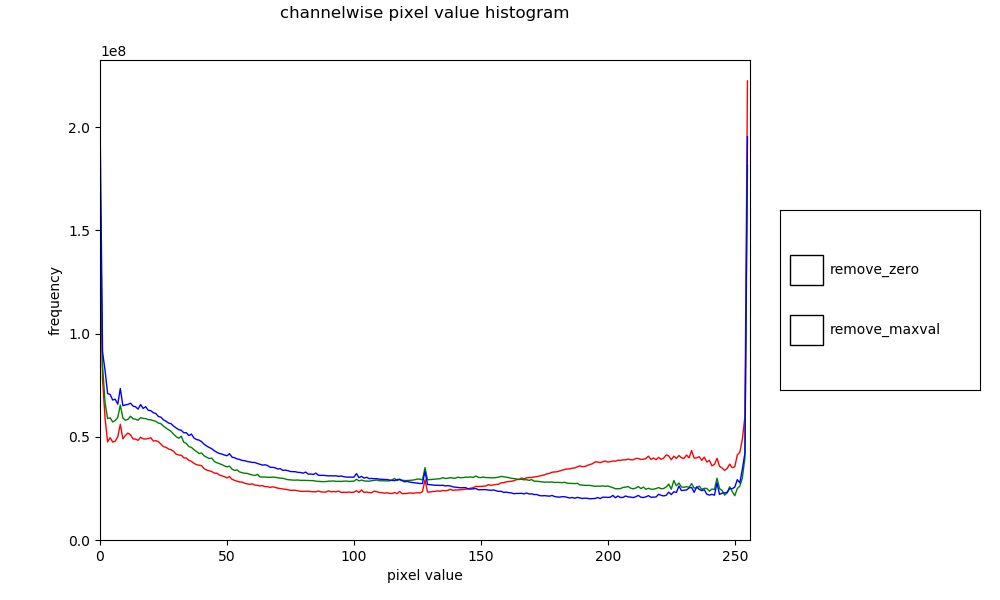
Results on celeba dataset (test set)
|
|
found 19962 images.
Using 12 threads. (max:12)

*--------------------------------------------------------------------------------------*
number of images                         |  19962

dtype                                    |  uint8
channels                                 |  [3]
extensions                               |  ['jpg']

min height                               |  85
max height                               |  5616
mean height                              |  591.8215108706543
median height                            |  500

min width                                |  85
max width                                |  5616
mean width                               |  490.2976655645727
median width                             |  396

mean height/width ratio                  |  1.207065732587525
median height/width ratio                |  1.2626262626262625
recommended input size(by mean)          |  [592 488] (h x w, multiples of 8)
recommended input size(by mean)          |  [592 496] (h x w, multiples of 16)
recommended input size(by mean)          |  [576 480] (h x w, multiples of 32)

channel mean(0~1)                        |  [0.4954518  0.42574266 0.39330518]
channel std(0~1)                         |  [0.3216056 0.3023355 0.3018837]
*--------------------------------------------------------------------------------------*
download site: http://mmlab.ie.cuhk.edu.hk/projects/CelebA.html
paper: S. Yang, P. Luo, C. C. Loy, and X. Tang, "From Facial Parts Responses to Face Detection: A Deep Learning Approach", in IEEE International Conference on Computer Vision (ICCV), 2015
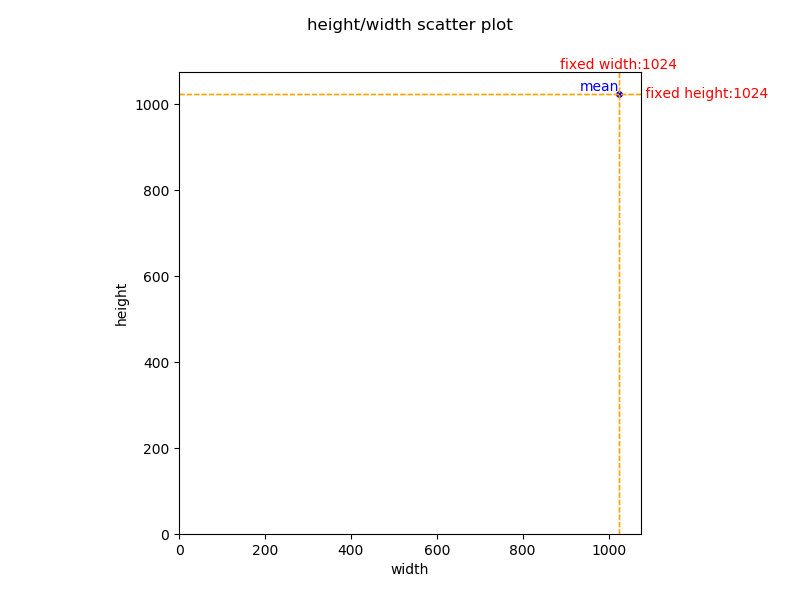
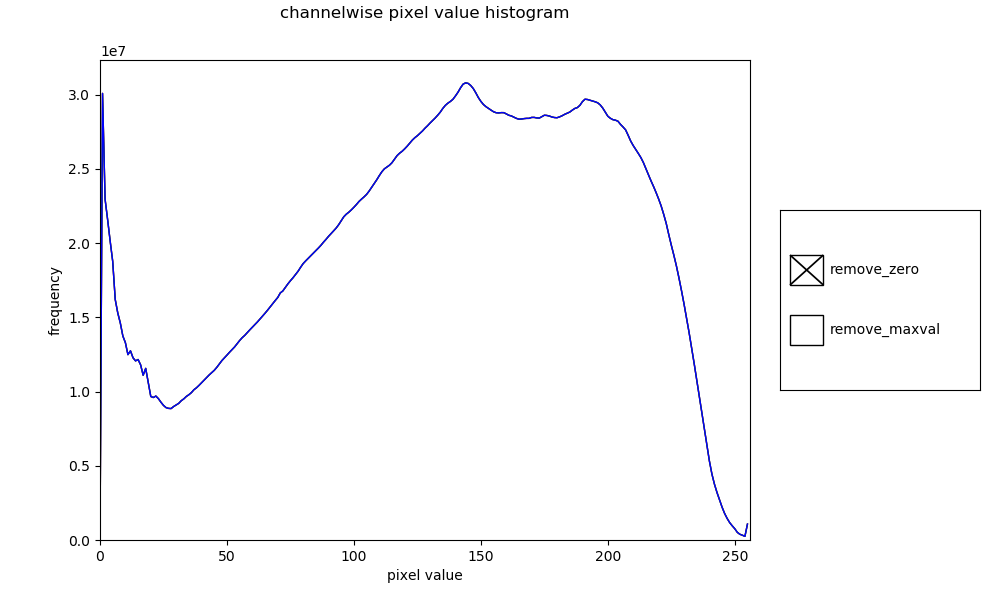
Results on NIH Chest X-ray dataset (images_001.tar.gz)
|
|
found 4999 images.
Using 12 threads. (max:12)

*--------------------------------------------------------------------------------------*
number of images                         |  4999

dtype                                    |  uint8
channels                                 |  [1, 4]
extensions                               |  ['png']

min height                               |  1024
max height                               |  1024
mean height                              |  1024.0
median height                            |  1024

min width                                |  1024
max width                                |  1024
mean width                               |  1024.0
median width                             |  1024

mean height/width ratio                  |  1.0
median height/width ratio                |  1.0
recommended input size(by mean)          |  [1024 1024] (h x w, multiples of 8)
recommended input size(by mean)          |  [1024 1024] (h x w, multiples of 16)
recommended input size(by mean)          |  [1024 1024] (h x w, multiples of 32)

channel mean(0~1)                        |  [0.5172472 0.5172472 0.5172472]
channel std(0~1)                         |  [0.25274998 0.25274998 0.25274998]
*--------------------------------------------------------------------------------------*
data provider: NIH Clinical Center
download site: https://nihcc.app.box.com/v/ChestXray-NIHCC
paper: Xiaosong Wang, Yifan Peng, Le Lu, Zhiyong Lu, Mohammadhadi Bagheri, Ronald Summers, ChestX-ray8:
Hospital-scale Chest X-ray Database and Benchmarks on Weakly-Supervised Classification and Localization of
Common Thorax Diseases, IEEE CVPR, pp. 3462-3471, 2017
License
1 maintainer

Metadata
1 maintainer
Release files for basic-image-eda 0.0.3
For a detailed explanation of source distributions (sdists) and built distributions (wheels), please see the package formats documentation.
Built distribution (wheel)
| File | Interpreter | ABI | Platform | Actions Reset |
|---|---|---|---|---|
| basic_image_eda-0.0.3-py3-none-any.whl | Python 3 | none | any | Details for basic_image_eda-0.0.3-py3-none-any.whl |
Release files / basic_image_eda-0.0.3-py3-none-any.whl
| Download URL | basic_image_eda-0.0.3-py3-none-any.whl |
|---|---|
| Size | 9.8 kB |
| Tags | Python 3 |
|
SHA-256 checksum How to use checksums |
c4a2500fbb967029b30df0767fbb7a85405650dc6f4dbf99a5914f77aaed8a6f
|
|
BLAKE2b-256 checksum How to use checksums |
a935183057a3723d4c0b9c0f1431af2ee4765b0b98d57ad5dd18205d3ba03bf1
|
| Upload date | |
|
Uploaded using Trusted Publishing? What is trusted publishing? |
No |
| Uploaded via |
twine/3.1.1 pkginfo/1.4.2 requests/2.21.0 setuptools/40.6.3 requests-toolbelt/0.9.1 tqdm/4.19.9 CPython/3.7.1
|
Security for basic-image-eda 0.0.3
Provenance
Provenance describes where a file came from. On PyPI, provenance is shared via attestations, which provide a verifiable record of the build or publishing details. View details, limitations and caveats.
No provenance found
None of the files in this release were uploaded with provenance metadata.
A note on package security
PyPI is a repository for distributing packages, not a service for auditing them. While third-party security researchers and our staff do their best to detect and remove malicious packages, PyPI cannot guarantee the quality, security or suitability of any given package.
To learn more about protecting yourself from malicious actors, visit our package security documentation.














