
BEM : beyond the exoplanet mass-radius relation with random forest
Predicting the radius of exoplanets based on its planetary and stellar parameters





Branca Edmée Marques
A portuguese scientist who worked on nuclear physics in France with Marie Curie
To install bem
pip install bem
or
git clone https://github.com/soleneulmer/bem.git
cd bem
python setup.py install
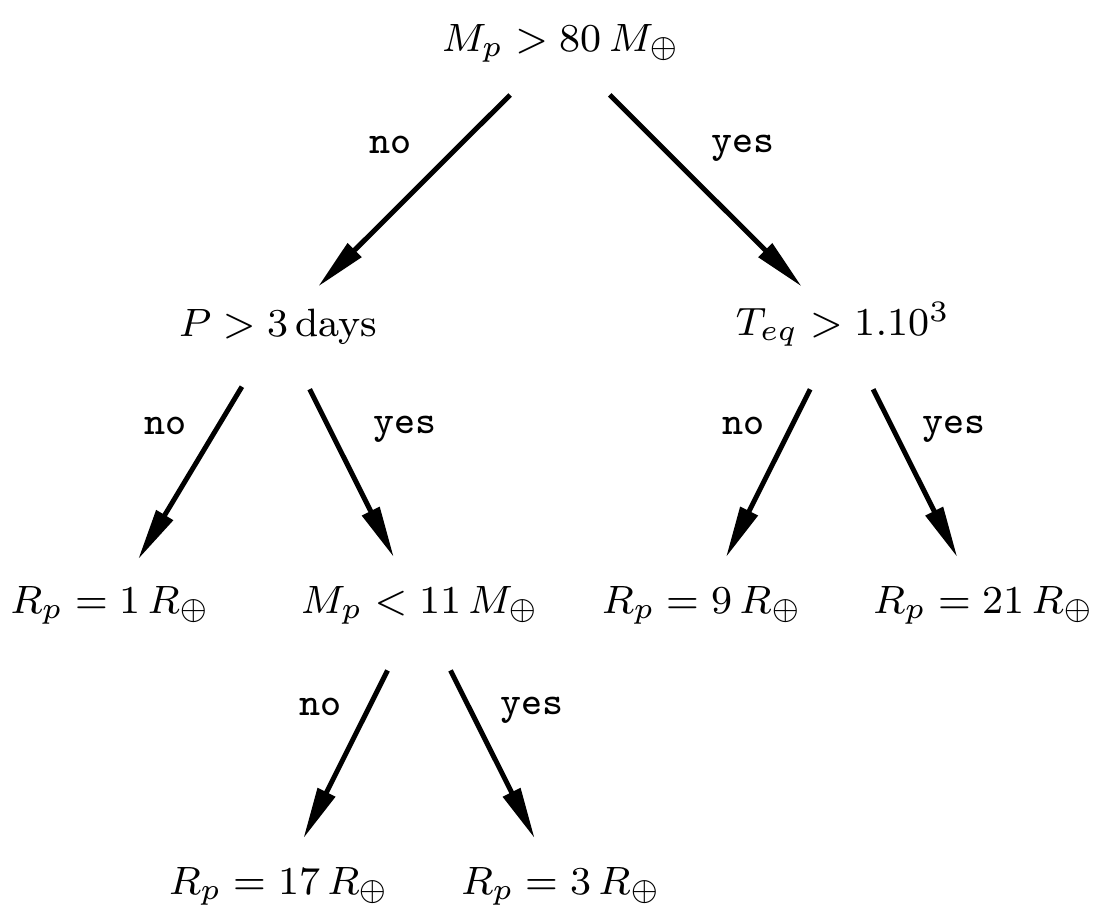
A simple decision tree
to predict exoplanet radius
How to run bem:
1. Load dataset and model
# Load exoplanet and solar system planets dataset
dataset = bem.load_dataset()
# Plot the dataset radius as a function of mass and equilibrium temperature
bem.plot_dataset(dataset)
# Build the random forest model and predict radius of the dataset
regr, y_test_predict, _, train_test_sets = bem.random_forest_regression(dataset)
2. Predict the radius of your planet
my_planet = [planetary_mass, semi major axis, eccentricity, stellar radius, stellar effective temperature, stellar mass]
or with error bars
my_planet = [planetary_mass, error, semi major axis, error eccentricity, error, stellar radius, error, stellar effective temperature, error, stellar mass, error]
# Predict a new radius
radius, my_pred_planet = bem.predict_radius(my_planet=np.array([[1.63,
								 0.034,
                                                 		 0.02,
                                                 		 0.337,
                                                 		 3505.0,
                                                 		 0.342]]),
                        		    my_name=np.array(['GJ 357 b']),
                            		    regr=regr,
                            		    jupiter_mass=False,
					    error_bar=False)
# If error_bar is True
# print('Radius: ', radius[0][0], '+-', radius[1])
3. Compute error bars for the radius predictions
# Load exoplanet and solar system planets dataset with uncertainties
dataset_errors = bem.load_dataset_errors()
# Compute the error bars for the test set planets
radii_test_output_error, _ = bem.computing_errorbars(regr,
                                                     dataset_errors,
                                                     train_test_sets)
# Plot the test set, true radius versus RF predicted radius
bem.plot_true_predicted(train_test_sets,
                        y_test_predict,
                        radii_test_output_error)
4. Radial velocity dataset
# Load the radial velocity dataset
dataset_rv = bem.load_dataset_RV()
# Predict the radius of the RV dataset
radii_RV_RF = regr.predict(dataset_rv)
# Plot the predictions of the RV dataset
bem.plot_dataset(dataset_rv, predicted_radii=radii_RV_RF, rv=True)
5. Diagnostic plots
# Plot the learning curve
bem.plot_learning_curve(regr, dataset)
# Plot the validation curves
bem.plot_validation_curves(regr, dataset, name='features')
bem.plot_validation_curves(regr, dataset, name='tree')
bem.plot_validation_curves(regr, dataset, name='depth')
6. LIME explanations
see their github
# Explain the RF predictions
# of the exoplanets from the test set
bem.plot_LIME_predictions(regr, dataset, train_test_sets)
# LIME explanation for your planet
# in this case GJ 357 b
bem.plot_LIME_predictions(regr, dataset, train_test_sets,
                          my_pred_planet=my_pred_planet,
                          my_true_radius=1.166)
1 maintainer

Metadata
1 maintainer
Release files for bem 1.0.0
For a detailed explanation of source distributions (sdists) and built distributions (wheels), please see the package formats documentation.
Source distribution (sdist)
| File | Size | Uploaded | Provenance | |
|---|---|---|---|---|
| bem-1.0.0.tar.gz | 743.9 kB | Without provenance | Details |
Release files / bem-1.0.0.tar.gz
| Download URL | bem-1.0.0.tar.gz |
|---|---|
| Size | 743.9 kB |
| Tags | Source |
|
SHA-256 checksum How to use checksums |
d0abed772e2ecde8b61f0dc34440d14a173f3384de9f9b3ced793d9380ae091a
|
|
BLAKE2b-256 checksum How to use checksums |
b741705e8f79cc54c62d37a2520f63fdc2ccc5944bd6da0c80d94b23f72e7628
|
| Upload date | |
|
Uploaded using Trusted Publishing? What is trusted publishing? |
No |
| Uploaded via |
twine/2.0.0 pkginfo/1.5.0.1 requests/2.22.0 setuptools/41.2.0 requests-toolbelt/0.9.1 tqdm/4.36.1 CPython/3.6.7
|
Security for bem 1.0.0
Provenance
Provenance describes where a file came from. On PyPI, provenance is shared via attestations, which provide a verifiable record of the build or publishing details. View details, limitations and caveats.
No provenance found
None of the files in this release were uploaded with provenance metadata.
A note on package security
PyPI is a repository for distributing packages, not a service for auditing them. While third-party security researchers and our staff do their best to detect and remove malicious packages, PyPI cannot guarantee the quality, security or suitability of any given package.
To learn more about protecting yourself from malicious actors, visit our package security documentation.














