
BenchNIRS

Benchmarking framework for machine learning with fNIRS
Quick links
→ Journal article
→ BenchNIRS source code
→ Install BenchNIRS
→ Documentation
→ Examples
→ Issue tracker



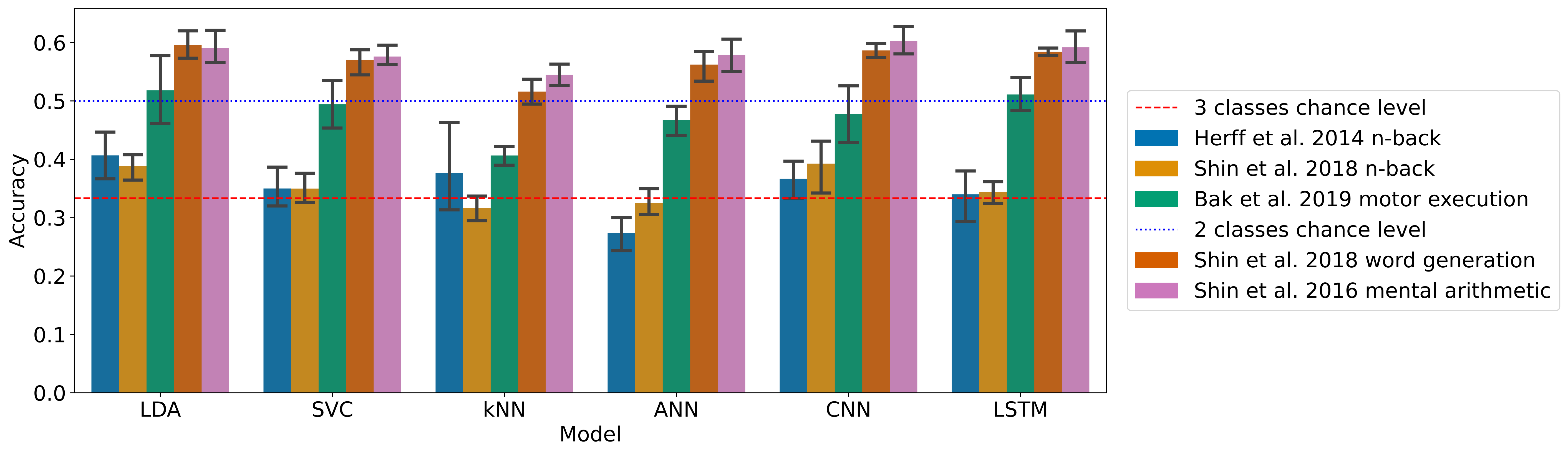
Features
- loading of open access datasets
- signal processing and feature extraction on fNIRS data
- training, hyperparameter tuning and evaluation of machine learning models (including deep learning)
- production of training graphs, metrics and other useful figures for evaluation
- benchmarking and comparison of machine learning models
- much more!
Documentation
The documentation of the framework with examples can be found here.
Recommendation checklist
A checklist of recommendations towards best practices for machine learning with fNIRS can be found here. We welcome contributions from the community in order to improve it, please see below for more information on how to contribute.
Setting up BenchNIRS
-
Download and install Python 3.9 or greater, for example with Miniconda.
-
To install the package with pip (cf. PyPI), open a terminal (eg. Anaconda Prompt) and type:
pip install benchnirs
- Download the datasets (see below).
Alternatively to install from source in development mode, download and unzip the repository (or clone it with Git), and run
devinstall.py.
Downloading datasets
- Herff et al. 2014 (n-back task): you can download the dataset by making a request here.
- Shin et al. 2018 (n-back and word generation tasks): you can download the dataset here.
- Shin et al. 2016 (mental arithmetic task): you can download the dataset by filling out the form here. Then click on NIRS_01-29 to download the fNIRS data.
- Bak et al. 2019 (motor execution task): you can download the dataset here.
Keeping BenchNIRS up to date
To update BenchNIRS to the latest version with pip, open a terminal (eg. Anaconda Prompt) and type:
pip install --upgrade benchnirs
Examples
A set of example scripts showing how to use the framework can be found here.
Simple use case
Define a model with PyTorch:
import torch.nn as nn
import torch.nn.functional as F


class MyModel(nn.Module):

    def __init__(self, n_classes):
        super().__init__()
        self.fc1 = nn.Linear(400, 250)
        self.fc2 = nn.Linear(250, 150)
        self.fc3 = nn.Linear(150, 60)
        self.fc4 = nn.Linear(60, n_classes)

    def forward(self, x):
        batch_size = x.size(0)
        x = x.view(batch_size, -1)  # flatten
        x = F.relu(self.fc1(x))
        x = F.relu(self.fc2(x))
        x = F.relu(self.fc3(x))
        x = self.fc4(x)
        return x
Evaluate the model on one of the datasets:
import benchnirs as bn

# Download dataset: https://figshare.com/ndownloader/files/18069143

# Load and process data:
epochs = bn.load_dataset('bak_2019_me', roi_sides=True, path='./bak_2019')
data = bn.process_epochs(epochs['right', 'left', 'foot'])

# Benchmark model:
results = bn.deep_learn(MyModel, *data)
print(results)
Contributing
Contributions to this repository are very welcome under the form of issues (for reporting bugs or requesting new features) and merge requests (for fixing bugs and implementing new features). Please refer to this tutorial for creating merge requests from a fork of the repository.
Contributors
Johann Benerradi • Jeremie Clos • Aleksandra Landowska • Michel F. Valstar • Max L. Wilson • Yujie Yao
Acknowledgements
If you are using BenchNIRS, please cite this article:
@article{benerradi2023benchmarking,
  title={Benchmarking framework for machine learning classification from fNIRS data},
  author={Benerradi, Johann and Clos, Jeremie and Landowska, Aleksandra and Valstar, Michel F and Wilson, Max L},
  journal={Frontiers in Neuroergonomics},
  volume={4},
  year={2023},
  publisher={Frontiers Media},
  url={https://www.frontiersin.org/articles/10.3389/fnrgo.2023.994969},
  doi={10.3389/fnrgo.2023.994969},
  issn={2673-6195}
}
If you are using the datasets of the framework, please also cite those related works:
1 maintainer

Release files for benchnirs 1.7.1
For a detailed explanation of source distributions (sdists) and built distributions (wheels), please see the package formats documentation.
Source distribution (sdist)
| File | Size | Uploaded | |
|---|---|---|---|
| benchnirs-1.7.1.tar.gz | 24.6 kB | Details |
Built distribution (wheel)
| File | Interpreter | ABI | Platform | Reset |
|---|---|---|---|---|
| benchnirs-1.7.1-py3-none-any.whl | Python 3 | none | any | Details |
Total release size: 48.7 kB
Release files / benchnirs-1.7.1.tar.gz
| Download URL | benchnirs-1.7.1.tar.gz |
|---|---|
| Size | 24.6 kB |
| Tags | Source |
|
SHA-256 checksum How to use checksums |
55c056c46a83b528bc65af8d7786ca5eb84820a4ba04c1fae4e9cede6c1b895d
|
|
BLAKE2b-256 checksum How to use checksums |
e42275616af6bc44e7533f05c36057313b40e42f0b0be7d3e7f4337f1aff70b9
|
| Upload date | |
|
Uploaded using Trusted Publishing? What is trusted publishing? |
No |
| Uploaded via |
twine/6.1.0 CPython/3.12.7
|
Release files / benchnirs-1.7.1-py3-none-any.whl
| Download URL | benchnirs-1.7.1-py3-none-any.whl |
|---|---|
| Size | 24.0 kB |
| Tags | Python 3 |
|
SHA-256 checksum How to use checksums |
47eb1dda609e3770e6d107d01dd8e402253d0f3cc4c9f9479ee726025df3dd1e
|
|
BLAKE2b-256 checksum How to use checksums |
d48f60b6bad5a441c5f8e69190e7e107f9c31b555a7430050b68a48395c62809
|
| Upload date | |
|
Uploaded using Trusted Publishing? What is trusted publishing? |
No |
| Uploaded via |
twine/6.1.0 CPython/3.12.7
|














