
Binary-doppler-beaming




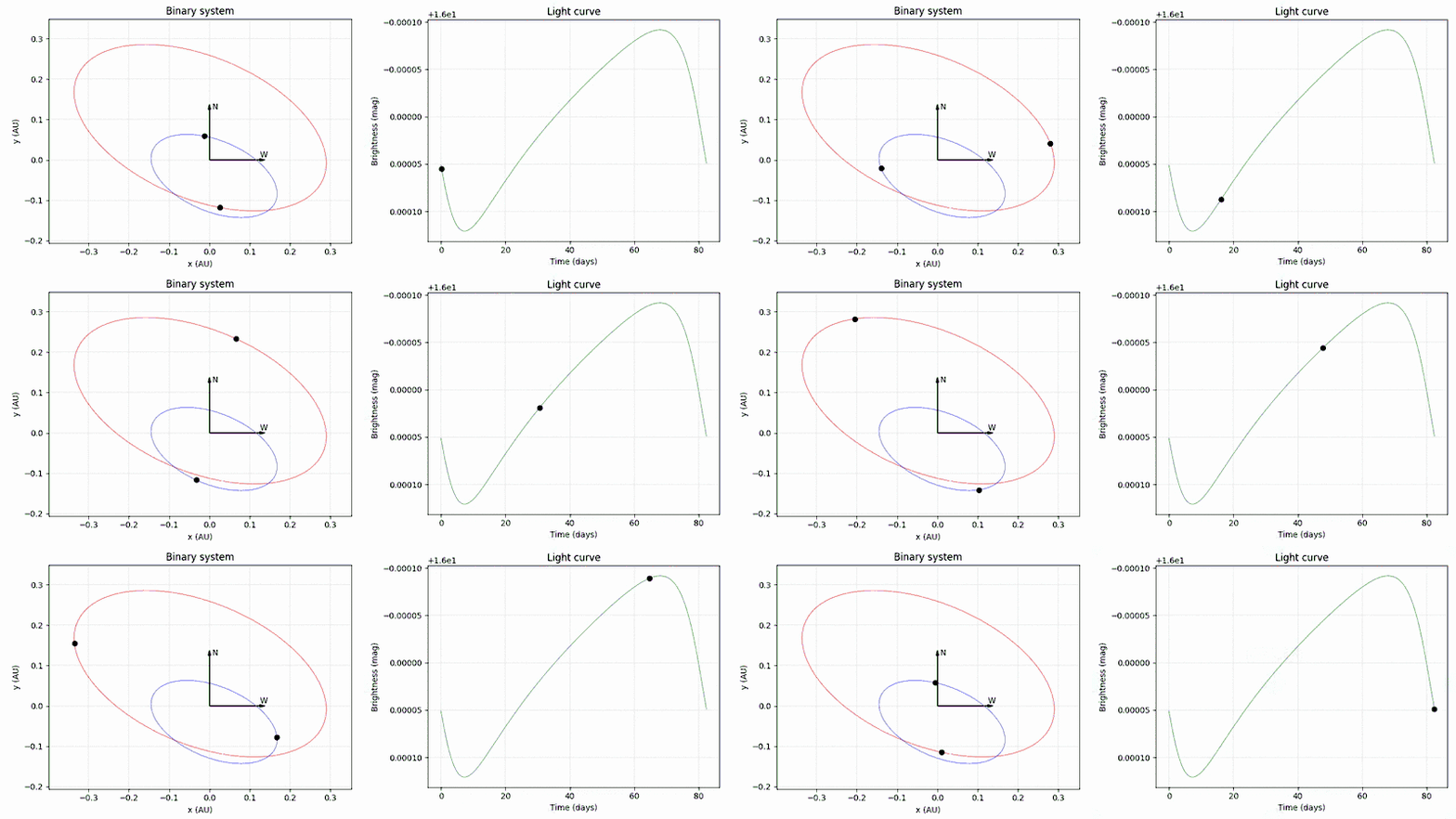
This software generates a light curve of a binary system which is caused by the photometric beaming. For more details see arXiv:0708.2100. You can set up any configuration of a binary system seen from Earth.
Installation
To install the package please type from the command line:
$ sudo pip3 install bidobe
or alternatively:
$ git clone https://github.com/pbrus/binary-doppler-beaming
$ cd binary-doppler-beaming
$ sudo python3 setup.py install
Usage
All you need are the doppler_beaming.py script and the binary.conf file. Edit the last one and configure your own binary system (see comments inside this file to find out which units are used):
[OBJECTS]
mass1 = 1
mass2 = 2
temperature1 = 6000
temperature2 = 8000
radius1 = 1.0
radius2 = 1.5
distance = 1000

[ORBITS]
sum_major_axis = 8e10
eccentricity = 0.4
longitude_node = 70.0
inclination = 60.0
periastron_argument = 110.0
...
Now you can run the doppler_beaming.py:
$ python3 doppler_beaming.py
The main module bidobe (binary doppler beaming) provides the interface to display, save to files and animate orbits, radial velocities and light curves. Moreover, it allows to convert SI units from and to astronomical units. For example:
orbit1_position = orbit1.convert_m_to_au(orbit1_position)
converts position in meters to position in AUs. The following commands:
plot_projected_orbits(orbit1_position, orbit2_position, "AU", "AU")
plot_projected_orbits(orbit1_position, orbit2_position, "AU", "AU", "orbits.eps")
animate_projected_orbits(orbit1_position, orbit2_position, "AU", "AU")
can be used to display orbits projected on the sky, save them to orbits.eps file and animate them on the screen, respectively.
I encourage to visit my website to see more detailed description of this project. The current link can be found on my GitHub profile.
License
Binary-doppler-beaming is licensed under the MIT license.
1 maintainer

Metadata
1 maintainer
Release files for bidobe 0.1.1
For a detailed explanation of source distributions (sdists) and built distributions (wheels), please see the package formats documentation.
Source distribution (sdist)
| File | Size | Uploaded | Provenance | Actions |
|---|---|---|---|---|
| bidobe-0.1.1.tar.gz | 9.6 kB | Without provenance | Details for bidobe-0.1.1.tar.gz |
Built distribution (wheel)
| File | Interpreter | ABI | Platform | Actions Reset |
|---|---|---|---|---|
| bidobe-0.1.1-py3-none-any.whl | Python 3 | none | any | Details for bidobe-0.1.1-py3-none-any.whl |
Total release size: 19.0 kB
Release files / bidobe-0.1.1.tar.gz
| Download URL | bidobe-0.1.1.tar.gz |
|---|---|
| Size | 9.6 kB |
| Tags | Source |
|
SHA-256 checksum How to use checksums |
ebdc29d1ccd7a9e8693e21bb696a364c09d204b9ba7daf95618a35a557450a8b
|
|
BLAKE2b-256 checksum How to use checksums |
626935ac390b52dc30fca47a21c9cdd2f00f328a85b25f1ab16c791eaf3906c5
|
| Upload date | |
|
Uploaded using Trusted Publishing? What is trusted publishing? |
No |
| Uploaded via |
twine/1.11.0 pkginfo/1.4.2 requests/2.18.4 setuptools/40.0.0 requests-toolbelt/0.8.0 tqdm/4.23.4 CPython/3.6.5
|
Release files / bidobe-0.1.1-py3-none-any.whl
| Download URL | bidobe-0.1.1-py3-none-any.whl |
|---|---|
| Size | 9.4 kB |
| Tags | Python 3 |
|
SHA-256 checksum How to use checksums |
b9069b2c473e5bff21cbe40add72c7d288cd38e13ca6c05b3c69d951f39a2b82
|
|
BLAKE2b-256 checksum How to use checksums |
6be7be90c0982b9a3c565f53710f8d18268fa3deccc388b2488af85d73aa35fa
|
| Upload date | |
|
Uploaded using Trusted Publishing? What is trusted publishing? |
No |
| Uploaded via |
twine/1.11.0 pkginfo/1.4.2 requests/2.18.4 setuptools/40.0.0 requests-toolbelt/0.8.0 tqdm/4.23.4 CPython/3.6.5
|
Security for bidobe 0.1.1
Provenance
Provenance describes where a file came from. On PyPI, provenance is shared via attestations, which provide a verifiable record of the build or publishing details. View details, limitations and caveats.
No provenance found
None of the files in this release were uploaded with provenance metadata.
A note on package security
PyPI is a repository for distributing packages, not a service for auditing them. While third-party security researchers and our staff do their best to detect and remove malicious packages, PyPI cannot guarantee the quality, security or suitability of any given package.
To learn more about protecting yourself from malicious actors, visit our package security documentation.














