
This project has been archived by its maintainers, and is no longer receiving any updates.



GitHub | PyPI | Issues | Changelog
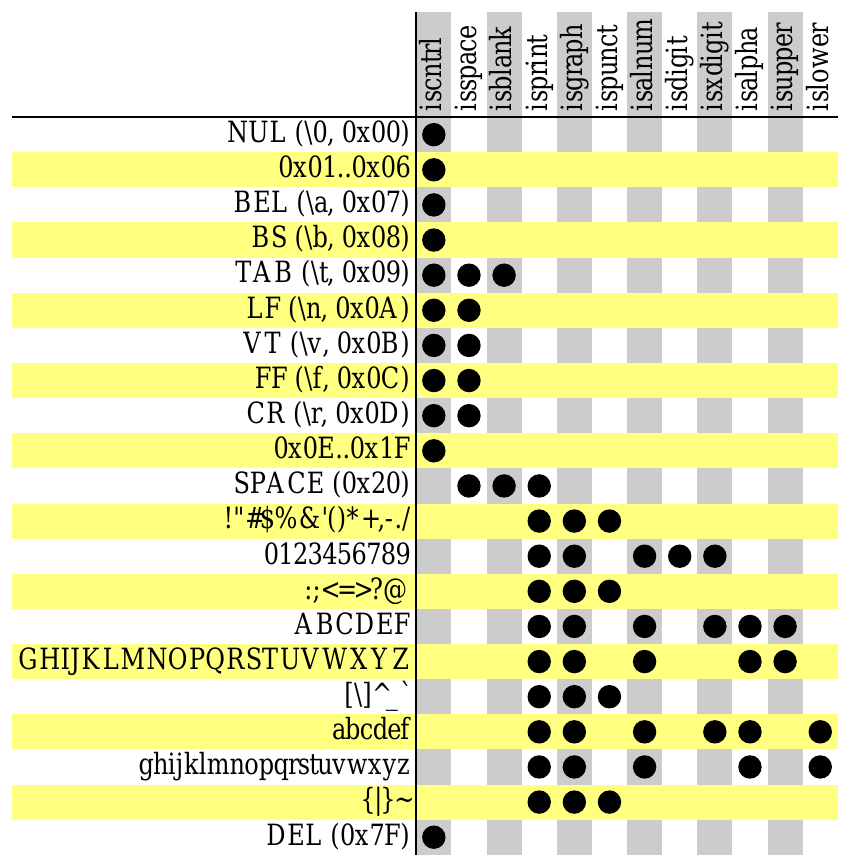
binheat converts a description of a binary relation into a PDF image of the relation as a binary heat map (a.k.a. matrix display, adjacency matrix, comparison chart, and probably a bunch of other names as well; see below for an example).
Each line of the input (except for blank lines and comments, which are ignored) must be of the form x<TAB>y<TAB>z..., denoting pairs (x, y), (x, z), etc. in the binary relation.
In the output table, the values from the first column of each input line become the labels of the table’s rows, and the values from the second input column onwards become the labels of the table’s columns. This can be reversed with the --transpose option.
Installation
binheat requires Python 3.7 or higher. Just use pip for Python 3 (You have pip, right?) to install binheat and its dependencies:
python3 -m pip install binheat
Usage
binheat [<OPTIONS>] [<infile> [<outfile>]]
Input is read from <infile> (defaulting to standard input), and the resulting PDF is written to <outfile> (defaulting to <infile> with its file extension changed to .pdf, or to standard output if <infile> is standard input).
Options
- -C FILE, --column-labels FILE
Use the lines in FILE (after discarding blank lines & comments) in the order they appear as column labels (or row labels if --transpose is in effect). Any pairs in the input whose second column does not appear in FILE are discarded.
- -F FONT, --font FONT
Typeset text in the given font. FONT must be either the name of a builtin PostScript font or the path to a .ttf file. By default, text is typeset in Times-Roman.
- -f SIZE, --font-size SIZE
Set the text size to SIZE (default 12).
- -R FILE, --row-labels FILE
Use the lines in FILE (after discarding blank lines & comments) in the order they appear as row labels (or column labels if --transpose is in effect). Any pairs in the input whose first column does not appear in FILE are discarded.
- --sort, --no-sort
Whether to list labels in the output in lexical order rather than in the order in which they appear in the input file; default: --no-sort
- -T, --transpose
The output will be transposed — i.e., the first column of the input will be used for the output table’s column labels, and the second input column onwards will be used for the table’s row labels.
Example
The following input file:
NUL (\0, 0x00)<TAB>iscntrl
0x01..0x06<TAB>iscntrl
BEL (\a, 0x07)<TAB>iscntrl
BS (\b, 0x08)<TAB>iscntrl
TAB (\t, 0x09)<TAB>iscntrl<TAB>isspace<TAB>isblank
LF (\n, 0x0A)<TAB>iscntrl<TAB>isspace
VT (\v, 0x0B)<TAB>iscntrl<TAB>isspace
FF (\f, 0x0C)<TAB>iscntrl<TAB>isspace
CR (\r, 0x0D)<TAB>iscntrl<TAB>isspace
0x0E..0x1F<TAB>iscntrl
SPACE (0x20)<TAB>isprint<TAB>isspace<TAB>isblank
!"#$%&'()*+,-./<TAB>isprint<TAB>isgraph<TAB>ispunct
0123456789<TAB>isprint<TAB>isgraph<TAB>isalnum<TAB>isdigit<TAB>isxdigit
:;<=>?@<TAB>isprint<TAB>isgraph<TAB>ispunct
ABCDEF<TAB>isprint<TAB>isgraph<TAB>isalnum<TAB>isalpha<TAB>isupper<TAB>isxdigit
GHIJKLMNOPQRSTUVWXYZ<TAB>isprint<TAB>isgraph<TAB>isalnum<TAB>isalpha<TAB>isupper
[\]^_`<TAB>isprint<TAB>isgraph<TAB>ispunct
abcdef<TAB>isprint<TAB>isgraph<TAB>isalnum<TAB>isalpha<TAB>islower<TAB>isxdigit
ghijklmnopqrstuvwxyz<TAB>isprint<TAB>isgraph<TAB>isalnum<TAB>isalpha<TAB>islower
{|}~<TAB>isprint<TAB>isgraph<TAB>ispunct
DEL (0x7F)<TAB>iscntrl
produces (using the default options) an output file that looks like this:
1 maintainer

Metadata
1 maintainer
Release files for binheat 0.2.2
For a detailed explanation of source distributions (sdists) and built distributions (wheels), please see the package formats documentation.
Source distribution (sdist)
| File | Size | Uploaded | Provenance | Actions |
|---|---|---|---|---|
| binheat-0.2.2.tar.gz | 131.1 kB | Without provenance | Details for binheat-0.2.2.tar.gz |
Built distribution (wheel)
| File | Interpreter | ABI | Platform | Actions Reset |
|---|---|---|---|---|
| binheat-0.2.2-py3-none-any.whl | Python 3 | none | any | Details for binheat-0.2.2-py3-none-any.whl |
Total release size: 138.8 kB
Release files / binheat-0.2.2.tar.gz
| Download URL | binheat-0.2.2.tar.gz |
|---|---|
| Size | 131.1 kB |
| Tags | Source |
|
SHA-256 checksum How to use checksums |
7020bb94871945ec831ce0a242c3c9de11d34d1c0339b95f2efc3f57df40385f
|
|
BLAKE2b-256 checksum How to use checksums |
4ec723e428e446883ecc912df967c99336bf9040391c5413a24ec909baa334bc
|
| Upload date | |
|
Uploaded using Trusted Publishing? What is trusted publishing? |
No |
| Uploaded via |
twine/4.0.2 CPython/3.11.6
|
Release files / binheat-0.2.2-py3-none-any.whl
| Download URL | binheat-0.2.2-py3-none-any.whl |
|---|---|
| Size | 7.7 kB |
| Tags | Python 3 |
|
SHA-256 checksum How to use checksums |
e4d375b409b1cb784cff786f9b7180928d473496cf018cba1803fa7f5ebdf46c
|
|
BLAKE2b-256 checksum How to use checksums |
a37065305d7cf8408a82acacdee9b6cc8cc494acc031acfa5f3c0b9361f671f1
|
| Upload date | |
|
Uploaded using Trusted Publishing? What is trusted publishing? |
No |
| Uploaded via |
twine/4.0.2 CPython/3.11.6
|
Security for binheat 0.2.2
Provenance
Provenance describes where a file came from. On PyPI, provenance is shared via attestations, which provide a verifiable record of the build or publishing details. View details, limitations and caveats.
No provenance found
None of the files in this release were uploaded with provenance metadata.
A note on package security
PyPI is a repository for distributing packages, not a service for auditing them. While third-party security researchers and our staff do their best to detect and remove malicious packages, PyPI cannot guarantee the quality, security or suitability of any given package.
To learn more about protecting yourself from malicious actors, visit our package security documentation.














