
Time series harmonic analysis for adaptive tuning systems and microtonal exploration

Project description

Biotuner
Python toolbox that incorporates tools from biological signal processing and musical theory to extract harmonic structures from biosignals.





✨ Features
- 🎵 Harmonic Analysis: Extract harmonic structures from biosignals using music theory principles
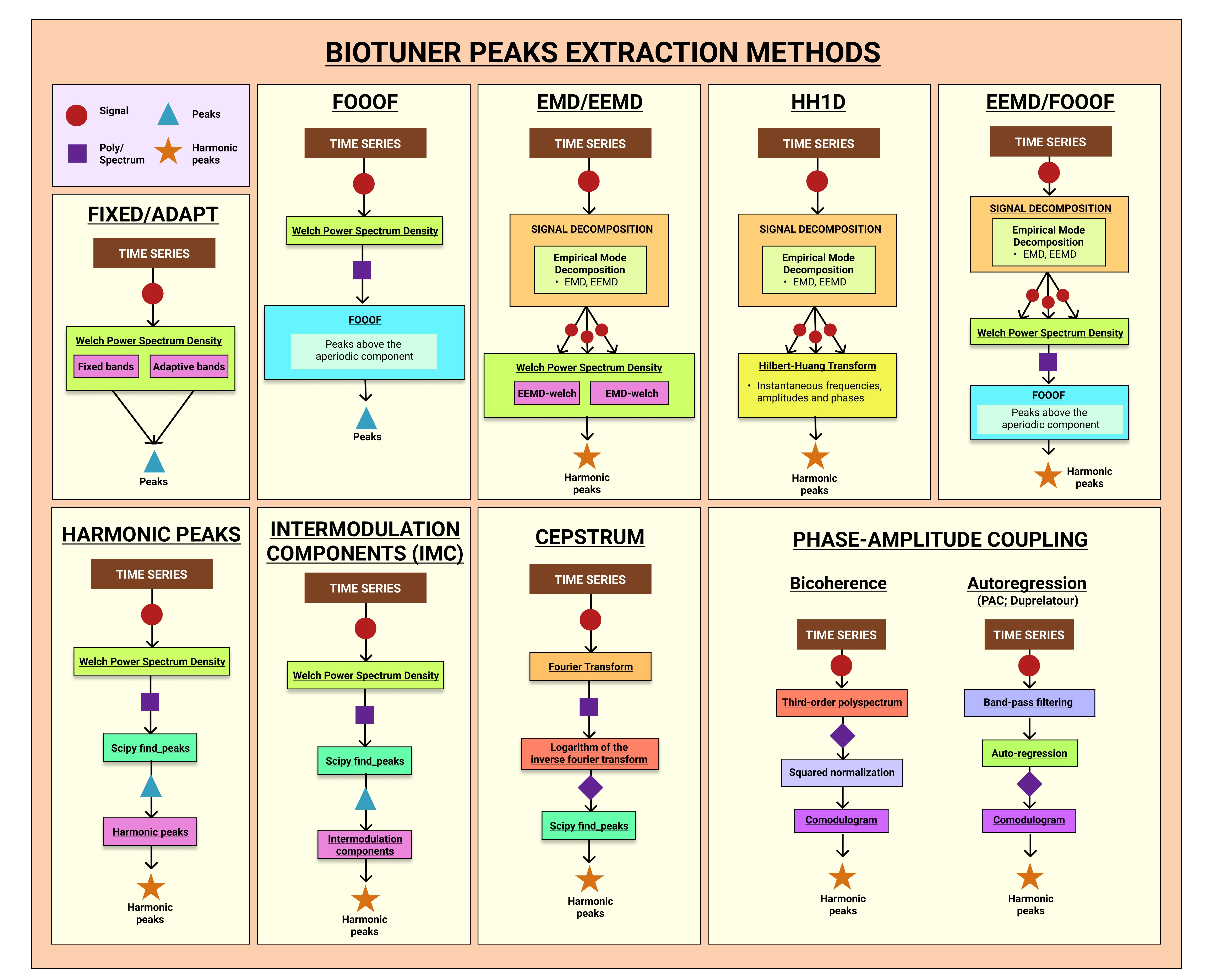
- 📊 Multiple Peak Detection Methods: FOOOF, EMD, fixed-frequency, and harmonic-recurrence based methods
- 🧮 Harmonicity Metrics: Compute consonance, dissonance, harmonic similarity, Tenney height, and more
- 🎹 Musical Applications: Generate musical scales, tuning systems, and MIDI output from biosignals
- 🔬 Group Analysis (BETA): Batch processing for multiple time series with automatic aggregation
- 🔷 Harmonic Geometry (BETA): Lift any chord / spectrum into 2-D & 3-D geometric structures — Lissajous curves, Chladni acoustic plates, Stern-Brocot trees, IFS attractors, torus knots, harmonic point clouds — with a per-method metrics layer for quantitative analysis
- 📈 Rich Visualizations: Publication-ready plots for spectral analysis and harmonic relationships
- 🧠 Multi-modal Support: Compatible with EEG, ECG, EMG, plant signals, and other biosignals
- 🎨 Interactive GUI: Graphical interface for easy exploration
Installation
1. Install using PyPI (Recommended)
To install the latest stable version of Biotuner from PyPI, run:
pip install biotuner
2. Install from the GitHub Repository (Development Version)
If you want the latest development version or contribute to the code, follow these steps:
2.1. Automatically Setup the Environment (Recommended)
The easiest way to set up a development environment is by using invoke, which will:
✅ Create a Conda environment
✅ Install dependencies
✅ Install Biotuner in editable mode
# Clone the repository
git clone https://github.com/AntoineBellemare/biotuner.git
cd biotuner

# Install Invoke (if not already installed)
pip install invoke

# Automatically create a Conda environment and install Biotuner
invoke setup
👉 This will create a Conda environment named biotuner_env and install all dependencies.
To activate the Conda environment manually:
conda activate biotuner_env
2.2. Manual Setup (Alternative)
If you prefer to set up the environment manually, follow these steps:
1️⃣ Create a Conda environment
conda create --name biotuner_env python=3.11 -y
conda activate biotuner_env
2️⃣ Install dependencies
pip install -r requirements.txt
pip install -e .
3. Verify Installation by Running Tests
To confirm that Biotuner is installed correctly, run the test suite:
invoke test
or manually using:
pytest tests/
If all tests pass ✅, your installation is complete!
🎯 Summary
- For general users: Install via
pip install biotuner - For development: Clone the repo and run
invoke setup - To verify installation: Run
invoke test
Simple use case
Single Time Series Analysis
from biotuner import compute_biotuner

# Initialize the object
biotuning = compute_biotuner(sf=1000)

# Extract spectral peaks
biotuning.peaks_extraction(data, peaks_function='FOOOF')

# Get consonance metrics for spectral peaks
biotuning.compute_peaks_metrics()
Group Analysis (🧪 BETA)
Analyze multiple time series simultaneously with automatic aggregation and group comparisons:
from biotuner import BiotunerGroup
import numpy as np

# Multiple trials or electrodes: shape (n_series, n_samples)
data = np.random.randn(10, 5000)

# Create group object
btg = BiotunerGroup(data, sf=1000, axis_labels=['trials'])

# Run analysis pipeline
btg.compute_peaks(peaks_function='FOOOF', min_freq=1, max_freq=50)
btg.compute_metrics(n_harm=10)

# Get summary statistics
summary = btg.summary()
Note: The BiotunerGroup module is currently in beta. The API may change in future releases.
🔷 Harmonic Geometry (🧪 BETA)
biotuner.harmonic_geometry lifts any harmonic content (a chord, a spectral
peak set, an EEG window) into structured 2-D and 3-D geometry, plus a
per-method metrics layer for quantitative analysis. Useful for
visual exploration, scientific comparison across chords / signals, and
animation of time-resolved harmonic transitions.
What's inside (each generator emits a typed GeometryData):
| Family | Generators |
|---|---|
| 2-D curves | lissajous_2d / 3d / compound / phase_drift / pairwise_grid, lissajous_topology |
| Damped trajectories | harmonograph_lateral / rotary / 3d, harmonograph_from_peaks |
| Polygons & circular | star_polygon, times_table_circle, times_table_from_input, tuning_circle, rose_curve, epicycloid, hypocycloid, interval_vector_diagram, polygon_chord_pattern, consonance_polygon |
| Acoustic plates | chladni_field_rectangular / circular / polygon / 3d_box, chladni_from_input, chladni_nodal_lines / surfaces |
| Fractal & number-theoretic | stern_brocot_tree, continued_fraction_rectangles, farey_sequence_layout (circle / line / ford), subharmonic_tree (depth + polar layouts), ifs_harmonic |
| Generative | lsystem_from_ratios, recursive_polygon, self_similar_tuning, geometry_sequence |
| 3-D geometry | lissajous_tube, harmonic_knot (T(p,q) from chord ratios), harmonic_surface, lsystem_3d, recursive_polyhedron (per-face bump + apex twist), harmonic_point_cloud (5 surfaces incl. Klein, hyperbolic, MOS) |
from biotuner.harmonic_geometry import (
    HarmonicInput, harmonic_knot, geometry_metrics, plotting,
)

# Bridge from biotuner peaks into the geometry layer
inp = HarmonicInput(ratios=[1, 5/4, 3/2, 7/4])     # Dom7 chord
g   = harmonic_knot(inp)                            # T(p, q) torus knot
print(geometry_metrics(g))                          # winding_p, winding_q, n_vertices, …
plotting.plot_geometry(g)
Metrics monitoring: every generator sets metadata['kind']; geometry_metrics(g) dispatches to one of 37 per-method extractors that yield method-specific scalars on top of the generic structural stats. Trajectories over HarmonicSequence (e.g. windowed biotuner output) come via sequence_metrics(seq, generator, **kw), with radar / line-plot helpers in plotting. Append-only MetricsLog exports CSV / JSON for downstream stats.
from biotuner.harmonic_geometry import MetricsLog
log = MetricsLog()
for chord_name, ratios in chord_table.items():
    log.log_geometry(harmonic_knot(HarmonicInput(ratios=ratios)),
                     label=chord_name)
log.to_csv("knot_metrics.csv")
Note: The harmonic_geometry module is currently in beta. The API surface (37 generators) is stable but optional dependencies (
scikit-imagefor nodal extraction;Pillowfor image embedding) are not yet declared as a[project.optional-dependencies]group.
🌐 Biotuner Engine - Web Interface
Explore Biotuner's capabilities through our interactive web interface:
biotuner-engine.kairos-hive.org
The Biotuner Engine provides a user-friendly web application to analyze biosignals, visualize harmonic structures, and explore musical applications directly in your browser—no installation required!
Multimodal Harmonic Analysis
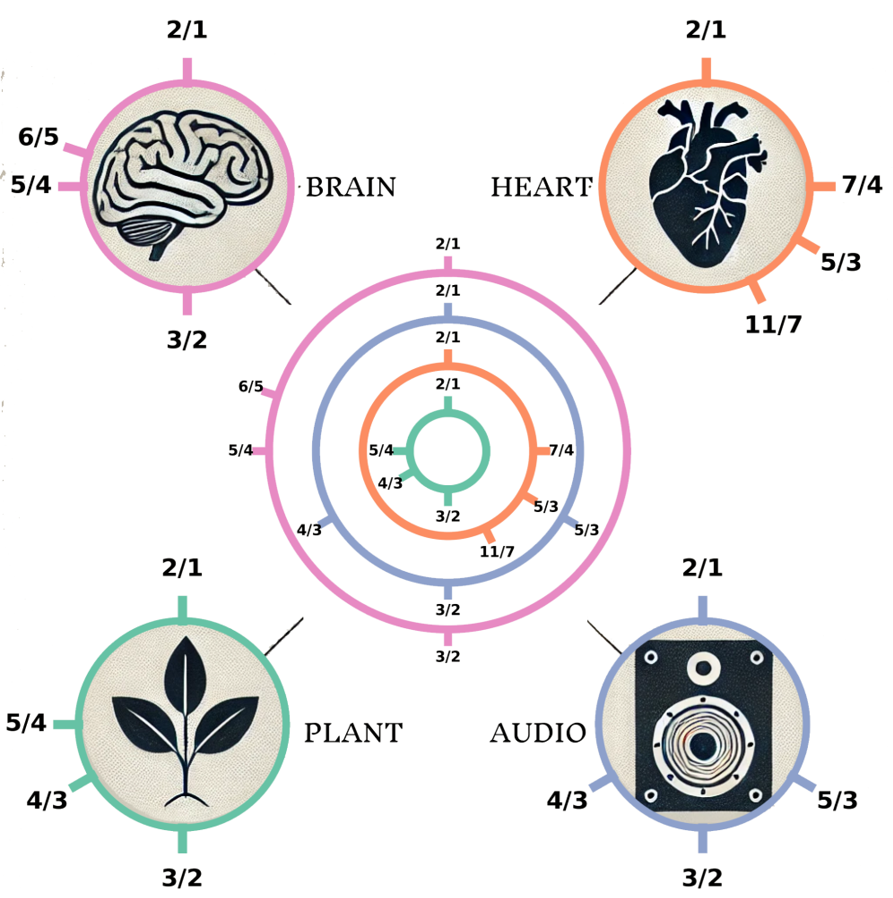
The figure above illustrates Biotuner's ability to extract harmonic structures across different biological and physical systems. It showcases harmonic ratios detected in biosignals from the brain, heart, and plants, as well as their correspondence with audio signals. By analyzing the fundamental frequency relationships in these diverse modalities, Biotuner enables a cross-domain exploration of resonance and tuning in biological and artificial systems.
Peaks extraction methods
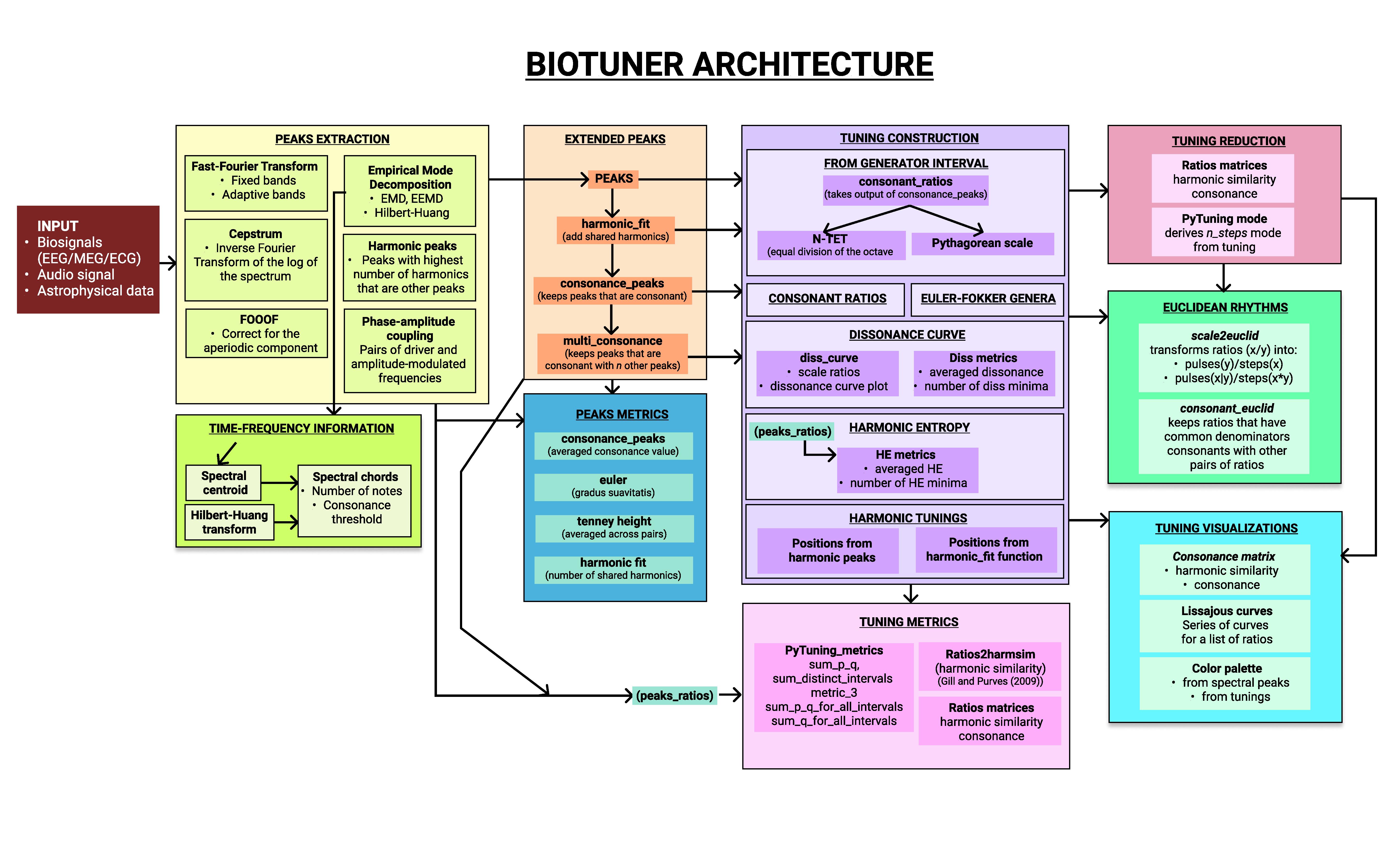
🧭 Package Architecture
The biotuner package is organized by kind — stateful pipeline classes first, then subpackages, then pure-function modules, then reference data. Each module declares its kind in its docstring header (Module type: Functions / Object / Objects / Data / Subpackage), so the same information is also visible from the source.
Objects (stateful pipeline classes)
| Module | What it does |
|---|---|
biotuner_object |
compute_biotuner — the main pipeline class: peaks, ratios, scales, metrics, PAC, IMFs, FOOOF, rhythm |
biotuner_group |
BiotunerGroup — multi-trial / multi-channel runs with aggregation |
harmonic_connectivity |
PAC, CFC, intermodulation pipeline across channels / bands |
transitional_harmony |
Time-resolved harmonic-state transitions across signal chunks |
harmonic_sequence |
Markov / DMD / topology / grammar / Wasserstein / latent-space models of harmonic evolution |
Subpackages
| Module | What it does |
|---|---|
harmonic_geometry/ |
Lissajous, Chladni, harmonograph, polygon/circular, fractal, 3D point clouds & surfaces — each as a submodule |
Functions
| Module | What it does |
|---|---|
peaks_extraction |
Welch / FOOOF / EMD / Hilbert-Huang / cepstrum, plus PAC frequencies, polycoherence, intermodulation |
peaks_extension |
Extend a peak set with harmonics / consonant fits |
scale_construction |
Sethares dissonance curve, harmonic entropy, Euler-Fokker, harmonic tunings |
rhythm_construction |
Euclidean / discrete & continuous polyrhythms / second-order / evolution / MIDI / OSC |
metrics |
Tenney height, Euler gradus, dyad similarity, harmonic similarity, subharmonic tension |
harmonic_spectrum |
Harmonicity / resonance / phase fields from PSDs |
biocolors |
Map biosignal frequencies to visible-light wavelengths and RGB |
bioelements |
Match biosignal peaks to atomic spectral lines (H, O, N, …) |
biotuner_mne |
MNE-Python integration entry point |
stats |
Group-level tests on biotuner metrics |
surrogates |
Surrogate-data generation and comparison |
vizs |
Dissonance curves, sidebands, scales, demos |
plot_utils |
Unified plotting helpers (consistent styling across analyses) |
plot_config |
Color schemes and styles for biotuner plots |
harmonic_sequence_viz |
Plots for harmonic_sequence outputs |
biotuner_utils |
Signal generation, .scl writer, MIDI helpers, ratio math |
Data
| Module | What it does |
|---|---|
dictionaries |
Rhythm pattern names, interval names |
Reading the table:
- Object / Objects — module's primary API is one or more classes; instantiate, then call methods.
- Subpackage — folder with its own submodules; see its
__init__.pyfor the public surface. - Functions — module is a flat collection of pure functions; import what you need.
- Data — module exposes data tables (dicts, constants); import and read.
The kind tag also lives at the top of every module file:
"""biotuner.peaks_extraction — extract spectral peaks from biosignals.

Module type: Functions
...
"""
so help(biotuner.peaks_extraction) and IDE tooltips surface the same information.
📚 Documentation & Resources
- Full Documentation - Complete API reference and tutorials
- Getting Started Guide - Step-by-step introduction
- API Reference - Detailed function and class documentation
- BiotunerObject - Single time series analysis
- BiotunerGroup (BETA) - Group analysis
- Harmonic Geometry (BETA) - 2-D & 3-D geometric structures + metrics layer (sphinx page coming soon)
- Metrics - Harmonicity metrics
- Peak Extraction - Peak detection methods
- Examples & Notebooks - Jupyter notebook tutorials
🤝 Contributing
We welcome contributions! Whether it's:
- 🐛 Bug reports
- 💡 Feature requests
- 📝 Documentation improvements
- 🔧 Code contributions
Please feel free to open an issue or submit a pull request on GitHub.
📄 License
Biotuner is licensed under the MIT License.
📖 Citation
If you use Biotuner in your research, please cite our work. See the citation guide for more information.
💬 Support
- Issues: GitHub Issues
- Email: antoine.bellemare9@gmail.com
- Documentation: https://antoinebellemare.github.io/biotuner/
Made with ❤️ by the Biotuner development team
Release history Release notifications | RSS feed


Download files
Download the file for your platform. If you're not sure which to choose, learn more about installing packages.
Source Distribution
Built Distribution
Filter files by name, interpreter, ABI, and platform.
If you're not sure about the file name format, learn more about wheel file names.
Copy a direct link to the current filters
File details
Details for the file biotuner-0.3.1.tar.gz.
File metadata
- Download URL: biotuner-0.3.1.tar.gz
- Upload date:
- Size: 302.7 kB
- Tags: Source
- Uploaded using Trusted Publishing? No
- Uploaded via: twine/6.2.0 CPython/3.9.25
File hashes
| Algorithm | Hash digest | |
|---|---|---|
| SHA256 |
9d74dbbf188321551620c58d432ca962effaa9773cfab057b3a51f0144f01064
|
|
| MD5 |
060d3f9f04cf1371a23ce9f88288a5a1
|
|
| BLAKE2b-256 |
b510e16504f8b0758a329723ee8b20336dfdd25828fe4d411c38ed6a1fbcf580
|
File details
Details for the file biotuner-0.3.1-py3-none-any.whl.
File metadata
- Download URL: biotuner-0.3.1-py3-none-any.whl
- Upload date:
- Size: 275.9 kB
- Tags: Python 3
- Uploaded using Trusted Publishing? No
- Uploaded via: twine/6.2.0 CPython/3.9.25
File hashes
| Algorithm | Hash digest | |
|---|---|---|
| SHA256 |
97c5915be18e978e9dce654f0339d88e3d40e8f4aeb3ff4a7ca35036f4f91092
|
|
| MD5 |
8c158e21b9975df839ae3158b30d831d
|
|
| BLAKE2b-256 |
11b1b1ac7e803c8ce381c6c249bb35d892610b8f42370bf490ee71eaedb06343
|






