
The example may be launched interactively via any of the following:

BrainWeb-based multimodal models of 20 normal brains
This project was initially inspired by "BrainWeb: 20 Anatomical Models of 20 Normal Brains"
However there are a number of generally useful tools, image processing &
display functions included in this project. For example, this includes
volshow() for interactive comparison of multiple 3D volumes,
get_file() for caching data URLs, and register() for image
coregistration.





Download and Preprocessing for PET-MR Simulations
This notebook will not re-download/re-process files if they already exist.
- Output data
~/.brainweb/subject_*.npz: dtype(shape):float32(127, 344, 344)
- Raw data source
~/.brainweb/subject_*.bin.gz: dtype(shape):uint16(362, 434, 362)
- Install
pip install brainweb
%matplotlib notebook
import brainweb
from brainweb import volshow
import numpy as np
from os import path
from tqdm.auto import tqdm
import logging
logging.basicConfig(level=logging.INFO)
Raw Data
# download
files = brainweb.get_files()

# read last file
data = brainweb.load_file(files[-1])

# show last subject
print(files[-1])
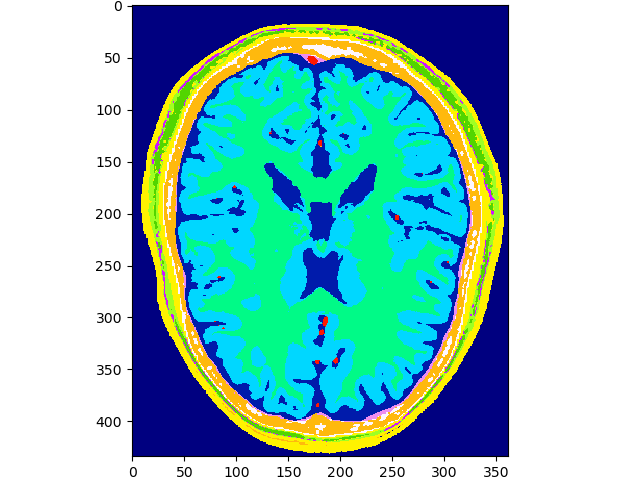
volshow(data, cmaps=['gist_ncar']);
~/.brainweb/subject_54.bin.gz
Transform
Convert raw image data:
- Siemens Biograph mMR resolution (~2mm) & dimensions (127, 344, 344)
- PET/T1/T2/uMap intensities
- PET defaults to FDG intensity ratios; could use e.g. Amyloid instead
- randomised structure for PET/T1/T2
- $t (1 + g [2 G_sigma(r) - 1])$, where
- r =
rand(127, 344, 344)$\in [0, 1)$, - Gaussian smoothing sigma = 1,
- g = 1 for PET; 0.75 for MR, and
- t = the PET or MR piecewise constant phantom
- r =
- $t (1 + g [2 G_sigma(r) - 1])$, where
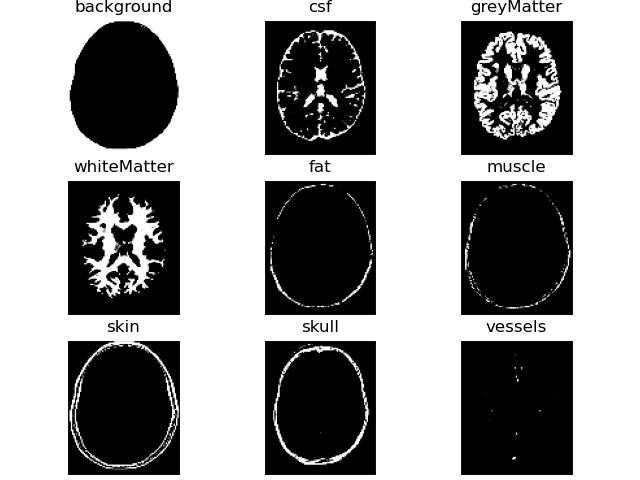
# show region probability masks
PetClass = brainweb.FDG
label_probs = brainweb.get_label_probabilities(files[-1], labels=PetClass.all_labels)
volshow(label_probs[brainweb.trim_zeros_ROI(label_probs)], titles=PetClass.all_labels, frameon=False);
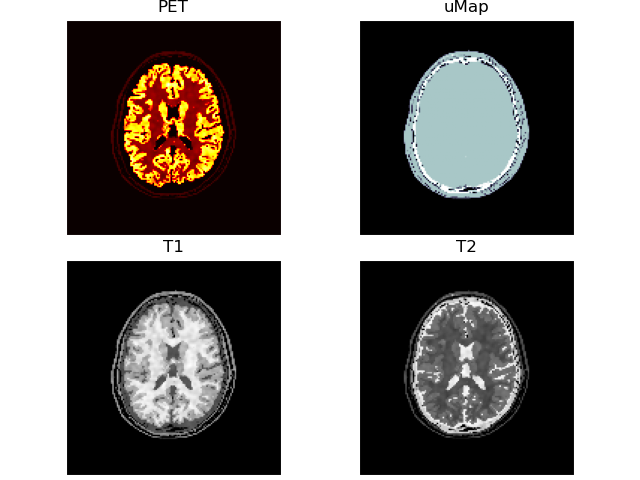
brainweb.seed(1337)

for f in tqdm(files, desc="mMR ground truths", unit="subject"):
    vol = brainweb.get_mmr_fromfile(
        f,
        petNoise=1, t1Noise=0.75, t2Noise=0.75,
        petSigma=1, t1Sigma=1, t2Sigma=1,
        PetClass=PetClass)
# show last subject
print(f)
volshow([vol['PET' ][:, 100:-100, 100:-100],
         vol['uMap'][:, 100:-100, 100:-100],
         vol['T1'  ][:, 100:-100, 100:-100],
         vol['T2'  ][:, 100:-100, 100:-100]],
        cmaps=['hot', 'bone', 'Greys_r', 'Greys_r'],
        titles=["PET", "uMap", "T1", "T2"],
        frameon=False);
~/.brainweb/subject_54.bin.gz
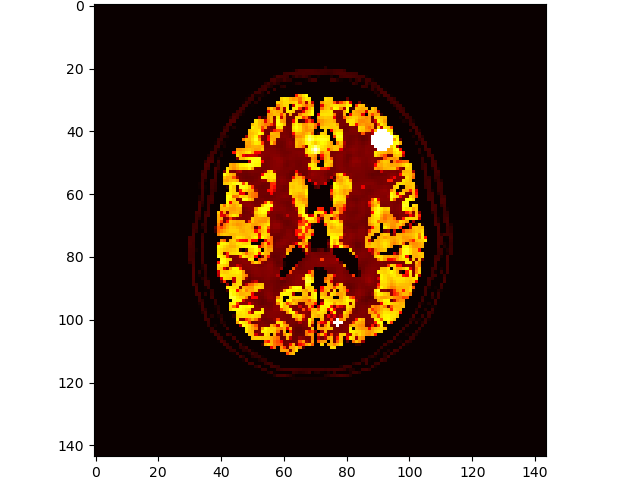
# add some lesions
brainweb.seed(1337)
im3d = brainweb.add_lesions(vol['PET'])
volshow(im3d[:, 100:-100, 100:-100], cmaps=['hot']);
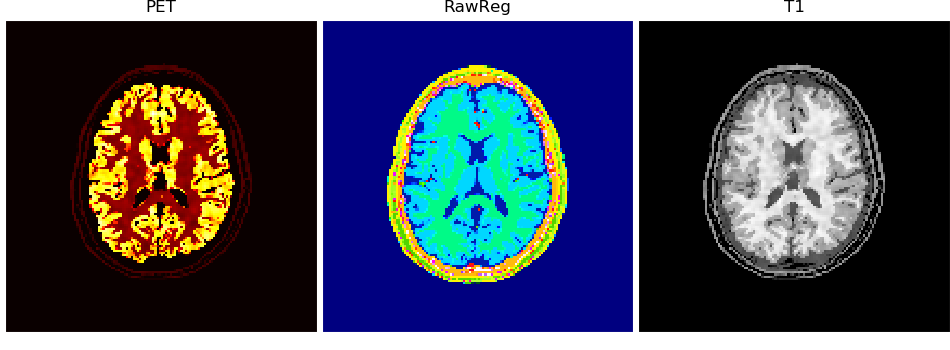
# bonus: use brute-force registration to transform
#!pip install -U 'brainweb[register]'
reg = brainweb.register(
    data[:, ::-1], target=vol['PET'],
    src_resolution=brainweb.Res.brainweb,
    target_resolution=brainweb.Res.mMR)

volshow({
    "PET":    vol['PET'][:, 100:-100, 100:-100],
    "RawReg": reg[       :, 100:-100, 100:-100],
    "T1":     vol['T1' ][:, 100:-100, 100:-100],
}, cmaps=['hot', 'gist_ncar', 'Greys_r'], ncols=3, tight_layout=5, figsize=(9.5, 3.5), frameon=False);
1 maintainer

Metadata
1 maintainer
Release files for brainweb 1.7.0
For a detailed explanation of source distributions (sdists) and built distributions (wheels), please see the package formats documentation.
Source distribution (sdist)
| File | Size | Uploaded | |
|---|---|---|---|
| brainweb-1.7.0.tar.gz | 287.0 kB | Details |
Built distribution (wheel)
| File | Interpreter | ABI | Platform | Reset |
|---|---|---|---|---|
| brainweb-1.7.0-py3-none-any.whl | Python 3 | none | any | Details |
Total release size: 298.9 kB
Release files / brainweb-1.7.0.tar.gz
| Download URL | brainweb-1.7.0.tar.gz |
|---|---|
| Size | 287.0 kB |
| Tags | Source |
|
SHA-256 checksum How to use checksums |
b8d7dde584a01a269c2a66cd1684af5658343b986ba961ba0599e80e86ab7c1d
|
|
BLAKE2b-256 checksum How to use checksums |
13a400a5f042e511ca51858dc9059b234c4e372ce41bc7b113d2a436a8720818
|
| Upload date | |
|
Uploaded using Trusted Publishing? What is trusted publishing? |
Yes |
| Uploaded via |
twine/7.0.0 CPython/3.14.6
|
Provenance
Provenance describes where a file came from. On PyPI, provenance is shared via attestations, which provide a verifiable record of the build or publishing details. View details, limitations and caveats.


PyPI Publish Attestation
PyPI verified that this artifact, at this checksum, originated from the publisher listed below.
Signed by GitHub Actions, verified by PyPI on Jul 30, 2026.
Transparency logRelease files / brainweb-1.7.0-py3-none-any.whl
| Download URL | brainweb-1.7.0-py3-none-any.whl |
|---|---|
| Size | 11.9 kB |
| Tags | Python 3 |
|
SHA-256 checksum How to use checksums |
fad653624ba332ea772b4e4fefd8d830614097322f305c313da3c0906b6f2895
|
|
BLAKE2b-256 checksum How to use checksums |
c6c58307be4d26ddd65bb4532ef521cae3a3af093b5e02f9b267455f8e72a302
|
| Upload date | |
|
Uploaded using Trusted Publishing? What is trusted publishing? |
Yes |
| Uploaded via |
twine/7.0.0 CPython/3.14.6
|
Provenance
Provenance describes where a file came from. On PyPI, provenance is shared via attestations, which provide a verifiable record of the build or publishing details. View details, limitations and caveats.
PyPI Publish Attestation
PyPI verified that this artifact, at this checksum, originated from the publisher listed below.
Signed by GitHub Actions, verified by PyPI on Jul 30, 2026.
Transparency log













