

WARNING Only
brax/trainingis actively being maintained as of 0.13.0. Instead ofbrax/envs, users should use MuJoCo Playground, all of which train well withbrax/training. If you want to use Brax for physics simulation, please use MJX available at github.com/google-deepmind/mujoco (pip install mujoco_mjx) or MuJoCo Warp rather than Brax as a wrapper to MuJoCo physics simulation. We may repurposebraxpurely as an RL library in the future.
Brax is a fast and fully differentiable physics engine used for research and development of robotics, human perception, materials science, reinforcement learning, and other simulation-heavy applications.
Brax is written in JAX and is designed for use on acceleration hardware. It is both efficient for single-device simulation, and scalable to massively parallel simulation on multiple devices, without the need for pesky datacenters.
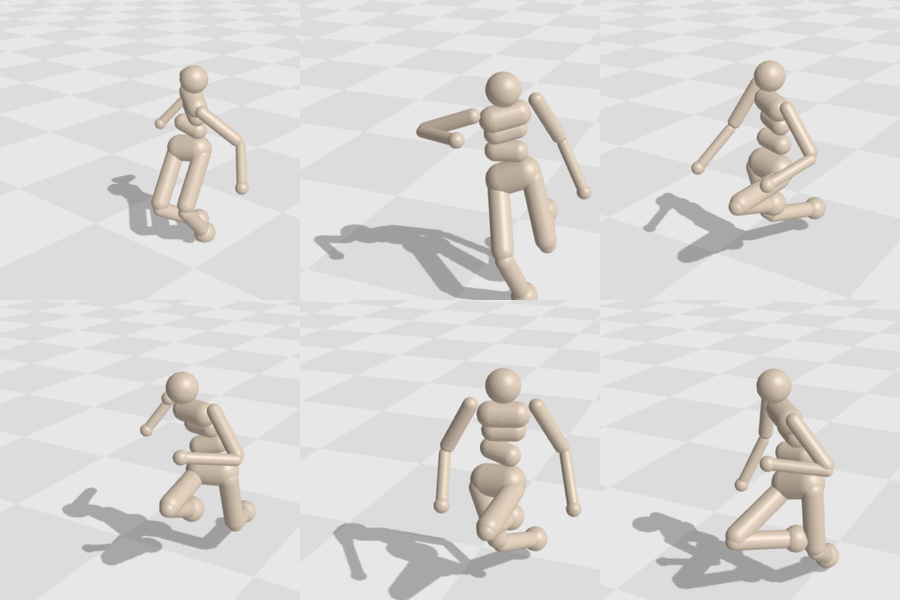
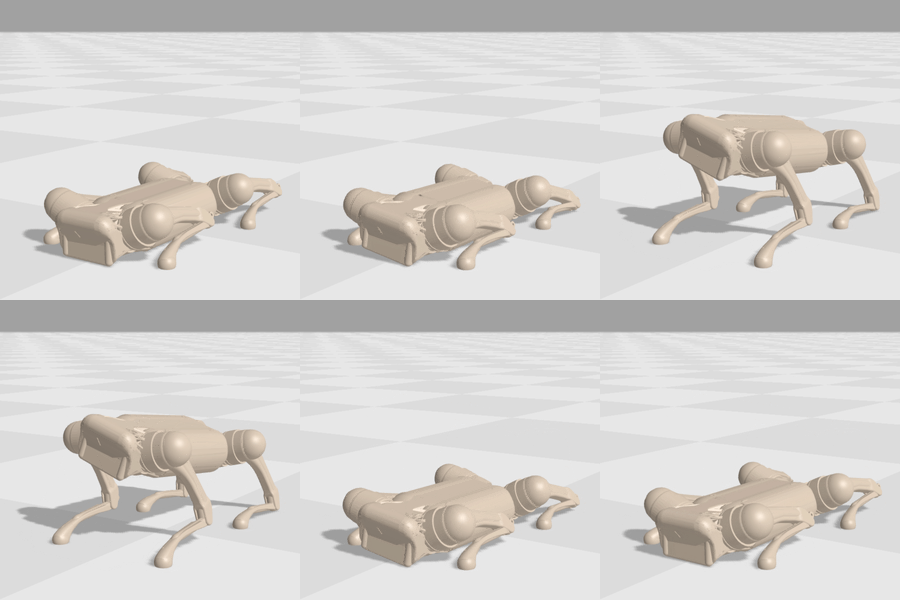
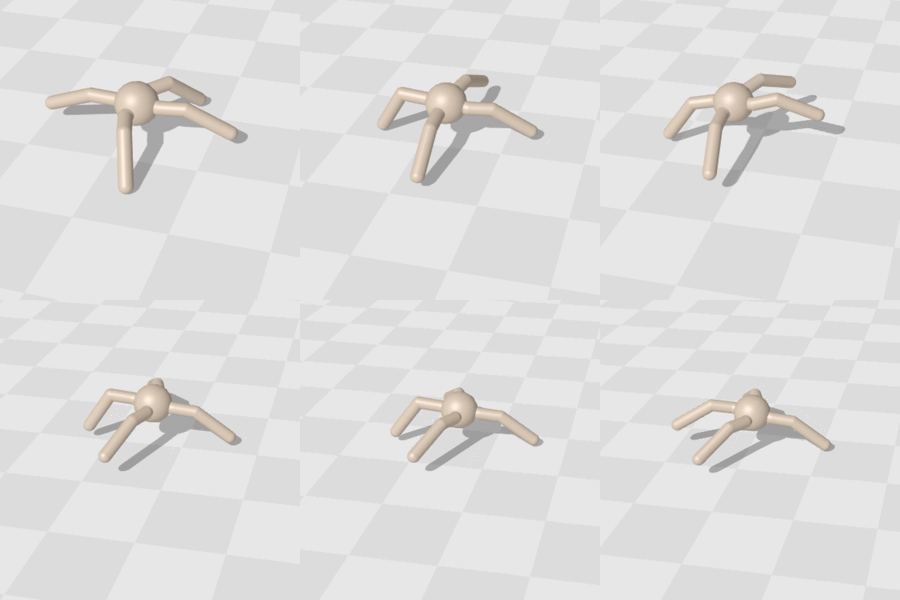
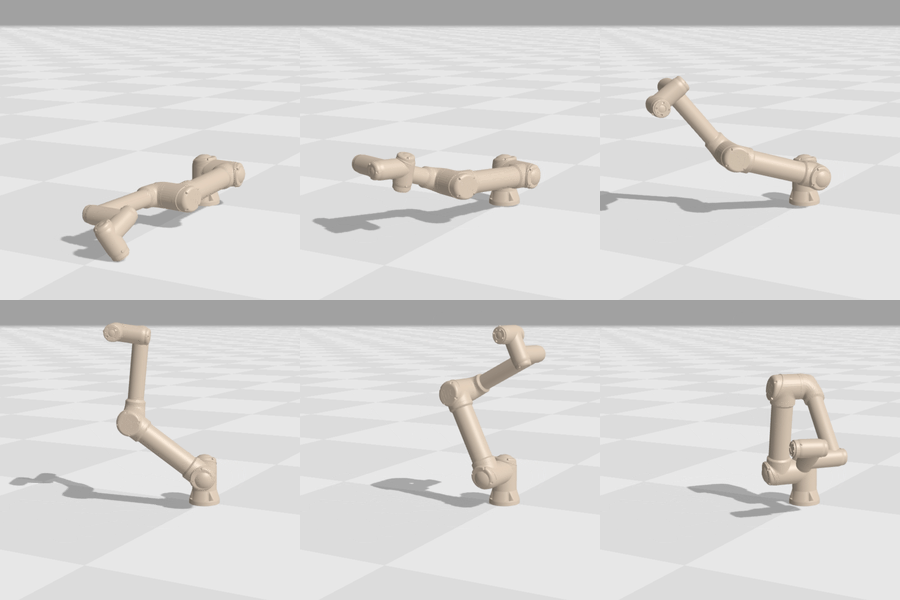
Brax simulates environments at millions of physics steps per second on TPU, and includes a suite of learning algorithms that train agents in seconds to minutes:
- Baseline learning algorithms such as PPO, SAC, ARS, and evolutionary strategies.
- Learning algorithms that leverage the differentiability of the simulator, such as analytic policy gradients.
One API, Four Pipelines
Brax offers four distinct physics pipelines that are easy to swap:
- MuJoCo XLA - MJX - a JAX reimplementation of the MuJoCo physics engine.
- Generalized calculates motion in generalized coordinates using dynamics algorithms similar to MuJoCo and TDS.
- Positional uses Position Based Dynamics, a fast but stable method of resolving joint and collision constraints.
- Spring provides fast and cheap simulation for rapid experimentation, using simple impulse-based methods often found in video games.
These pipelines share the same API and can run side-by-side within the same simulation. This makes Brax well suited for experiments in transfer learning and closing the gap between simulation and the real world.
Quickstart: Colab in the Cloud
Explore Brax easily and quickly through a series of colab notebooks:
- Brax Basics introduces the Brax API, and shows how to simulate basic physics primitives.
- Brax Training introduces Brax's training algorithms, and lets you train your own policies directly within the colab. It also demonstrates loading and saving policies.
- Brax Training with MuJoCo XLA - MJX demonstrates training in Brax using the
MJXphysics simulator. - Brax Training with PyTorch on GPU demonstrates how Brax can be used in other ML frameworks for fast training, in this case PyTorch.
Using Brax Locally
To install Brax from pypi, install it with:
python3 -m venv env
source env/bin/activate
pip install --upgrade pip
pip install brax
You may also install from Conda or Mamba:
conda install -c conda-forge brax # s/conda/mamba for mamba
Alternatively, to install Brax from source, clone this repo, cd to it, and then:
python3 -m venv env
source env/bin/activate
pip install --upgrade pip
pip install -e .
To train a model:
learn
Training on NVidia GPU is supported, but you must first install CUDA, CuDNN, and JAX with GPU support.
Learn More
For a deep dive into Brax's design and performance characteristics, please see our paper, Brax -- A Differentiable Physics Engine for Large Scale Rigid Body Simulation , which appeared in the Datasets and Benchmarks Track at NeurIPS 2021.
Citing Brax
If you would like to reference Brax in a publication, please use:
@software{brax2021github,
  author = {C. Daniel Freeman and Erik Frey and Anton Raichuk and Sertan Girgin and Igor Mordatch and Olivier Bachem},
  title = {Brax - A Differentiable Physics Engine for Large Scale Rigid Body Simulation},
  url = {http://github.com/google/brax},
  version = {0.14.2},
  year = {2021},
}
Acknowledgements
Brax has come a long way since its original publication. We offer gratitude and effusive praise to the following people:
- Manu Orsini and Nikola Momchev who provided a major refactor of Brax's training algorithms to make them more accessible and reusable.
- Erwin Coumans who has graciously offered advice and mentorship, and many useful references from Tiny Differentiable Simulator.
- Baruch Tabanpour, a colleague who helped launch brax v2 and overhauled the contact library.
- Shixiang Shane Gu and Hiroki Furuta, who contributed BIG-Gym and Braxlines, and a scene composer to Brax.
- Our awesome open source collaborators and contributors. Thank you!


Release files for brax 0.14.2
For a detailed explanation of source distributions (sdists) and built distributions (wheels), please see the package formats documentation.
Source distribution (sdist)
| File | Size | Uploaded | |
|---|---|---|---|
| brax-0.14.2.tar.gz | 211.6 kB | Details |
Built distribution (wheel)
| File | Interpreter | ABI | Platform | Reset |
|---|---|---|---|---|
| brax-0.14.2-py3-none-any.whl | Python 3 | none | any | Details |
Total release size: 568.4 kB
Release files / brax-0.14.2.tar.gz
| Download URL | brax-0.14.2.tar.gz |
|---|---|
| Size | 211.6 kB |
| Tags | Source |
|
SHA-256 checksum How to use checksums |
fd5240fb30ea0d7b0a9da162eb4a460c3ad415c049453936118e2e05089222c2
|
|
BLAKE2b-256 checksum How to use checksums |
0f64c9edc16f856641a4ae5e21372cb5c56344971f5665f0b2dfbd2dbc8e0dfc
|
| Upload date | |
|
Uploaded using Trusted Publishing? What is trusted publishing? |
No |
| Uploaded via |
twine/6.2.0 CPython/3.13.12
|
Release files / brax-0.14.2-py3-none-any.whl
| Download URL | brax-0.14.2-py3-none-any.whl |
|---|---|
| Size | 356.9 kB |
| Tags | Python 3 |
|
SHA-256 checksum How to use checksums |
d33b7b222ba5d85fd0fc4d4c59aa46feb978684107ad3f79de6bfef97ab06693
|
|
BLAKE2b-256 checksum How to use checksums |
2c34c12809ec36063ffab41880b37f2305f8d502345dbf6b5a6471133231c687
|
| Upload date | |
|
Uploaded using Trusted Publishing? What is trusted publishing? |
No |
| Uploaded via |
twine/6.2.0 CPython/3.13.12
|














