

BugSplat
Crash and error reporting built for busy developers.


👋 Introduction
This repo contains the source code for bugsplat-py, a BugSplat integration for reporting Unhandled Exceptions in Python.
🏗 Installation
BugSplat recommends you use bugsplat-py with a Python virtual environment. To create a virtual environment for your project please run the following command at your project's root directory:
python -m venv venv
Activate your virtual environment by running the following command:
# unix/macos
source venv/bin/activate

# windows
.\env\Scripts\activate
Install the bugsplat package using pip:
pip install bugsplat
⚙️ Configuration
- Import the BugSplat class
from bugsplat import BugSplat
- Create a new BugSplat instance passing it the name of your BugSplat database, application and version
bugsplat = BugSplat(database, application, version)
- Optionally, you set default values for appKey, description, email, user and additionaFilePaths
bugsplat.set_default_app_key('key!')
bugsplat.set_default_description('description!')
bugsplat.set_default_email('fred@bugsplat.com')
bugsplat.set_default_user('Fred')
bugsplat.set_default_additional_file_paths([
    './path/to/additional-file.txt',
    './path/to/additional-file-2.txt'
])
- Wrap your application code in a try except block. In the except block call post. You can override any of the default properties that were set in step 3
try:
    crash()
except Exception as e:
    bugsplat.post(
        e,
        additional_file_paths=[],
        app_key='other key!',
        description='other description!',
        email='barney@bugsplat.com',
        user='Barney'
    )
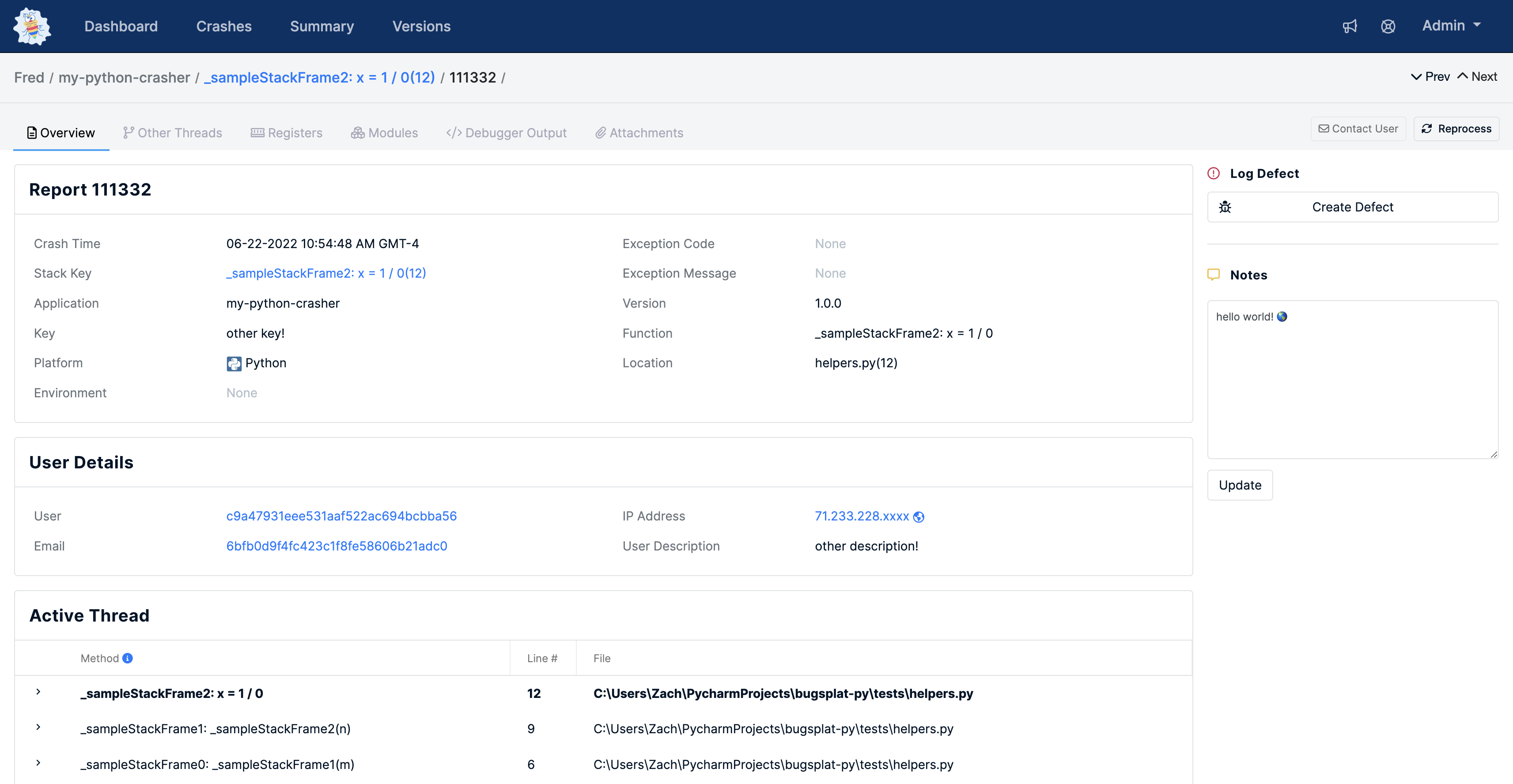
- Once you've posted a crash, navigate to the Crashes page and click the link in the ID column to be see the crash's details
🧑💻 Development
To configure a development environment:
- Clone the repository
git clone https://github.com/BugSplat-Git/bugsplat-py.git
- Create a virtual environment
python -m venv .venv
- Activate the virtual environment
# unix/macos
source .venv/bin/activate

# windows
.\.venv\Scripts\activate
- Install the project's dependencies
pip install .
Thanks for using BugSplat ❤️
1 maintainer

Metadata
1 maintainer
Release files for bugsplat 1.1.0
For a detailed explanation of source distributions (sdists) and built distributions (wheels), please see the package formats documentation.
Source distribution (sdist)
| File | Size | Uploaded | Provenance | Actions |
|---|---|---|---|---|
| bugsplat-1.1.0.tar.gz | 5.9 kB | Without provenance | Details for bugsplat-1.1.0.tar.gz |
Built distribution (wheel)
| File | Interpreter | ABI | Platform | Actions Reset |
|---|---|---|---|---|
| bugsplat-1.1.0-py3-none-any.whl | Python 3 | none | any | Details for bugsplat-1.1.0-py3-none-any.whl |
Total release size: 11.7 kB
Release files / bugsplat-1.1.0.tar.gz
| Download URL | bugsplat-1.1.0.tar.gz |
|---|---|
| Size | 5.9 kB |
| Tags | Source |
|
SHA-256 checksum How to use checksums |
7be93c892a44c22ec4b5ed8068dcb9e25d664d186d220524ebb69f4237b33979
|
|
BLAKE2b-256 checksum How to use checksums |
672e7309da4bbe0399190d26ef4524d4fea1646b995c308e7bfc66a0938eb7ef
|
| Upload date | |
|
Uploaded using Trusted Publishing? What is trusted publishing? |
No |
| Uploaded via |
twine/6.2.0 CPython/3.10.5
|
Release files / bugsplat-1.1.0-py3-none-any.whl
| Download URL | bugsplat-1.1.0-py3-none-any.whl |
|---|---|
| Size | 5.9 kB |
| Tags | Python 3 |
|
SHA-256 checksum How to use checksums |
1a4fdb25053bb2c83f65ca3f87ba38105b08db69326ea52b2d3b34770a38f47f
|
|
BLAKE2b-256 checksum How to use checksums |
505ab7334717a217539c106986c577b959f43cfe0bfd50e4b570e8bcdeb5949b
|
| Upload date | |
|
Uploaded using Trusted Publishing? What is trusted publishing? |
No |
| Uploaded via |
twine/6.2.0 CPython/3.10.5
|
Security for bugsplat 1.1.0
Provenance
Provenance describes where a file came from. On PyPI, provenance is shared via attestations, which provide a verifiable record of the build or publishing details. View details, limitations and caveats.
No provenance found
None of the files in this release were uploaded with provenance metadata.
A note on package security
PyPI is a repository for distributing packages, not a service for auditing them. While third-party security researchers and our staff do their best to detect and remove malicious packages, PyPI cannot guarantee the quality, security or suitability of any given package.
To learn more about protecting yourself from malicious actors, visit our package security documentation.














