
byecycle 🚲





Find and expose cyclic imports in python projects.
Installation
byecycle uses the built-in ast module
to parse code files. As a consequence, it can only handle python code within the same
major version (read: no support for python 1 and 2), and the same or lower minor version
of the python interpreter it was installed with. If byecycle raises SyntaxErrors in
code that you know to be working, try using a byecycle that is installed with the same
python version that can run the code in question.
From PyPI
Requirements:
- python 3.11 or higher
- pipx
pipx install byecycle
Development Setup
Requirements:
- python 3.11 or higher
- pdm
- git
git clone https://github.com/a-recknagel/byecycle.git
cd byecycle
pdm install -G:all
Usage
As a Command Line Tool
# with a path
byecycle /home/me/dev/byecycle/src/byecycle/
# or the name of an installed package
byecycle byecycle
The result will be a json string:
{
  "byecycle.misc": {},
  "byecycle.graph": {
    "byecycle": {
      "tags": [
        "vanilla",
        "parent"
      ],
      "cycle": "complicated"
    },
    "byecycle.misc": {
      "tags": [
        "vanilla"
      ],
      "cycle": null
    }
  },
  [...]
  "byecycle": {
    "byecycle.graph": {
      "tags": [
        "vanilla",
        "parent"
      ],
      "cycle": "complicated"
    }
  }
}
By default, the result is printed with some rich formatting to highlight types and such.
If you need the output to be plain ascii, pass the --no-rich flag.
For bigger projects, you might get much more complex output. The intent of returning
json is to have something that can be easily piped into e.g. jq for further
processing:
# filter out imports that don't have a cycle
byecycle byecycle | jq '.[] |= (.[] |= select(.cycle != null) | select(. != {}))'
{
  "byecycle.graph": {
    "byecycle": {
      "tags": [
        "parent",
        "vanilla"
      ],
      "cycle": "complicated"
    }
  },
  "byecycle.cli": {
    "byecycle": {
      "tags": [
        "parent",
        "vanilla"
      ],
      "cycle": "complicated"
    }
  },
  "byecycle": {
    "byecycle.graph": {
      "tags": [
        "parent",
        "vanilla"
      ],
      "cycle": "complicated"
    },
    "byecycle.cli": {
      "tags": [
        "parent",
        "vanilla"
      ],
      "cycle": "complicated"
    }
  }
}
Alternatively, you can also call the main entrypoint's core functionality as a regular python function. Among other things, it returns a dictionary equivalent to the CLI's json that you can work with:
from byecycle import run
cycles, *_ = run("byecycle")
# filter out imports that don't have a cycle
for outer_k, outer_v in cycles.items():
    for inner_k, inner_v in outer_v.items():
        if inner_v["cycle"]:
            print(f"{outer_k} -> {inner_k}: {inner_v['cycle']}")
byecycle.graph -> byecycle -> complicated
byecycle.cli -> byecycle -> complicated
byecycle -> byecycle.graph -> complicated
byecycle -> byecycle.cli -> complicated
See the help text of byecycle for an explanation of tags/ImportKinds and
cycle/EdgeKinds.
In short, if there is a cycle, the tags of all involved imports inform the cycle-severity, with the highest severity winning out if multiple apply. The defaults can be overriden in order to isolate, filter, or highlight cycles with specific severities.
To Visualize the Import Graph
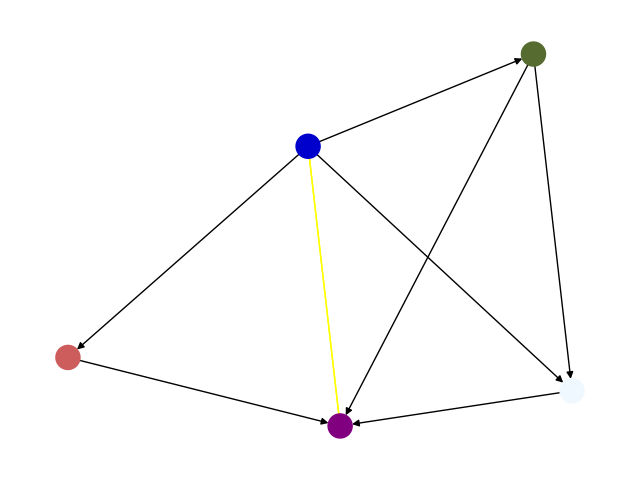
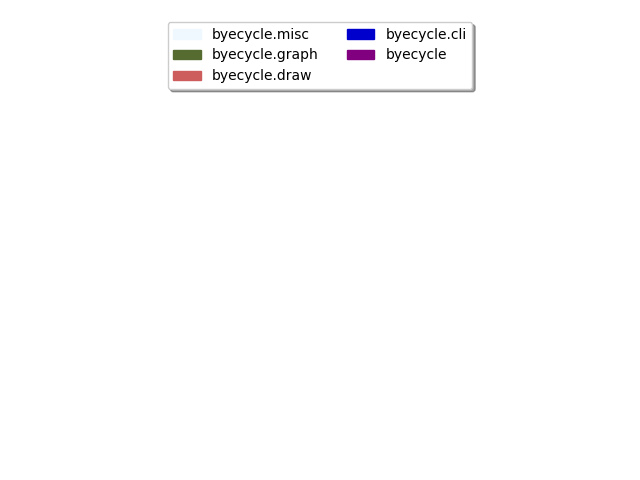
If you pass the --draw flag1 on your command-line-call, byecycle will create an image of
the import graph instead:
byecycle byecycle --draw
[1] Requires installation of the draw-extra, i.e. pipx install "byecycle[draw]".
1 maintainer

Metadata
1 maintainer
Release files for byecycle 0.1.5
For a detailed explanation of source distributions (sdists) and built distributions (wheels), please see the package formats documentation.
Source distribution (sdist)
| File | Size | Uploaded | Provenance | Actions |
|---|---|---|---|---|
| byecycle-0.1.5.tar.gz | 18.1 kB | Without provenance | Details for byecycle-0.1.5.tar.gz |
Built distribution (wheel)
| File | Interpreter | ABI | Platform | Actions Reset |
|---|---|---|---|---|
| byecycle-0.1.5-py3-none-any.whl | Python 3 | none | any | Details for byecycle-0.1.5-py3-none-any.whl |
Total release size: 33.9 kB
Release files / byecycle-0.1.5.tar.gz
| Download URL | byecycle-0.1.5.tar.gz |
|---|---|
| Size | 18.1 kB |
| Tags | Source |
|
SHA-256 checksum How to use checksums |
be2c907b090d27f9699daa7a8dec419d573b59b1ef9413302f013c822e0bdacb
|
|
BLAKE2b-256 checksum How to use checksums |
44b7053810b8f83772d72c8814168b1a010184a7b8146eb0368a33cbd768b63d
|
| Upload date | |
|
Uploaded using Trusted Publishing? What is trusted publishing? |
No |
| Uploaded via |
pdm/2.15.4 CPython/3.10.12 Linux/6.5.0-1021-azure
|
Release files / byecycle-0.1.5-py3-none-any.whl
| Download URL | byecycle-0.1.5-py3-none-any.whl |
|---|---|
| Size | 15.9 kB |
| Tags | Python 3 |
|
SHA-256 checksum How to use checksums |
a75cf216b0e0ba6f061beb5c94ed1a9a9e080ea6ed93993c71790276da075a89
|
|
BLAKE2b-256 checksum How to use checksums |
1aa178de79b757bccae010a1eb90bab3998d099c4090f71849ccfccf00c5a71d
|
| Upload date | |
|
Uploaded using Trusted Publishing? What is trusted publishing? |
No |
| Uploaded via |
pdm/2.15.4 CPython/3.10.12 Linux/6.5.0-1021-azure
|
Security for byecycle 0.1.5
Provenance
Provenance describes where a file came from. On PyPI, provenance is shared via attestations, which provide a verifiable record of the build or publishing details. View details, limitations and caveats.
No provenance found
None of the files in this release were uploaded with provenance metadata.
A note on package security
PyPI is a repository for distributing packages, not a service for auditing them. While third-party security researchers and our staff do their best to detect and remove malicious packages, PyPI cannot guarantee the quality, security or suitability of any given package.
To learn more about protecting yourself from malicious actors, visit our package security documentation.














