
Welcome to the Corpus Annotation Graph Builder (CAG)







cagis a Python Library offering an architectural framework to employ the build-annotate pattern when building Graphs.
Corpus Annotation Graph builder (CAG) is an architectural framework that employs the build-and-annotate pattern for creating a graph. CAG is built on top of ArangoDB and its Python drivers (PyArango). The build-and-annotate pattern consists of two phases (see Figure below): (1) data is collected from different sources (e.g., publication databases, online encyclopedias, news feeds, web portals, electronic libraries, repositories, media platforms) and preprocessed to build the core nodes, which we call Objects of Interest. The component responsible for this phase is the Graph-Creator. (2) Annotations are extracted from the OOIs, and corresponding annotation nodes are created and linked to the core nodes. The component dealing with this phase is the Graph-Annotator.
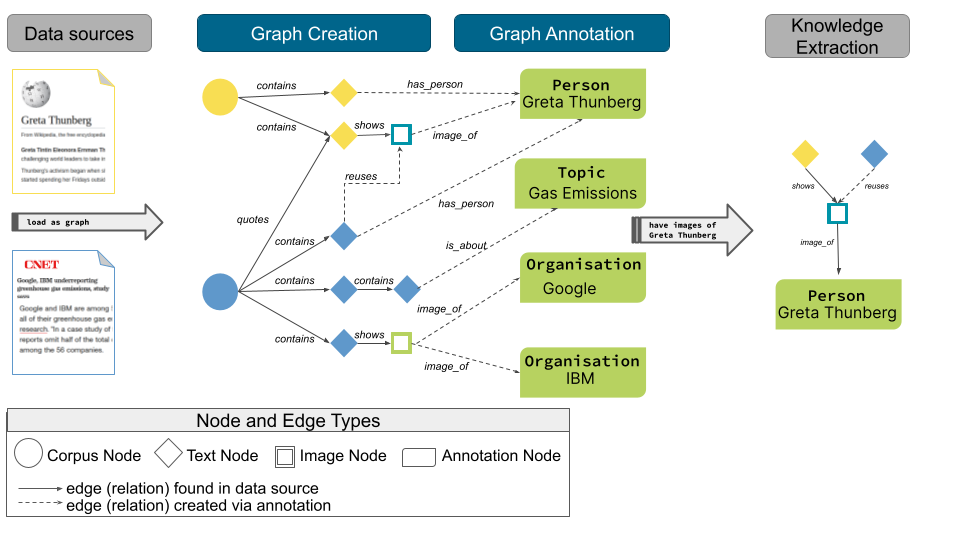
This framework aims to offer researchers a flexible but unified and reproducible way of organizing and maintaining their interlinked document collections in a Corpus Annotation Graph.
Installation
Direct install via pip
The package can also be installed directly via pip.
pip install cag
This will allow you to use the module cag from any python script locally. The two main packages are cag.framework and cag.view_wrapper.
Manual cloning
Clone the repository, go to the root folder and then run:
pip install -e .
Citation
Please cite us in case you use CAG
@inproceedings{el-baff-etal-2023-corpus,
  title = "Corpus Annotation Graph Builder ({CAG}): An Architectural Framework to Create and Annotate a Multi-source Graph",
  author = "El Baff, Roxanne  and
    Hecking, Tobias  and
    Hamm, Andreas  and
    Korte, Jasper W.  and
    Bartsch, Sabine",
  booktitle = "Proceedings of the 17th Conference of the European Chapter of the Association for Computational Linguistics: System Demonstrations",
  month = may,
  year = "2023",
  address = "Dubrovnik, Croatia",
  publisher = "Association for Computational Linguistics",
  url = "https://aclanthology.org/2023.eacl-demo.28",
  pages = "248--255"
}
Usage
- After the installation, a project scaffold can be created with the command
cag start-project - Graph Creation [jupyter notebook]
- Graph Annotation [jupyter notebook]
Zenodo refs
- v1.5.17
- v1.5.0
- v1.4.0


1 maintainer

Metadata
1 maintainer
Release files for cag 1.6.0
For a detailed explanation of source distributions (sdists) and built distributions (wheels), please see the package formats documentation.
Source distribution (sdist)
| File | Size | Uploaded | Provenance | Actions |
|---|---|---|---|---|
| cag-1.6.0.tar.gz | 3.1 MB | Without provenance | Details for cag-1.6.0.tar.gz |
Built distribution (wheel)
| File | Interpreter | ABI | Platform | Actions Reset |
|---|---|---|---|---|
| cag-1.6.0-py3-none-any.whl | Python 3 | none | any | Details for cag-1.6.0-py3-none-any.whl |
Total release size: 3.2 MB
Release files / cag-1.6.0.tar.gz
| Download URL | cag-1.6.0.tar.gz |
|---|---|
| Size | 3.1 MB |
| Tags | Source |
|
SHA-256 checksum How to use checksums |
cf0a24a5640eb8c21600be1631d0f07ce7fc719854166d64a815ec97ef7d5936
|
|
BLAKE2b-256 checksum How to use checksums |
1e866b58120867cd3603bb0e540d00c32b63a6f5194f1e6fd0bc9140f83c4ff0
|
| Upload date | |
|
Uploaded using Trusted Publishing? What is trusted publishing? |
No |
| Uploaded via |
python-requests/2.31.0
|
Release files / cag-1.6.0-py3-none-any.whl
| Download URL | cag-1.6.0-py3-none-any.whl |
|---|---|
| Size | 98.4 kB |
| Tags | Python 3 |
|
SHA-256 checksum How to use checksums |
d5fc7cf8ba00c18413d2ded609b40e1ceb804a01c6e885b7136729a87e3624c3
|
|
BLAKE2b-256 checksum How to use checksums |
c9a82eb53ae618e578f4debb5cb58504c7edd4781653bfdcc38dc2529e57a849
|
| Upload date | |
|
Uploaded using Trusted Publishing? What is trusted publishing? |
No |
| Uploaded via |
python-requests/2.31.0
|
Security for cag 1.6.0
Provenance
Provenance describes where a file came from. On PyPI, provenance is shared via attestations, which provide a verifiable record of the build or publishing details. View details, limitations and caveats.
No provenance found
None of the files in this release were uploaded with provenance metadata.
A note on package security
PyPI is a repository for distributing packages, not a service for auditing them. While third-party security researchers and our staff do their best to detect and remove malicious packages, PyPI cannot guarantee the quality, security or suitability of any given package.
To learn more about protecting yourself from malicious actors, visit our package security documentation.














