


Callisto
The fourth Galilean moon of Jupyter.
A command line utility to create kernels in Jupyter from virtual environments.
Installation
Callisto may be installed from pypi:
pip install callisto
Tested against python 2.7, 3.4, 3.5, 3.6.
Basic Usage.
Typical use is to just activate it inside a virtual environment:
$  virtualenv venv
...
$  source venv/bin/activate
(venv) $  callisto
Successfully installed a new jupyter kernel "venv":
{
  "env": {},
  "language": "python",
  "display_name": "venv",
  "argv": [
    "/Users/colin/venv/bin/python",
    "-m",
    "ipykernel",
    "-f",
    "{connection_file}"
  ]
}
See /Users/colin/Library/Jupyter/kernels/venv/kernel.json to edit.
Jupyter servers will now have an option for a kernel called venv.
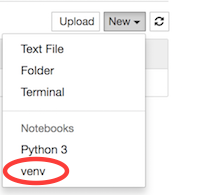
Naming the kernel.
You may also give kernels a more descriptive name:
(venv) $  callisto -n pete
Successfully installed a new jupyter kernel "pete":
{
  "env": {},
  "display_name": "pete",
  "argv": [
    "/Users/colin/venv/bin/python",
    "-m",
    "ipykernel",
    "-f",
    "{connection_file}"
  ],
  "language": "python"
}
See /Users/colin/Library/Jupyter/kernels/pete/kernel.json to edit.
Jupyter servers will now have an option for a kernel called venv, and pete.
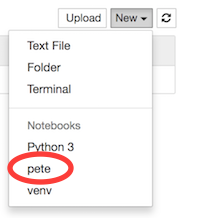
Deleting kernels.
Sometimes you may want to tidy kernels up a bit.
(venv) $  callisto -d
Deleted jupyter kernel "venv" from /Users/colin/Library/Jupyter/kernels/venv/kernel.json:
{
  "argv": [
    "/Users/colin/venv/bin/python",
    "-m",
    "ipykernel",
    "-f",
    "{connection_file}"
  ],
  "env": {},
  "language": "python",
  "display_name": "venv"
}
Jupyter servers will no longer have a kernel named venv.
Lacking courage.
Callisto doesn’t try to be too clever.
(venv) $  deactivate

$  callisto
Usage: callisto [OPTIONS]

Error: The environment variable VIRTUAL_ENV is not set (usually this is set
automatically activating a virtualenv).  Please make sure you are in a
virtual environment!
Viewing existing kernels.
If you forgot the informative message about the kernel information, you can see it later.
$  source venv/bin/activate

(venv) $  callisto --list
No kernel found at /Users/colin/Library/Jupyter/kernels/venv/kernel.json

(venv) $  callisto -l --name pete
Found kernel "pete" at /Users/colin/Library/Jupyter/kernels/pete/kernel.json:
{
  "display_name": "pete",
  "language": "python",
  "argv": [
    "/Users/colin/venv/bin/python",
    "-m",
    "ipykernel",
    "-f",
    "{connection_file}"
  ],
  "env": {}
}
Adjusting the PYTHONPATH.
With isolated kernels, you may wish to run all your notebooks from a single directory, but using code from the project directories.
(venv) $  callisto -n pete --path=$(pwd)
Successfully installed a new jupyter kernel "pete":

{
  "argv": [
    "/Users/colin/venv/bin/python",
    "-m",
    "ipykernel",
    "-f",
    "{connection_file}"
  ],
  "language": "python",
  "env": {
    "PYTHONPATH": "/Users/colin/projects/pete:PYTHONPATH"
  },
  "display_name": "pete"
}
See /Users/colin/Library/Jupyter/kernels/pete/kernel.json to edit.
Now the pete kernel will be able to import from the folder /Users/colin/projects/pete.
1 maintainer

Metadata
1 maintainer
Release files for callisto 0.7
For a detailed explanation of source distributions (sdists) and built distributions (wheels), please see the package formats documentation.
Built distribution (wheel)
| File | Interpreter | ABI | Platform | Reset |
|---|---|---|---|---|
| callisto-0.7-py2.py3-none-any.whl | Python 2, Python 3 | none | any | Details |
Release files / callisto-0.7-py2.py3-none-any.whl
| Download URL | callisto-0.7-py2.py3-none-any.whl |
|---|---|
| Size | 7.1 kB |
| Tags | Python 2 Python 3 |
|
SHA-256 checksum How to use checksums |
41ef963666741a75c44cd7dbf70a0762be496fa48b96181805cfebd7b51e71e4
|
|
BLAKE2b-256 checksum How to use checksums |
de6005d035ae76a2036e3008f5f5f7b14015a7e08ad6b4dc1c895a5f7eda1aa3
|
| Upload date | |
|
Uploaded using Trusted Publishing? What is trusted publishing? |
No |














