
carbontracker






About
carbontracker is a tool for tracking and predicting the energy consumption and carbon footprint of training deep learning models as described in Anthony et al. (2020).
Citation
Kindly cite our work if you use carbontracker in a scientific publication:
@misc{anthony2020carbontracker,
  title={Carbontracker: Tracking and Predicting the Carbon Footprint of Training Deep Learning Models},
  author={Lasse F. Wolff Anthony and Benjamin Kanding and Raghavendra Selvan},
  howpublished={ICML Workshop on Challenges in Deploying and monitoring Machine Learning Systems},
  month={July},
  note={arXiv:2007.03051},
  year={2020}}
_
Installation
PyPI
pip install carbontracker
Optional Dependencies
To generate PDF reports from carbontracker logs, install with the pdfreport extra:
pip install 'carbontracker[pdfreport]'
Basic usage
Command Line Mode
Wrap any of your scripts (python, bash, etc.):
carbontracker python script.py
Embed into Python Scripts
Required arguments
epochs: Total epochs of your training loop.
Optional arguments
epochs_before_pred(default=1): Epochs to monitor before outputting predicted consumption. Set to -1 for all epochs. Set to 0 for no prediction.monitor_epochs(default=1): Total number of epochs to monitor. Outputs actual consumption when reached. Set to -1 for all epochs. Cannot be less thanepochs_before_predor equal to 0.update_interval(default=10): Interval in seconds between power usage measurements are taken.interpretable(default=True): If set to True then the CO2eq are also converted to interpretable numbers such as the equivalent distance travelled in a car, etc. Otherwise, no conversions are done.stop_and_confirm(default=False): If set to True then the main thread (with your training loop) is paused afterepochs_before_predepochs to output the prediction and the user will need to confirm to continue training. Otherwise, prediction is output and training is continued instantly.ignore_errors(default=False): If set to True then all errors will cause energy monitoring to be stopped and training will continue. Otherwise, training will be interrupted as with regular errors.components(default="all"): Comma-separated string of which components to monitor. Options are: "all", "gpu", "cpu", or "gpu,cpu".devices_by_pid(default=False): If True, only devices (under the chosen components) running processes associated with the main process are measured. If False, all available devices are measured (see Section 'Notes' for jobs running on SLURM or in containers). Note that this requires your devices to have active processes before instantiating theCarbonTrackerclass.log_dir(default=None): Path to the desired directory to write log files. If None, then no logging will be done.log_file_prefix(default=""): Prefix to add to the log file name.verbose(default=1): Sets the level of verbosity.decimal_precision(default=6): Desired decimal precision of reported values.sim_cpu(default=None): Name of the simulated CPU. If set, will use simulated CPU power measurements.sim_cpu_tdp(default=None): Thermal Design Power (TDP) in Watts for the simulated CPU. Required ifsim_cpuis set.sim_cpu_util(default=None): CPU utilization factor between 0 and 1. If not set, defaults to 0.5 (50% utilization).sim_gpu(default=None): Name of the simulated GPU. If set, will use simulated GPU power measurements.sim_gpu_watts(default=None): Power consumption in Watts for the simulated GPU. Required ifsim_gpuis set.sim_gpu_util(default=None): GPU utilization factor between 0 and 1. If not set, defaults to 0.5 (50% utilization).
Example usage
from carbontracker.tracker import CarbonTracker

tracker = CarbonTracker(epochs=max_epochs)

# Training loop.
for epoch in range(max_epochs):
    tracker.epoch_start()

    # Your model training.

    tracker.epoch_end()

# Optional: Add a stop in case of early termination before all monitor_epochs has
# been monitored to ensure that actual consumption is reported.
tracker.stop()
Example output
Default settings
CarbonTracker:
Actual consumption for 1 epoch(s):
        Time:   0:00:10
        Energy: 0.000038 kWh
        CO2eq:  0.003130 g
        This is equivalent to:
        0.000026 km travelled by car
CarbonTracker:
Predicted consumption for 1000 epoch(s):
        Time:   2:52:22
        Energy: 0.038168 kWh
        CO2eq:  4.096665 g
        This is equivalent to:
        0.034025 km travelled by car
CarbonTracker: Finished monitoring.
verbose=2
CarbonTracker: The following components were found: CPU with device(s) cpu:0.
CarbonTracker: Average carbon intensity during training was 82.00 gCO2eq/kWh at detected location: Copenhagen, Capital Region, DK.
CarbonTracker:
Actual consumption for 1 epoch(s):
        Time:   0:00:10
        Energy: 0.000041 kWh
        CO2eq:  0.003357 g
        This is equivalent to:
        0.000028 km travelled by car
CarbonTracker: Carbon intensity for the next 2:59:06 is predicted to be 107.49 gCO2eq/kWh at detected location: Copenhagen, Capital Region, DK.
CarbonTracker:
Predicted consumption for 1000 epoch(s):
        Time:   2:59:06
        Energy: 0.040940 kWh
        CO2eq:  4.400445 g
        This is equivalent to:
        0.036549 km travelled by car
CarbonTracker: Finished monitoring.
Parsing log files
Aggregating log files
carbontracker supports aggregating all log files in a specified directory to a single estimate of the carbon footprint.
Example usage
from carbontracker import parser

parser.print_aggregate(log_dir="./my_log_directory/")
Example output
The training of models in this work is estimated to use 4.494 kWh of electricity contributing to 0.423 kg of CO2eq. This is equivalent to 3.515 km travelled by car. Measured by carbontracker (https://github.com/lfwa/carbontracker).
Convert logs to dictionary objects
Log files can be parsed into dictionaries using parser.parse_all_logs() or parser.parse_logs().
Example usage
from carbontracker import parser

logs = parser.parse_all_logs(log_dir="./logs/")
first_log = logs[0]

print(f"Output file name: {first_log['output_filename']}")
print(f"Standard file name: {first_log['standard_filename']}")
print(f"Stopped early: {first_log['early_stop']}")
print(f"Measured consumption: {first_log['actual']}")
print(f"Predicted consumption: {first_log['pred']}")
print(f"Measured GPU devices: {first_log['components']['gpu']['devices']}")
Example output
Output file name: ./logs/2020-05-17T19:02Z_carbontracker_output.log
Standard file name: ./logs/2020-05-17T19:02Z_carbontracker.log
Stopped early: False
Measured consumption: {'epochs': 1, 'duration (s)': 8.0, 'energy (kWh)': 6.5e-05, 'co2eq (g)': 0.019201, 'equivalents': {'km travelled by car': 0.000159}}
Predicted consumption: {'epochs': 3, 'duration (s)': 25.0, 'energy (kWh)': 1000.000196, 'co2eq (g)': 10000.057604, 'equivalents': {'km travelled by car': 10000.000478}}
Measured GPU devices: ['Tesla T4']
Generating PDF reports
Carbontracker can generate detailed PDF reports from log files. This feature requires the optional reportlab dependency.
Note: You must install the PDF report dependencies first:
pip install 'carbontracker[pdfreport]'
Example usage
from carbontracker.report import generate_report_from_log

generate_report_from_log("./logs/carbontracker.log", "./report.pdf")
The generated PDF includes:
- Energy consumption metrics and visualizations
- Carbon footprint analysis with CO2eq calculations
- Power usage breakdown by component (CPU/GPU)
- Training duration and efficiency metrics
Compatibility
carbontracker is compatible with:
- NVIDIA GPUs that support NVIDIA Management Library (NVML)
- Intel CPUs that support Intel RAPL
- Slurm
- Google Colab / Jupyter Notebook
Notes
Availability of GPUs and Slurm
- Available GPU devices are determined by first checking the environment variable
CUDA_VISIBLE_DEVICES(only ifdevices_by_pid=False otherwise we find devices by PID). This ensures that for Slurm we only fetch GPU devices associated with the current job and not the entire cluster. If this fails we measure all available GPUs. - NVML cannot find processes for containers spawned without
--pid=host. This affects thedevices_by_pidparameter and means that it will never find any active processes for GPUs in affected containers.
Extending carbontracker
See CONTRIBUTING.md.
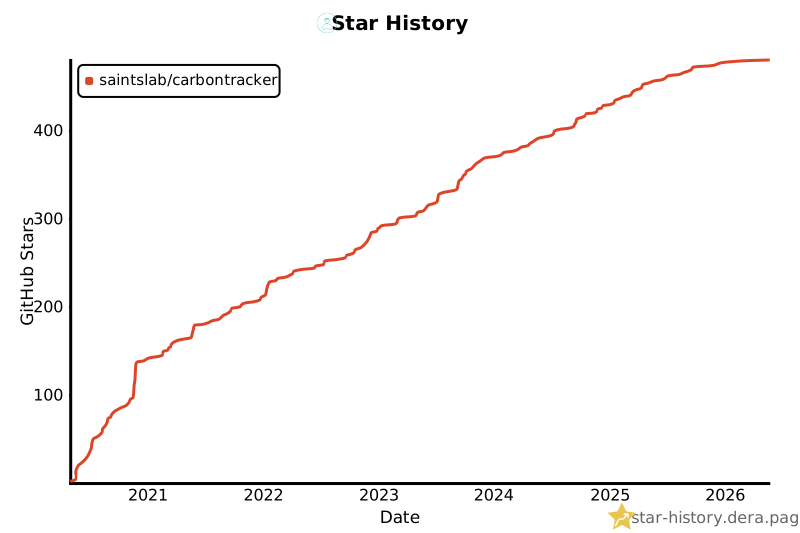
Star History
carbontracker in media
3 maintainers


Metadata
3 maintainers
Release files for carbontracker 2.4.7
For a detailed explanation of source distributions (sdists) and built distributions (wheels), please see the package formats documentation.
Source distribution (sdist)
| File | Size | Uploaded | |
|---|---|---|---|
| carbontracker-2.4.7.tar.gz | 97.2 kB | Details |
Built distribution (wheel)
| File | Interpreter | ABI | Platform | Reset |
|---|---|---|---|---|
| carbontracker-2.4.7-py3-none-any.whl | Python 3 | none | any | Details |
Total release size: 164.9 kB
Release files / carbontracker-2.4.7.tar.gz
| Download URL | carbontracker-2.4.7.tar.gz |
|---|---|
| Size | 97.2 kB |
| Tags | Source |
|
SHA-256 checksum How to use checksums |
46ad3067e360f7616e4f92625f50fde2b3da20ee5531af54a9acf555824db378
|
|
BLAKE2b-256 checksum How to use checksums |
3b9872c5191f7b941cddac7cdd732a98afc605bc162fe13bf349963d79644b58
|
| Upload date | |
|
Uploaded using Trusted Publishing? What is trusted publishing? |
No |
| Uploaded via |
twine/6.1.0 CPython/3.12.8
|
Release files / carbontracker-2.4.7-py3-none-any.whl
| Download URL | carbontracker-2.4.7-py3-none-any.whl |
|---|---|
| Size | 67.7 kB |
| Tags | Python 3 |
|
SHA-256 checksum How to use checksums |
b83395096344f6466d526e4f20c12d38bafbfc0a56fd793085b1ac7df8a0aa0f
|
|
BLAKE2b-256 checksum How to use checksums |
48d6a3b3cf7c4bfd9c96d51e58481759700479a07d76be4f8529800c329ba269
|
| Upload date | |
|
Uploaded using Trusted Publishing? What is trusted publishing? |
No |
| Uploaded via |
twine/6.1.0 CPython/3.12.8
|














