



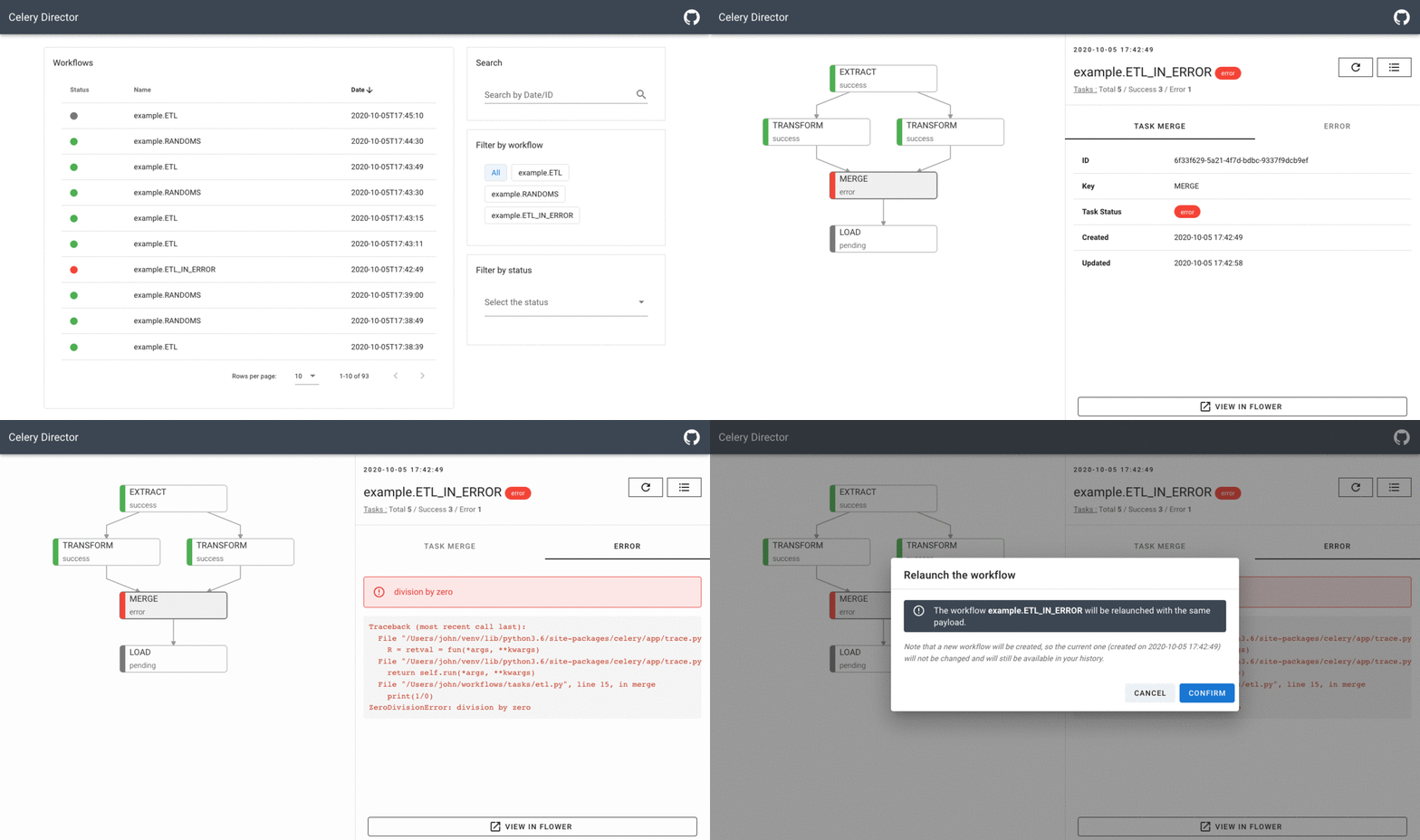
Director is a simple and rapid framework used to manage tasks and build workflows using Celery.
The objective is to make Celery easier to use by providing :
- a WebUI, an API and a CLI to manage and execute the workflows,
- a WebUI to track the tasks states,
- a YAML syntax used to combine tasks into workflows,
- the ability to periodically launch a whole workflow,
- and many others.
See how to use Director with the quickstart and guides in the documentation.
Installation
Install the latest version of Director with pip (requires at least Python 3.7):
pip install celery-director
Usage
Write your code in Python
# tasks/orders.py
from director import task
from .utils import Order, Mail

@task(name="ORDER_PRODUCT")
def order_product(*args, **kwargs):
    order = Order(
      user=kwargs["payload"]["user"],
      product=kwargs["payload"]["product"]
    ).save()
    return {"id": order.id}

@task(name="SEND_MAIL")
def send_mail(*args, **kwargs):
    order_id = args[0]["id"]
    mail = Mail(
      title=f"Your order #{order_id} has been received",
      user=kwargs["payload"]["user"]
    )
    mail.send()
Build your workflows in YAML
# workflows.yml
product.ORDER:
  tasks:
    - ORDER_PRODUCT
    - SEND_MAIL
Run it
You can simply test your workflow in local :
$ director workflow run product.ORDER '{"user": 1234, "product": 1000}'
And run it in production using the director API :
$ curl --header "Content-Type: application/json" \
  --request POST \
  --data '{"project": "product", "name": "ORDER", "payload": {"user": 1234, "product": 1000}}' \
  http://localhost:8000/api/workflows
Read the documentation to try the quickstart and see advanced usages of Celery Director.
Project layout
.env                # The configuration file.
workflows.yml       # The workflows definition.
tasks/
    example.py      # A file containing some tasks.
    ...             # Other files containing other tasks.
Commands
director init [path]- Create a new project.director celery [worker|beat|flower]- Start Celery daemons.director webserver- Start the webserver.director workflow [list|show|run]- Manage your project workflows.
License
See https://github.com/ovh/celery-director/blob/master/LICENSE


Release files for celery-director 0.10.0
For a detailed explanation of source distributions (sdists) and built distributions (wheels), please see the package formats documentation.
Source distribution (sdist)
| File | Size | Uploaded | Provenance | Actions |
|---|---|---|---|---|
| celery-director-0.10.0.tar.gz | 45.3 kB | Without provenance | Details for celery-director-0.10.0.tar.gz |
Built distribution (wheel)
| File | Interpreter | ABI | Platform | Actions Reset |
|---|---|---|---|---|
| celery_director-0.10.0-py3-none-any.whl | Python 3 | none | any | Details for celery_director-0.10.0-py3-none-any.whl |
Total release size: 103.7 kB
Release files / celery-director-0.10.0.tar.gz
| Download URL | celery-director-0.10.0.tar.gz |
|---|---|
| Size | 45.3 kB |
| Tags | Source |
|
SHA-256 checksum How to use checksums |
51cc097db4700a19b7aba0f102606590971b493c26b06db42c689c82a7839d44
|
|
BLAKE2b-256 checksum How to use checksums |
ddd2469f0b99c22e62851493d352c5aa827ef5e7361be64fe1940c497e8a56a0
|
| Upload date | |
|
Uploaded using Trusted Publishing? What is trusted publishing? |
No |
| Uploaded via |
twine/6.1.0 CPython/3.11.0rc1
|
Release files / celery_director-0.10.0-py3-none-any.whl
| Download URL | celery_director-0.10.0-py3-none-any.whl |
|---|---|
| Size | 58.4 kB |
| Tags | Python 3 |
|
SHA-256 checksum How to use checksums |
58e2bcde6fac9ea23bdd0809c6f5d07bc6af41ec1ec0968ddb2867cf8bca8064
|
|
BLAKE2b-256 checksum How to use checksums |
83b8220bd4d27e78a5d417d9f27d83600c636380239249fb1ff68e96836a700e
|
| Upload date | |
|
Uploaded using Trusted Publishing? What is trusted publishing? |
No |
| Uploaded via |
twine/6.1.0 CPython/3.11.0rc1
|
Security for celery-director 0.10.0
Provenance
Provenance describes where a file came from. On PyPI, provenance is shared via attestations, which provide a verifiable record of the build or publishing details. View details, limitations and caveats.
No provenance found
None of the files in this release were uploaded with provenance metadata.
A note on package security
PyPI is a repository for distributing packages, not a service for auditing them. While third-party security researchers and our staff do their best to detect and remove malicious packages, PyPI cannot guarantee the quality, security or suitability of any given package.
To learn more about protecting yourself from malicious actors, visit our package security documentation.














