
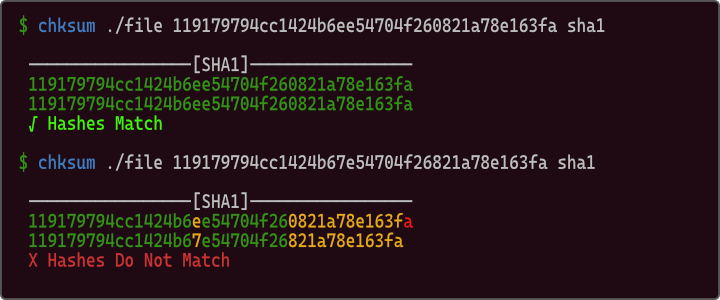
chksum
CLI for comparing two checksums
Install
Requires Python >= 3.10
pip install chksum-cli
Features
- User friendly non-specific argument order
- Visual feedback comparing hashes
- Exit code matches hash results
- Can ignore dot files
- Interactive mode
- Hash only function
- Can use md5, sha1, sha256, and sha512
Usage
CHKSUM [-?] [-i] [-d] position1 position2 [position3]

Calculate and compare the checksums of files or directories.
Can also compare against pasted strings.
ALGORITHMS = ['md5', 'sha1', 'sha256', 'sha512']

positional arguments:
  position1          Checksum, file, or algorithm
  position2          Checksum, file, or algorithm
  position3          Checksum, file, or algorithm

options:
  -?, --help         Show this help message and exit.
  -i, --interactive  Run in interactive mode.
  -d, --dots         Ignore '.' (dot) files from directories.

If the first 2 positional arguments are strings, the algorithm is not needed. Default is md5.
Likewise, passing only a single path will simply out the digest.
Arguments can be passed in any order. [Note: This issue]
E.g. the following are equivalent:
chksum <PathToFile> <PathToDir> sha256 -d
chksum -d <PathToDir> sha256 <PathToFile>
Interactive mode
Use -i to enter the interactive mode where arguments can be passed one at a time.
Note that -i is mutually exclusive.
$ chksum -i

      _     _
     | |   | |
  ___| |__ | | _____ _   _ _ __ ___
 / __| '_ \| |/ / __| | | | '_ ` _ \
| (__| | | |   <\__ \ |_| | | | | | |
 \___|_| |_|_|\_\___/\__,_|_| |_| |_|
 Copyright (c) 2022, espehon
 All rights reserved.

 ALGORITHMS = ['md5', 'sha1', 'sha256', 'sha512']

Enter Algorithm or path to File or Directory >
Inputs are checked after each entry and the prompt is updated accordingly
Enter Algorithm or path to File or Directory > ./
        Directory entered.
Enter Algorithm or path to File or Directory > ./
        Directory entered.
Enter Algorithm > md5
        Algorithm entered.
Do you want to include '.' (dot) files? [Y/n] > n
        include_dots = False

-------------[MD5]--------------
59198d6aad1674a0b372027ce275a9b6
59198d6aad1674a0b372027ce275a9b6
√ Hashes Match
Issues
Using -d in between positionals can causes an argparse error. (See Issue: #11)
Example:
$ chksum ./file ./file -d sha1
Author
1 maintainer

Metadata
1 maintainer
Release files for chksum-cli 1.1.0
For a detailed explanation of source distributions (sdists) and built distributions (wheels), please see the package formats documentation.
Source distribution (sdist)
| File | Size | Uploaded | Provenance | Actions |
|---|---|---|---|---|
| chksum-cli-1.1.0.tar.gz | 21.3 kB | Without provenance | Details for chksum-cli-1.1.0.tar.gz |
Built distribution (wheel)
| File | Interpreter | ABI | Platform | Actions Reset |
|---|---|---|---|---|
| chksum_cli-1.1.0-py3-none-any.whl | Python 3 | none | any | Details for chksum_cli-1.1.0-py3-none-any.whl |
Total release size: 42.3 kB
Release files / chksum-cli-1.1.0.tar.gz
| Download URL | chksum-cli-1.1.0.tar.gz |
|---|---|
| Size | 21.3 kB |
| Tags | Source |
|
SHA-256 checksum How to use checksums |
2c89ef5175f9a5de87a4b1b4b09fed8ccc937051f63692e6be797e13f3deb809
|
|
BLAKE2b-256 checksum How to use checksums |
b9ace256b57baa1ac84e7e229c3c9bf51f89a575976a5e80800459e3e0ad3a29
|
| Upload date | |
|
Uploaded using Trusted Publishing? What is trusted publishing? |
No |
| Uploaded via |
twine/4.0.1 CPython/3.11.0
|
Release files / chksum_cli-1.1.0-py3-none-any.whl
| Download URL | chksum_cli-1.1.0-py3-none-any.whl |
|---|---|
| Size | 20.9 kB |
| Tags | Python 3 |
|
SHA-256 checksum How to use checksums |
63dc1099604f738bc33662d5fb20006a6955e62d9f1436205ebd6585918132c5
|
|
BLAKE2b-256 checksum How to use checksums |
1605dbac6d9ea980e5d73de6283ba355fc1b806488b0f3ae143a63773208f2fd
|
| Upload date | |
|
Uploaded using Trusted Publishing? What is trusted publishing? |
No |
| Uploaded via |
twine/4.0.1 CPython/3.11.0
|
Security for chksum-cli 1.1.0
Provenance
Provenance describes where a file came from. On PyPI, provenance is shared via attestations, which provide a verifiable record of the build or publishing details. View details, limitations and caveats.
No provenance found
None of the files in this release were uploaded with provenance metadata.
A note on package security
PyPI is a repository for distributing packages, not a service for auditing them. While third-party security researchers and our staff do their best to detect and remove malicious packages, PyPI cannot guarantee the quality, security or suitability of any given package.
To learn more about protecting yourself from malicious actors, visit our package security documentation.














