
clonedetective
A python package for automated cell lineage analysis.
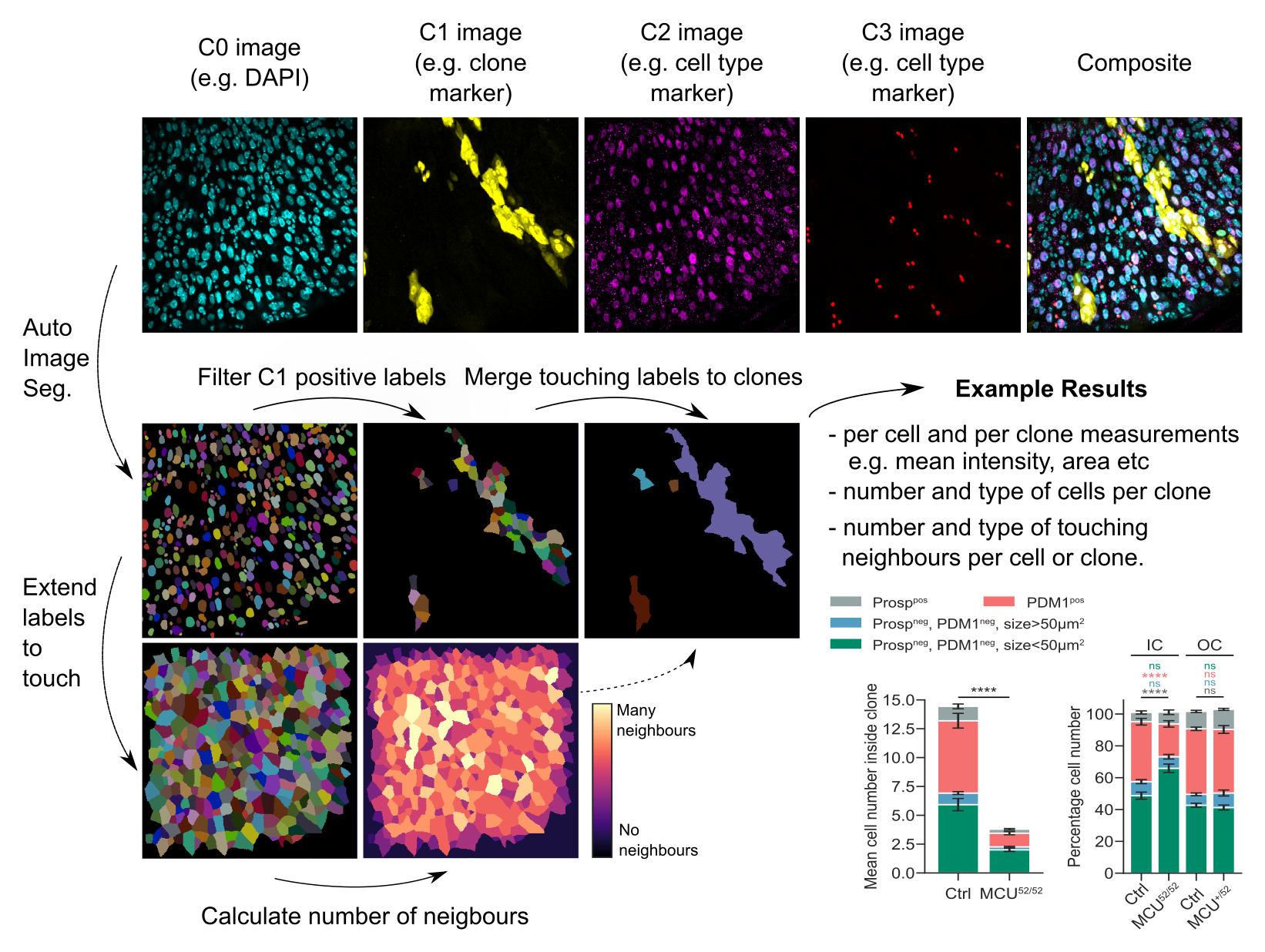
What does it do?
clonedetective is a package for analysing fluorescent imaging data from cell lineage experiments (e.g. FLP-out, MARCM or Cre-lox clones).
Outputted quantifications include:
- counts of each cell type per “clone”
- spatial metrics e.g. number of nearest neighbors of each cell per clone
- cell and clone properties e.g. area, mean intensity etc.
If clones label genetic mutations, these metrics can be useful in addressing biological questions such as:
- does my gene of interest regulate clone size (i.e. cell proliferation) or clone composition (i.e. cell differentiation)?
- does the local cell neighbourhood (e.g. number and type of neighbours) non-autonomously impact cell proliferation or differentiation?
- does my gene of interest regulate the expression of other (immunostained) proteins?
Under the hood
clonedetective is constructed using many amazing python libraries, including scikit-image, numpy, Xarray, pandas, numba, Dask, Dask-image and pyclesperanto-prototype.
Many functions are lazy-loaded and parallelized using Dask, enabling clonedetective to scale to large multi-dimensional datasets that do not fit in RAM.
Install
It is recommended to install clonedetective into a virtual environment e.g. using conda. Once you have anaconda or miniconda installed, you can create a virtual environment using the following command. It is often helpful to install something into an empty environment, in this case we install scipy:
conda create -n myenv scipy
You can then install clonedetective via pip:
pip install clonedetective
How to use
Please see the tutorials:
- Example walkthrough
- Downstream Analysis using Python
- Downstream Analysis using R
- Generating nuclei segmentation using StarDist
In progress, more to come!
1 maintainer

Metadata
1 maintainer
Release files for clonedetective 0.0.3
For a detailed explanation of source distributions (sdists) and built distributions (wheels), please see the package formats documentation.
Source distribution (sdist)
| File | Size | Uploaded | Provenance | Actions |
|---|---|---|---|---|
| clonedetective-0.0.3.tar.gz | 21.4 kB | Without provenance | Details for clonedetective-0.0.3.tar.gz |
Built distribution (wheel)
| File | Interpreter | ABI | Platform | Actions Reset |
|---|---|---|---|---|
| clonedetective-0.0.3-py3-none-any.whl | Python 3 | none | any | Details for clonedetective-0.0.3-py3-none-any.whl |
Total release size: 40.5 kB
Release files / clonedetective-0.0.3.tar.gz
| Download URL | clonedetective-0.0.3.tar.gz |
|---|---|
| Size | 21.4 kB |
| Tags | Source |
|
SHA-256 checksum How to use checksums |
62e8bb34d3ad889ea7ef31b31c9d8594efbb9229850194eb28477ff77de22273
|
|
BLAKE2b-256 checksum How to use checksums |
09d4e0624a21c9e896284e67d55b99c117f09e956d88d4aee7792f6559589bd8
|
| Upload date | |
|
Uploaded using Trusted Publishing? What is trusted publishing? |
No |
| Uploaded via |
twine/3.4.2 importlib_metadata/3.10.0 pkginfo/1.7.1 requests/2.25.1 requests-toolbelt/0.9.1 tqdm/4.62.0 CPython/3.8.10
|
Release files / clonedetective-0.0.3-py3-none-any.whl
| Download URL | clonedetective-0.0.3-py3-none-any.whl |
|---|---|
| Size | 19.0 kB |
| Tags | Python 3 |
|
SHA-256 checksum How to use checksums |
82c0c954ae330e4d3d82b445a014d44272e786eff8d0a9080c20df6b9a8b6159
|
|
BLAKE2b-256 checksum How to use checksums |
6add2bd483c80896a655cbf4116045dd77365633f9b39877f1e21be0d6e89ce6
|
| Upload date | |
|
Uploaded using Trusted Publishing? What is trusted publishing? |
No |
| Uploaded via |
twine/3.4.2 importlib_metadata/3.10.0 pkginfo/1.7.1 requests/2.25.1 requests-toolbelt/0.9.1 tqdm/4.62.0 CPython/3.8.10
|
Security for clonedetective 0.0.3
Provenance
Provenance describes where a file came from. On PyPI, provenance is shared via attestations, which provide a verifiable record of the build or publishing details. View details, limitations and caveats.
No provenance found
None of the files in this release were uploaded with provenance metadata.
A note on package security
PyPI is a repository for distributing packages, not a service for auditing them. While third-party security researchers and our staff do their best to detect and remove malicious packages, PyPI cannot guarantee the quality, security or suitability of any given package.
To learn more about protecting yourself from malicious actors, visit our package security documentation.














