
clusteval








clusteval is a python package that is developed to evaluate detected clusters and return the cluster labels that have most optimal clustering tendency, Number of clusters and clustering quality. Multiple evaluation strategies are implemented for the evaluation; silhouette, dbindex, and derivative, and four clustering methods can be used: agglomerative, kmeans, dbscan and hdbscan.
Blogs
- A step-by-step guide for clustering images
- Detection of Duplicate Images Using Image Hash Functions
- From Data to Clusters: When is Your Clustering Good Enough?
- From Clusters To Insights; The Next Step
Documentation
Full documentation is available at erdogant.github.io/clusteval, including examples and API references.
Installation
It is advisable to use a virtual environment:
conda create -n env_clusteval python=3.12
conda activate env_clusteval
Install via PyPI:
pip install clusteval
To upgrade to the latest version:
pip install --upgrade clusteval
Import the library:
from clusteval import clusteval
Examples
A structured overview is available in the documentation.

Silhouette Score |

Optimal Clusters |

Dendrogram |

Davies-Bouldin Index |

Derivative Method |

DBSCAN |

HDBSCAN A |

HDBSCAN B |
Citation
Please cite clusteval in your publications if it has been helpful in your research. Citation information is available at the top right of the GitHub page.
Related Tools & Blogs
- Use ARI when clustering contains large equal-sized clusters
- Use AMI for unbalanced clusters with small components
- Adjusted Rand Score — scikit-learn
- Adjusted for Chance Measures — scikit-learn
- imagededup GitHub repo
- Clustering images by visual similarity
- Facebook DeepCluster
- PCA on Hyperspectral Data
- Face Recognition with PCA
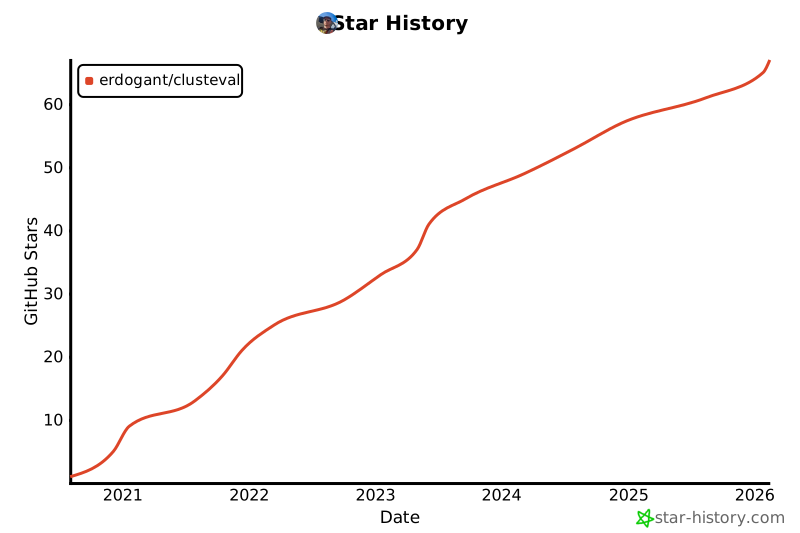
Star history
Contributors
Thank the contributors!

Maintainer
- Erdogan Taskesen, github: erdogant
- Contributions are welcome.
- Yes! This library is entirely free but it runs on coffee! :) Feel free to support with a Coffee.

1 maintainer

Metadata
1 maintainer
Release files for clusteval 2.2.7
For a detailed explanation of source distributions (sdists) and built distributions (wheels), please see the package formats documentation.
Source distribution (sdist)
| File | Size | Uploaded | Provenance | Actions |
|---|---|---|---|---|
| clusteval-2.2.7.tar.gz | 37.0 kB | Without provenance | Details for clusteval-2.2.7.tar.gz |
Built distribution (wheel)
| File | Interpreter | ABI | Platform | Actions Reset |
|---|---|---|---|---|
| clusteval-2.2.7-py3-none-any.whl | Python 3 | none | any | Details for clusteval-2.2.7-py3-none-any.whl |
Total release size: 79.7 kB
Release files / clusteval-2.2.7.tar.gz
| Download URL | clusteval-2.2.7.tar.gz |
|---|---|
| Size | 37.0 kB |
| Tags | Source |
|
SHA-256 checksum How to use checksums |
439ab17de89d6f9a6d1e9e9d7f7058b24b8520dd9590135414b8297e7ec569d2
|
|
BLAKE2b-256 checksum How to use checksums |
a7d46826ec5d2a85d33eaf32acb1fd04c750d4a7afd918399e56fa30c5553c68
|
| Upload date | |
|
Uploaded using Trusted Publishing? What is trusted publishing? |
No |
| Uploaded via |
twine/6.2.0 CPython/3.12.12
|
Release files / clusteval-2.2.7-py3-none-any.whl
| Download URL | clusteval-2.2.7-py3-none-any.whl |
|---|---|
| Size | 42.7 kB |
| Tags | Python 3 |
|
SHA-256 checksum How to use checksums |
20adfa5723ab0c939027c5073e21f685826b3450e6df2ea85593baa12d349ab2
|
|
BLAKE2b-256 checksum How to use checksums |
1ca94ed583c2d5856e52e0ed3b1a7ee4f5567d1e9aea7b7ca4a60506645b5f5b
|
| Upload date | |
|
Uploaded using Trusted Publishing? What is trusted publishing? |
No |
| Uploaded via |
twine/6.2.0 CPython/3.12.12
|
Security for clusteval 2.2.7
Provenance
Provenance describes where a file came from. On PyPI, provenance is shared via attestations, which provide a verifiable record of the build or publishing details. View details, limitations and caveats.
No provenance found
None of the files in this release were uploaded with provenance metadata.
A note on package security
PyPI is a repository for distributing packages, not a service for auditing them. While third-party security researchers and our staff do their best to detect and remove malicious packages, PyPI cannot guarantee the quality, security or suitability of any given package.
To learn more about protecting yourself from malicious actors, visit our package security documentation.














