
DCM or CManager




DracOS Connection Manager/Connection Manager is a CLI (Command Line Interface) based program written in Python. This program help DracOS Linux’s users to manage their connection ex: wifi connection. For other Linux distros’ users, feel free to use this program.
Installation
CManager require the user as sudoers.
You can install CManager directly from PyPI:
$ sudo pip install cmanager
$ sudo cmanager configure
Or download from github repository, then:
$ sudo python setup.py install
$ sudo cmanager configure
# Or
$ sudo ./install.sh
DCM needs some python module below, (this modules already included at pypi installed requires).
colorama: sudo pip install colorama
terminaltables: sudo pip install terminaltables
pbkdf2: sudo pip install pbkdf2
netifaces: sudo pip install netifaces
python-wifi: sudo pip install python-wifi
CManager needs some program/binary in sudoers file’s whitelist so it won’t ask for password while executing those program:
iwlist
wpa_supplicant
dhclient
pkill
To make you easier in installing CManager, just use install.sh script. You just need to run it with ./install.sh
Usage
$ sudo cmanager
Documentation
Don’t forget to run cmanager as with sudo cmanager, type help inside DCM to get information about available commands
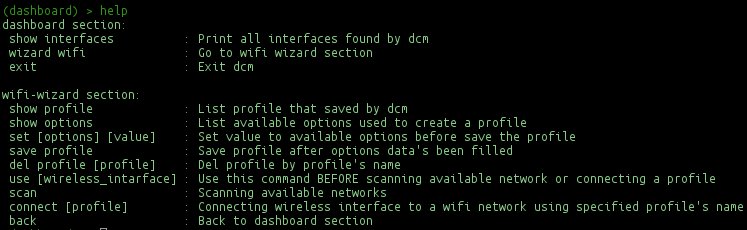
Dashboard section
See available interfaces
CManager will detect interfaces on your system, categorize them into three types of interface (wireless, ethernet, localhost). Use show interface to print those interface

Wifi-wizard section
Specifying wireless interface to used by DCM
Before you can ask CManager to scan available networks and connecting to one of them using profile that you’ve been created (see profile explanation), you should specify wireless interface that CManager will use to do those activity, type use [wireless_interface].

Scan available wifi networks
To scan available network, simply type scan.

Creating profile
Profile in CManager is a configuration file that has information about wifi connection like SSID, type of connection (Open/WPA), and passphrase if the connection is WPA type. To create a profile, simply input value to available option (name, ssid, type, passphrase) using set name [value], set ssid [value], set type [value], set passphrase [value]. show options to see available options. For Open type connection, you just need to input name, ssid, and type, no need to supply passphrase information.
After all informations needed to create a profile have been provided, simply save profile and your profile will be saved. To see all information about all profiles that have been saved, type show profile.
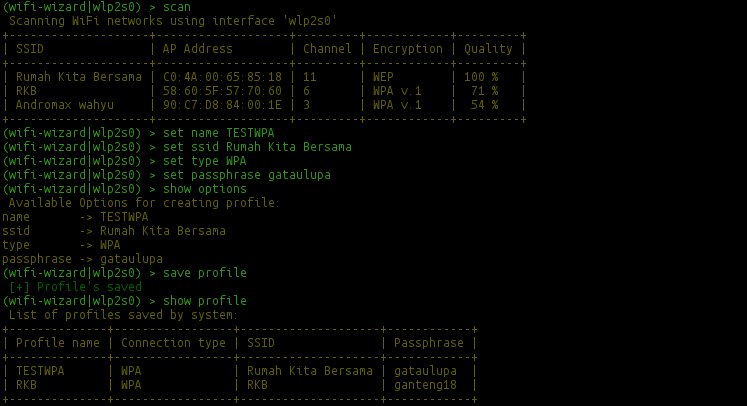
Connecting to a network
To connecting CManager to a network use a specified profile name, type connect [profile]. To disconnect it, simply type CTRL+C.

Contributing to CManager
The easiest way to contribute to CManager is to file issues.
License
See LICENSE
Changelog
See CHANGELOG.md
Special thanks to
Agus Makmun for the contribution making this program downloadable via PyPi
1 maintainer

Metadata
1 maintainer
Release files for cmanager 2.6
For a detailed explanation of source distributions (sdists) and built distributions (wheels), please see the package formats documentation.
Source distribution (sdist)
| File | Size | Uploaded | Provenance | |
|---|---|---|---|---|
| cmanager-2.6.tar.gz | 169.7 kB | Without provenance | Details |
Release files / cmanager-2.6.tar.gz
| Download URL | cmanager-2.6.tar.gz |
|---|---|
| Size | 169.7 kB |
| Tags | Source |
|
SHA-256 checksum How to use checksums |
92ba1f882b7fe5ed4a531b8885fb93eed7e1e6bf0dbc6159c1aa38ea794ef0de
|
|
BLAKE2b-256 checksum How to use checksums |
637f509cee1b080be7fc5c1a0e80c0cbc71525adc16a4fb896d0539f78642f17
|
| Upload date | |
|
Uploaded using Trusted Publishing? What is trusted publishing? |
No |
Security for cmanager 2.6
Provenance
Provenance describes where a file came from. On PyPI, provenance is shared via attestations, which provide a verifiable record of the build or publishing details. View details, limitations and caveats.
No provenance found
None of the files in this release were uploaded with provenance metadata.
A note on package security
PyPI is a repository for distributing packages, not a service for auditing them. While third-party security researchers and our staff do their best to detect and remove malicious packages, PyPI cannot guarantee the quality, security or suitability of any given package.














