
COVID-19 daily death prediction

DOI: https://doi.org/10.24433/CO.1663204.v1
The paper was published: Takefuji, Y. Deathdaily: A Python Package Index for predicting the number of daily COVID-19 deaths. Netw Model Anal Health Inform Bioinforma 11, 14 (2022). https://doi.org/10.1007/s13721-022-00359-1
Verification for computational reproducibility & quality is doned by codeocean: https://codeocean.com/capsule/3aa3e186-03f3-43b4-85d1-fe86f43bedd9/tree
deathdaily is a Python program using new_deaths.csv for predicting daily deaths due to COVID-19 in the next seven days. The prediction is based on the Xthe degree polynomial curve-fitting.
According to PyPI Stats at https://pepy.tech/, deathdaily has been downloaded by 30105 times worldwide as of Feb.22, 2023, one of the most popular COVID-19 tools of its kind.
deathdaily takes three parameters: country, days, the xth degree of a polynomial. Days shows the number of days used for calculating the curve-fiting function with xth degree of a polynomial for curve-fitting function.
The maximum days range is available from Jan.22 2020 to the day you have downloaded in new_deaths.csv file.
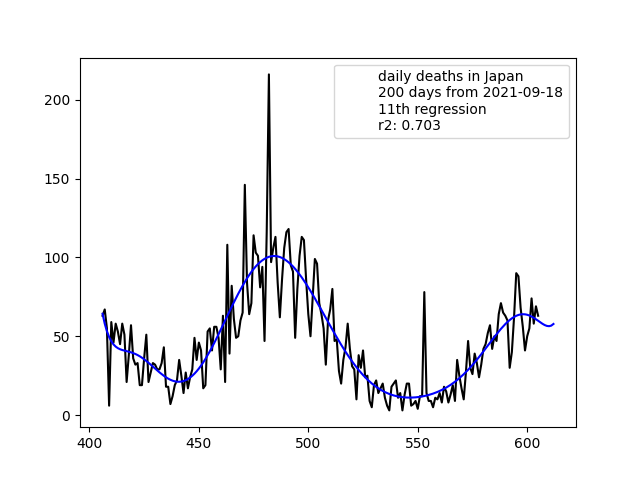
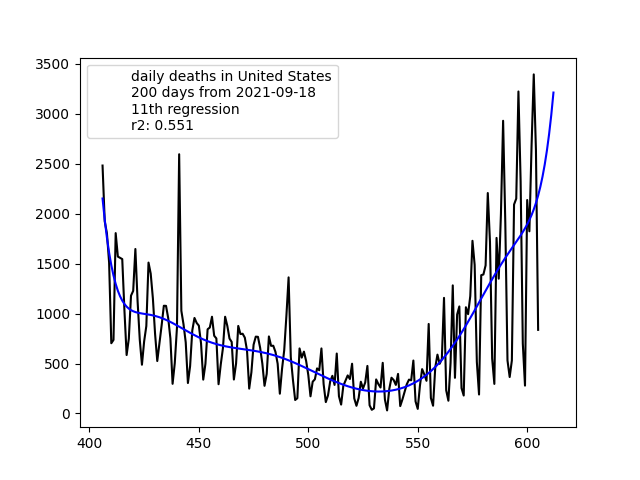
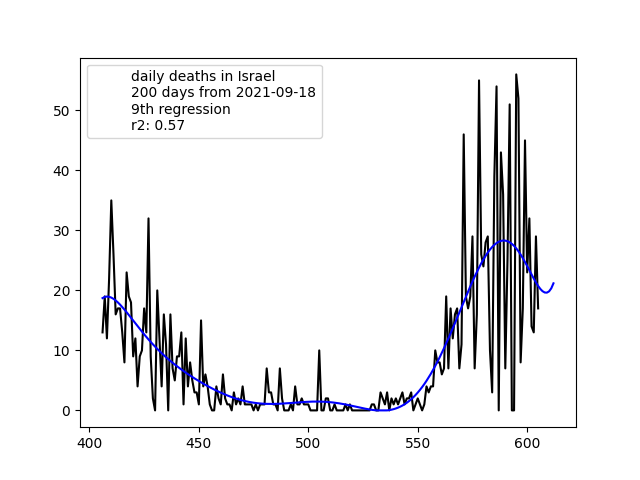
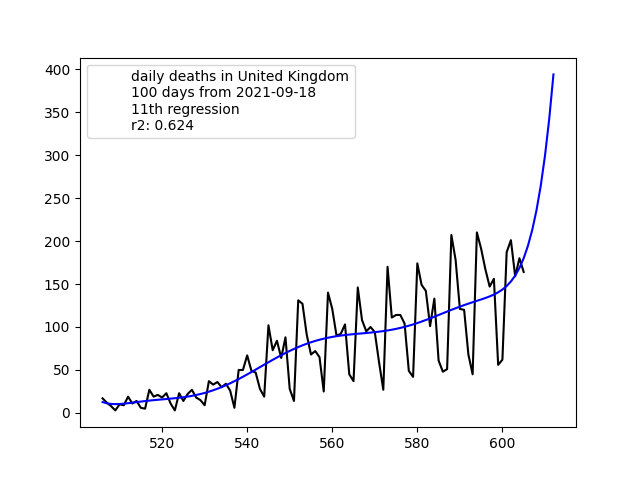
Y-axis depicts the number of daily deaths in the country.
new_deaths.csv
deathdaily needs a new_deaths.csv file for predicting the daily deaths of the next seven days.
The new_deaths.csv file is automatically downloaded by deathdaily from the following site:
https://raw.githubusercontent.com/owid/covid-19-data/master/public/data/jhu/new_deaths.csv
How to install deathdaily
$ pip install deathdaily
or
$ pip install deathdaily --force-reinstall --no-cache-dir --no-binary :all:
How to run deathdaily
"country" shows which country you would like to predict the daily deaths of the next seven days.
"days" indicates how many days are used for Xth degree polynomial curve-fitting.
"degree" determines the degree of polynomial curve-fitting.
$ deathdaily Japan days degree
$ deathdaily Japan 200 11
country="Japan", days=200, degree=11
$ deathdaily 'United States' 200 11
$ deathdaily Israel 200 9
$ deathdaily 'United Kingdom' 100 11
1 maintainer

Metadata
1 maintainer
Release files for deathdaily 0.1.7
For a detailed explanation of source distributions (sdists) and built distributions (wheels), please see the package formats documentation.
Source distribution (sdist)
| File | Size | Uploaded | Provenance | Actions |
|---|---|---|---|---|
| deathdaily-0.1.7.tar.gz | 3.3 kB | Without provenance | Details for deathdaily-0.1.7.tar.gz |
Built distribution (wheel)
| File | Interpreter | ABI | Platform | Actions Reset |
|---|---|---|---|---|
| deathdaily-0.1.7-py3-none-any.whl | Python 3 | none | any | Details for deathdaily-0.1.7-py3-none-any.whl |
Total release size: 6.8 kB
Release files / deathdaily-0.1.7.tar.gz
| Download URL | deathdaily-0.1.7.tar.gz |
|---|---|
| Size | 3.3 kB |
| Tags | Source |
|
SHA-256 checksum How to use checksums |
b179e50304e86a694412156d02f49cfe059755f3adc345d8ad9880598ff92896
|
|
BLAKE2b-256 checksum How to use checksums |
b4e20cd625c1d794e89f93a645323ec6d50f31b0db6c158c1e94e2c58674eada
|
| Upload date | |
|
Uploaded using Trusted Publishing? What is trusted publishing? |
No |
| Uploaded via |
twine/5.0.0 CPython/3.8.12
|
Release files / deathdaily-0.1.7-py3-none-any.whl
| Download URL | deathdaily-0.1.7-py3-none-any.whl |
|---|---|
| Size | 3.5 kB |
| Tags | Python 3 |
|
SHA-256 checksum How to use checksums |
4d378f2074359e2a72bcba4750d266e78d159f7183671c5362206bbb3a24a788
|
|
BLAKE2b-256 checksum How to use checksums |
b7fc98afa4a469fe710f682837cc14b6e701a7d7795316f5a04525f7368777d5
|
| Upload date | |
|
Uploaded using Trusted Publishing? What is trusted publishing? |
No |
| Uploaded via |
twine/5.0.0 CPython/3.8.12
|
Security for deathdaily 0.1.7
Provenance
Provenance describes where a file came from. On PyPI, provenance is shared via attestations, which provide a verifiable record of the build or publishing details. View details, limitations and caveats.
No provenance found
None of the files in this release were uploaded with provenance metadata.
A note on package security
PyPI is a repository for distributing packages, not a service for auditing them. While third-party security researchers and our staff do their best to detect and remove malicious packages, PyPI cannot guarantee the quality, security or suitability of any given package.
To learn more about protecting yourself from malicious actors, visit our package security documentation.














