
Decouple
Say NO to monolithic architecture.
Decouple complex system to separated modules by mediator.
pip install decouple
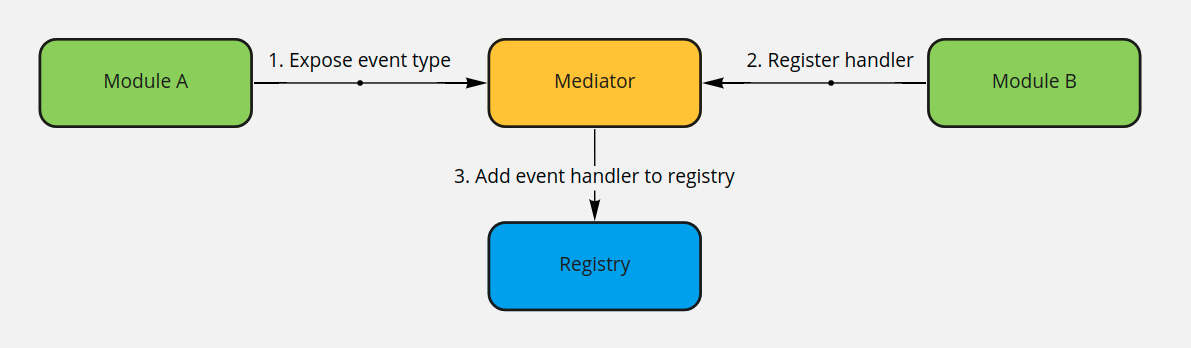
Register event handler
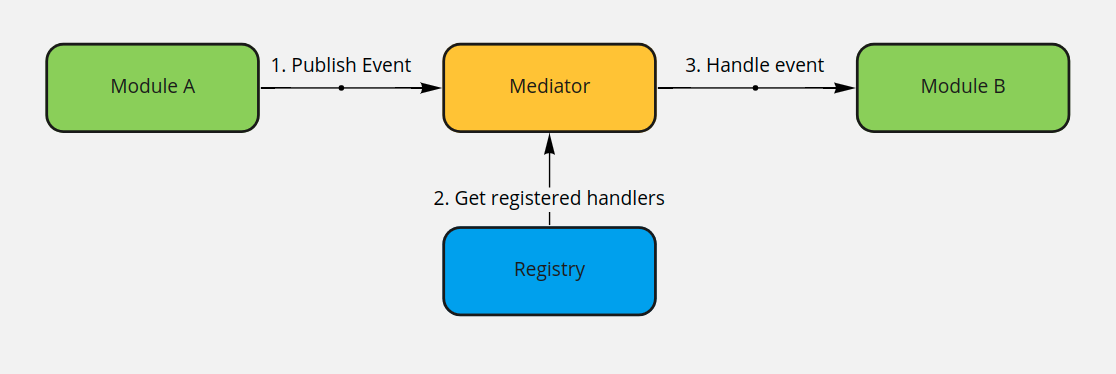
Dispatch events
Example
Simple usage
Code of example is here
- Write ModuleA - publisher
from dataclasses import dataclass

from decouple import Module, Event, Mediator


class ModuleA(Module):
    def __init__(self, mediator: Mediator = Mediator()):
        super().__init__(mediator)

    def start(self):
        self.pub(StartEvent(a=7))


@dataclass
class StartEvent(Event):
    a: int = 0  # must be serializable
- Write ModuleB - subscriber
from decouple import Module
from examples.simple.module_a import StartEvent


class ModuleB(Module):
    def __init__(self):
        super().__init__()

        self.sub(StartEvent, self.handle_a)

    def handle_start(self, event: StartEvent):
        print(f'field a:{event.a}')
- Compose both modules to the whole
from examples.simple.module_a import ModuleA
from examples.simple.module_b import ModuleB


module_a = ModuleA()
module_a.add(ModuleB())

module_a.start()
Priorities
Manual control
from decouple import Module
from examples.simple.module_a import StartEvent


class ModuleB(Module):
    def __init__(self):
        super().__init__()

        # handler with higher priority will be triggered early
        self.sub(StartEvent, self.handle_b, priority=0)
        self.sub(StartEvent, self.handle_a, priority=100)

    def handle_a(self, event: StartEvent):
        # will be triggered first
        print(f'field a:{event.a}')

    def handle_b(self, event: StartEvent):
        # will be triggered second
        print(f'event.uuid:{event.uuid}, event.timestamp:{event.timestamp}')
Default priority depends on registration order
from decouple import Module
from examples.simple.module_a import StartEvent


class ModuleB(Module):
    def __init__(self):
        super().__init__()

        # priority of handlers call increased by 1 every registration for the same event
        self.sub(StartEvent, self.handle_b)   # priority=1
        self.sub(StartEvent, self.handle_a)   # priority=2

    def handle_a(self, event: StartEvent):
        # will be triggered second
        print(f'field a:{event.a}')

    def handle_b(self, event: StartEvent):
        # will be triggered first
        print(f'event.uuid:{event.uuid}, event.timestamp:{event.timestamp}')
Feedback
I will be glad to read your feedback in issues and pull requests.
1 maintainer

Metadata
1 maintainer
Release files for decouple 0.0.7
For a detailed explanation of source distributions (sdists) and built distributions (wheels), please see the package formats documentation.
Source distribution (sdist)
| File | Size | Uploaded | Provenance | |
|---|---|---|---|---|
| decouple-0.0.7.tar.gz | 3.3 kB | Without provenance | Details |
Release files / decouple-0.0.7.tar.gz
| Download URL | decouple-0.0.7.tar.gz |
|---|---|
| Size | 3.3 kB |
| Tags | Source |
|
SHA-256 checksum How to use checksums |
c253c1cc62b76e9720a066f334552548c6de1884bc3bdf456ddb62d61b867b09
|
|
BLAKE2b-256 checksum How to use checksums |
6ce3f70681dd89a96a701f22055caedc79cf88cebdeac9df827a5720bca80278
|
| Upload date | |
|
Uploaded using Trusted Publishing? What is trusted publishing? |
No |
| Uploaded via |
twine/3.1.1 pkginfo/1.5.0.1 requests/2.22.0 setuptools/41.4.0 requests-toolbelt/0.9.1 tqdm/4.36.1 CPython/3.7.4
|
Security for decouple 0.0.7
Provenance
Provenance describes where a file came from. On PyPI, provenance is shared via attestations, which provide a verifiable record of the build or publishing details. View details, limitations and caveats.
No provenance found
None of the files in this release were uploaded with provenance metadata.
A note on package security
PyPI is a repository for distributing packages, not a service for auditing them. While third-party security researchers and our staff do their best to detect and remove malicious packages, PyPI cannot guarantee the quality, security or suitability of any given package.
To learn more about protecting yourself from malicious actors, visit our package security documentation.














