
DeepLabCut-live! SDK









This package contains a DeepLabCut inference pipeline for real-time applications that has minimal (software) dependencies. Thus, it is as easy to install as possible (in particular, on atypical systems like NVIDIA Jetson boards).
Performance: If you would like to see estimates on how your model should perform given different video sizes, neural network type, and hardware, please see: https://deeplabcut.github.io/DLC-inferencespeed-benchmark/
If you have different hardware, please consider submitting your results too! https://github.com/DeepLabCut/DLC-inferencespeed-benchmark
What this SDK provides: This package provides a DLCLive class which enables pose estimation online to provide feedback. This object loads and prepares a DeepLabCut network for inference, and will return the predicted pose for single images.
To perform processing on poses (such as predicting the future pose of an animal given it's current pose, or to trigger external hardware like send TTL pulses to a laser for optogenetic stimulation), this object takes in a Processor object. Processor objects must contain two methods: process and save.
- The
processmethod takes in a pose, performs some processing, and returns processed pose. - The
savemethod saves any valuable data created by or used by the processor
For more details and examples, see documentation here.
Note :: alone, this object does not record video or capture images from a camera. This must be done separately, i.e. see our DeepLabCut-live GUI.
Installation:
Please see our instruction manual to install on a Windows or Linux machine or on a NVIDIA Jetson Development Board
- available on pypi as:
pip install deeplabcut-live
Note, you can then test your installation by running:
dlc-live-test
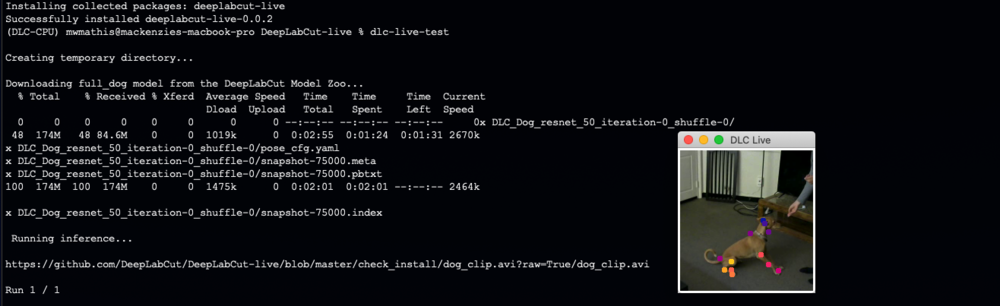
If installed properly, this script will i) create a temporary folder ii) download the full_dog model from the DeepLabCut Model Zoo, iii) download a short video clip of a dog, and iv) run inference while displaying keypoints. v) remove the temporary folder.
Quick Start: instructions for use:
- Initialize
Processor(if desired) - Initialize the
DLCLiveobject - Perform pose estimation!
from dlclive import DLCLive, Processor
dlc_proc = Processor()
dlc_live = DLCLive(<path to exported model directory>, processor=dlc_proc)
dlc_live.init_inference(<your image>)
dlc_live.get_pose(<your image>)
DLCLive parameters:
path= string; full path to the exported DLC model directorymodel_type= string; the type of model to use for inference. Types include:base= the base DeepLabCut modeltensorrt= apply tensor-rt optimizations to modeltflite= use tensorflow lite inference (in progress...)
cropping= list of int, optional; cropping parameters in pixel number: [x1, x2, y1, y2]dynamic= tuple, optional; defines parameters for dynamic cropping of imagesindex 0= use dynamic cropping, boolindex 1= detection threshold, floatindex 2= margin (in pixels) around identified points, int
resize= float, optional; factor by which to resize image (resize=0.5 downsizes both width and height of image by half). Can be used to downsize large images for faster inferenceprocessor= dlc pose processor object, optionaldisplay= bool, optional; display processed image with DeepLabCut points? Can be used to troubleshoot cropping and resizing parameters, but is very slow
DLCLive inputs:
<path to exported model directory>= path to the folder that has the.pbfiles that you acquire after runningdeeplabcut.export_model<your image>= is a numpy array of each frame
Benchmarking/Analyzing your exported DeepLabCut models
DeepLabCut-live offers some analysis tools that allow users to peform the following operations on videos, from python or from the command line:
- Test inference speed across a range of image sizes, downsizing images by specifying the
resizeorpixelsparameter. Using thepixelsparameter will resize images to the desired number ofpixels, without changing the aspect ratio. Results will be saved (along with system info) to a pickle file if you specify an output directory.
python
dlclive.benchmark_videos('/path/to/exported/model', ['/path/to/video1', '/path/to/video2'], output='/path/to/output', resize=[1.0, 0.75, '0.5'])
command line
dlc-live-benchmark /path/to/exported/model /path/to/video1 /path/to/video2 -o /path/to/output -r 1.0 0.75 0.5
- Display keypoints to visually inspect the accuracy of exported models on different image sizes (note, this is slow and only for testing purposes):
python
dlclive.benchmark_videos('/path/to/exported/model', '/path/to/video', resize=0.5, display=True, pcutoff=0.5, display_radius=4, cmap='bmy')
command line
dlc-live-benchmark /path/to/exported/model /path/to/video -r 0.5 --display --pcutoff 0.5 --display-radius 4 --cmap bmy
- Analyze and create a labeled video using the exported model and desired resize parameters. This option functions similar to
deeplabcut.benchmark_videosanddeeplabcut.create_labeled_video(note, this is slow and only for testing purposes).
python
dlclive.benchmark_videos('/path/to/exported/model', '/path/to/video', resize=[1.0, 0.75, 0.5], pcutoff=0.5, display_radius=4, cmap='bmy', save_poses=True, save_video=True)
command line
dlc-live-benchmark /path/to/exported/model /path/to/video -r 0.5 --pcutoff 0.5 --display-radius 4 --cmap bmy --save-poses --save-video
Reference:
If you utilize our tool, please cite our paper:
@Article{Kane2020dlclive,
  author    = {Kane, Gary and Lopes, Gonçalo and Sanders, Jonny and Mathis, Alexander and Mathis, Mackenzie},
  title     = {Real-time, low-latency closed-loop feedback using markerless posture tracking},
  journal   = {BioRxiv},
  year      = {2020},
}
License:
This project is licensed under the GNU Lesser General Public License v3.0. Note that the software is provided "as is", without warranty of any kind, express or implied. If you use the code or data, please cite us!
Community Support, Developers, & Help:
This is an actively developed package and we welcome community development and involvement.
-
If you want to contribute to the code, please read our guide here, which is provided at the main repository of DeepLabCut.
-
We are a community partner on the
-
If you encounter a previously unreported bug/code issue, please post here (we encourage you to search issues first): https://github.com/DeepLabCut/DeepLabCut-live/issues
-
For quick discussions here:


Release files for deeplabcut-live 0.0.3
For a detailed explanation of source distributions (sdists) and built distributions (wheels), please see the package formats documentation.
Source distribution (sdist)
| File | Size | Uploaded | Provenance | Actions |
|---|---|---|---|---|
| deeplabcut-live-0.0.3.tar.gz | 22.5 kB | Without provenance | Details for deeplabcut-live-0.0.3.tar.gz |
Built distribution (wheel)
| File | Interpreter | ABI | Platform | Actions Reset |
|---|---|---|---|---|
| deeplabcut_live-0.0.3-py3-none-any.whl | Python 3 | none | any | Details for deeplabcut_live-0.0.3-py3-none-any.whl |
Total release size: 62.1 kB
Release files / deeplabcut-live-0.0.3.tar.gz
| Download URL | deeplabcut-live-0.0.3.tar.gz |
|---|---|
| Size | 22.5 kB |
| Tags | Source |
|
SHA-256 checksum How to use checksums |
dc86d927376449a9ea7b0cc9215842d8a5ba1ef57cd2e907a177b91934594759
|
|
BLAKE2b-256 checksum How to use checksums |
b674223519cdba43a5332f7d99d37ae7347619e9bdeb94d5d4fab3cb23e2b913
|
| Upload date | |
|
Uploaded using Trusted Publishing? What is trusted publishing? |
No |
| Uploaded via |
twine/3.1.1 pkginfo/1.4.2 requests/2.22.0 setuptools/45.2.0 requests-toolbelt/0.8.0 tqdm/4.30.0 CPython/3.8.5
|
Release files / deeplabcut_live-0.0.3-py3-none-any.whl
| Download URL | deeplabcut_live-0.0.3-py3-none-any.whl |
|---|---|
| Size | 39.6 kB |
| Tags | Python 3 |
|
SHA-256 checksum How to use checksums |
ea9b549bbc6783e2fac5d1940aca972aee8666f45befa0e7369d6ffcce981727
|
|
BLAKE2b-256 checksum How to use checksums |
1e4dd76b35313dd8dccede06ee539b406934d99289e4756f9917c6b83f02fa65
|
| Upload date | |
|
Uploaded using Trusted Publishing? What is trusted publishing? |
No |
| Uploaded via |
twine/3.1.1 pkginfo/1.4.2 requests/2.22.0 setuptools/45.2.0 requests-toolbelt/0.8.0 tqdm/4.30.0 CPython/3.8.5
|
Security for deeplabcut-live 0.0.3
Provenance
Provenance describes where a file came from. On PyPI, provenance is shared via attestations, which provide a verifiable record of the build or publishing details. View details, limitations and caveats.
No provenance found
None of the files in this release were uploaded with provenance metadata.
A note on package security
PyPI is a repository for distributing packages, not a service for auditing them. While third-party security researchers and our staff do their best to detect and remove malicious packages, PyPI cannot guarantee the quality, security or suitability of any given package.
To learn more about protecting yourself from malicious actors, visit our package security documentation.














