


Deep Continuous Quantile Regression
This package explores different approaches to learning the uncertainty, and, more generally, the conditional distribution of the target variable. We introduce a new type of network, the "Deep Continuous Quantile Regression Network", that approximates the inverse conditional CDF directly by a mult-layer perceptron, instead of relying on variational methods which require priors on the functional form of the distribution. In many cases we find that it presents a robust alternative to well-known Mixture Density Networks`.
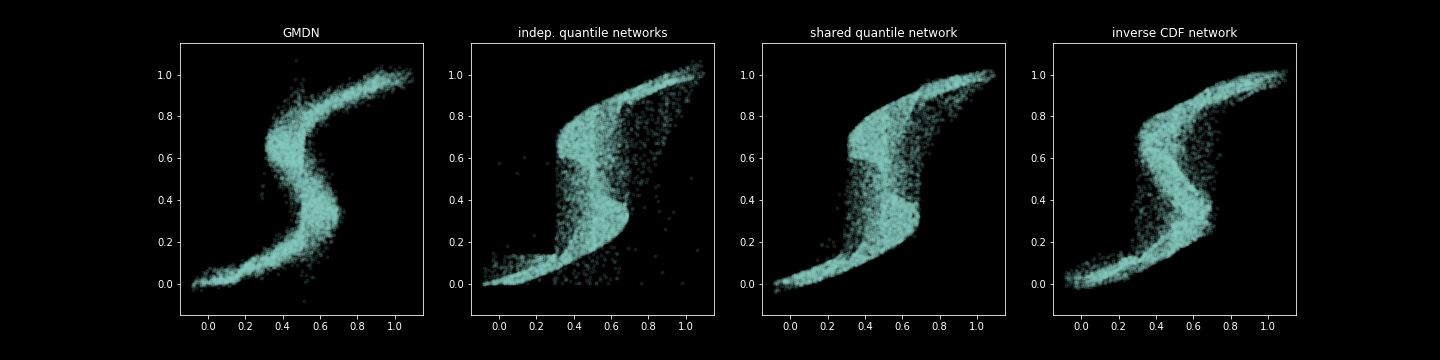
This is particularily important when
- the mean of the target variable is not sufficient for the use case
- the errors are heteroscedastic, i.e. vary depending on input features
- the errors are skewed, making a single summary statistic such as variance inadequate.
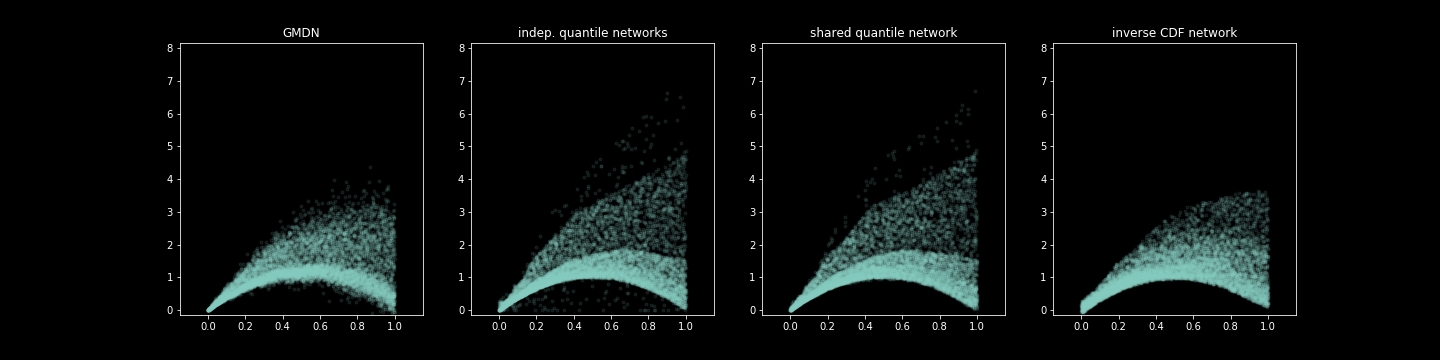
We explore two main approches:
- fitting a mixture density model
- learning the location of conditional qunatiles,
q, of the distribution.
Our mixture density network exploits an implementation trick to achieve negative-log-likelihood minimisation in keras.
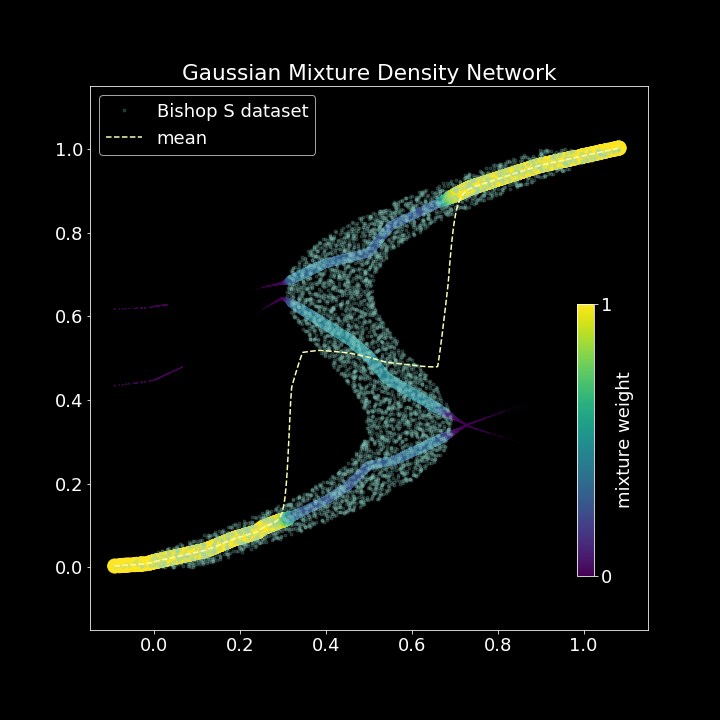
Same trick is useed to optimize the "pinball" loss in quantile regression networks, and in fact can be used to optimize an arbitrary loss function of (X, y, y_hat).
Within the quantile-based approach, we further explore:
a. fitting a separate model to predict each quantile
b. fitting a multi-output network to predict multiple quantiles simultaneously
c. learning a regression on X and q simultanesously, thus effectively
learning the complete (conditional) cumulative density function.
Installation
Install package from source:
pip install git+https://github.com/ig248/deepquantiles
Or from PyPi:
pip install deepquantiles
Usage
from deepquantiles import MultiQuantileRegressor, InverseCDFRegressor, MixtureDensityRegressor
As this package is largely an experiment, please explore the Jupyter notebooks and expect to look at the source code.
Content
deepqunatiles.regressors: implementation of core algorithmsdeepquantiles.presets: a collection of pre-configured estimators and settings used in experimentsdeepquantiles.datasets: functions used for generating test datadeepquantiles.nb_utils: helper functions used in notebooksnotebooks: Jupyter notebooks with examples and experiments
Tests
Run
make dev-install
make lint
make test
References
Mixture Density Networks, Christopher M. Bishop, NCRG/94/004 (1994)
1 maintainer

Metadata
1 maintainer
Release files for deepquantiles 0.0.2
For a detailed explanation of source distributions (sdists) and built distributions (wheels), please see the package formats documentation.
Source distribution (sdist)
| File | Size | Uploaded | Provenance | |
|---|---|---|---|---|
| deepquantiles-0.0.2.tar.gz | 9.9 kB | Without provenance | Details |
Built distribution (wheel)
| File | Interpreter | ABI | Platform | Reset |
|---|---|---|---|---|
| deepquantiles-0.0.2-py2.py3-none-any.whl | Python 3, Python 2 | none | any | Details |
Total release size: 21.9 kB
Release files / deepquantiles-0.0.2.tar.gz
| Download URL | deepquantiles-0.0.2.tar.gz |
|---|---|
| Size | 9.9 kB |
| Tags | Source |
|
SHA-256 checksum How to use checksums |
91023eec0c9745f34b0fa558b4090aceac4fbe3454836f7c3d45e55ae0dbb0fa
|
|
BLAKE2b-256 checksum How to use checksums |
e17349fb5e90c7176393690020fb2a3d9b4b852ea451ff850fa49855c00ae8e0
|
| Upload date | |
|
Uploaded using Trusted Publishing? What is trusted publishing? |
No |
| Uploaded via |
twine/1.13.0 pkginfo/1.5.0.1 requests/2.21.0 setuptools/40.8.0 requests-toolbelt/0.9.1 tqdm/4.31.1 CPython/3.6.7
|
Release files / deepquantiles-0.0.2-py2.py3-none-any.whl
| Download URL | deepquantiles-0.0.2-py2.py3-none-any.whl |
|---|---|
| Size | 12.0 kB |
| Tags | Python 2 Python 3 |
|
SHA-256 checksum How to use checksums |
a80aa4a121cf23477f8d235a8fcfe0ddb6ae664b21baed5b37315b5f9413aed7
|
|
BLAKE2b-256 checksum How to use checksums |
ec44954fb3dcdde500d3b7ab7cae302c11d36179ff9d116a88d5c8178e8f38ad
|
| Upload date | |
|
Uploaded using Trusted Publishing? What is trusted publishing? |
No |
| Uploaded via |
twine/1.13.0 pkginfo/1.5.0.1 requests/2.21.0 setuptools/40.8.0 requests-toolbelt/0.9.1 tqdm/4.31.1 CPython/3.6.7
|
Security for deepquantiles 0.0.2
Provenance
Provenance describes where a file came from. On PyPI, provenance is shared via attestations, which provide a verifiable record of the build or publishing details. View details, limitations and caveats.
No provenance found
None of the files in this release were uploaded with provenance metadata.
A note on package security
PyPI is a repository for distributing packages, not a service for auditing them. While third-party security researchers and our staff do their best to detect and remove malicious packages, PyPI cannot guarantee the quality, security or suitability of any given package.
To learn more about protecting yourself from malicious actors, visit our package security documentation.














