
## What is this?
diagram-autobuild improves the efficiency of the making diagrams.
diagram-autobuild is supporting the following tools.
- graphviz (http://www.graphviz.org/)
- blockdiag (https://pypi.python.org/pypi/blockdiag)
- nwdiag (https://pypi.python.org/pypi/nwdiag)
- actdiag (https://pypi.python.org/pypi/actdiag)
- seqdiag (https://pypi.python.org/pypi/seqdiag)
- ERAlchemy (https://pypi.python.org/pypi/ERAlchemy)
### Background
If you make a diagram, you usually do the following cycle.
1. Edit the source (e.g. \*.dot)
2. Build the diagram (e.g. execute 'dot' command)
3. Open the diagram
4. Make sure whether the diagram is your intended (If it isn't so, retry from the first)
This procedure is inefficient and bother you.
### Solution
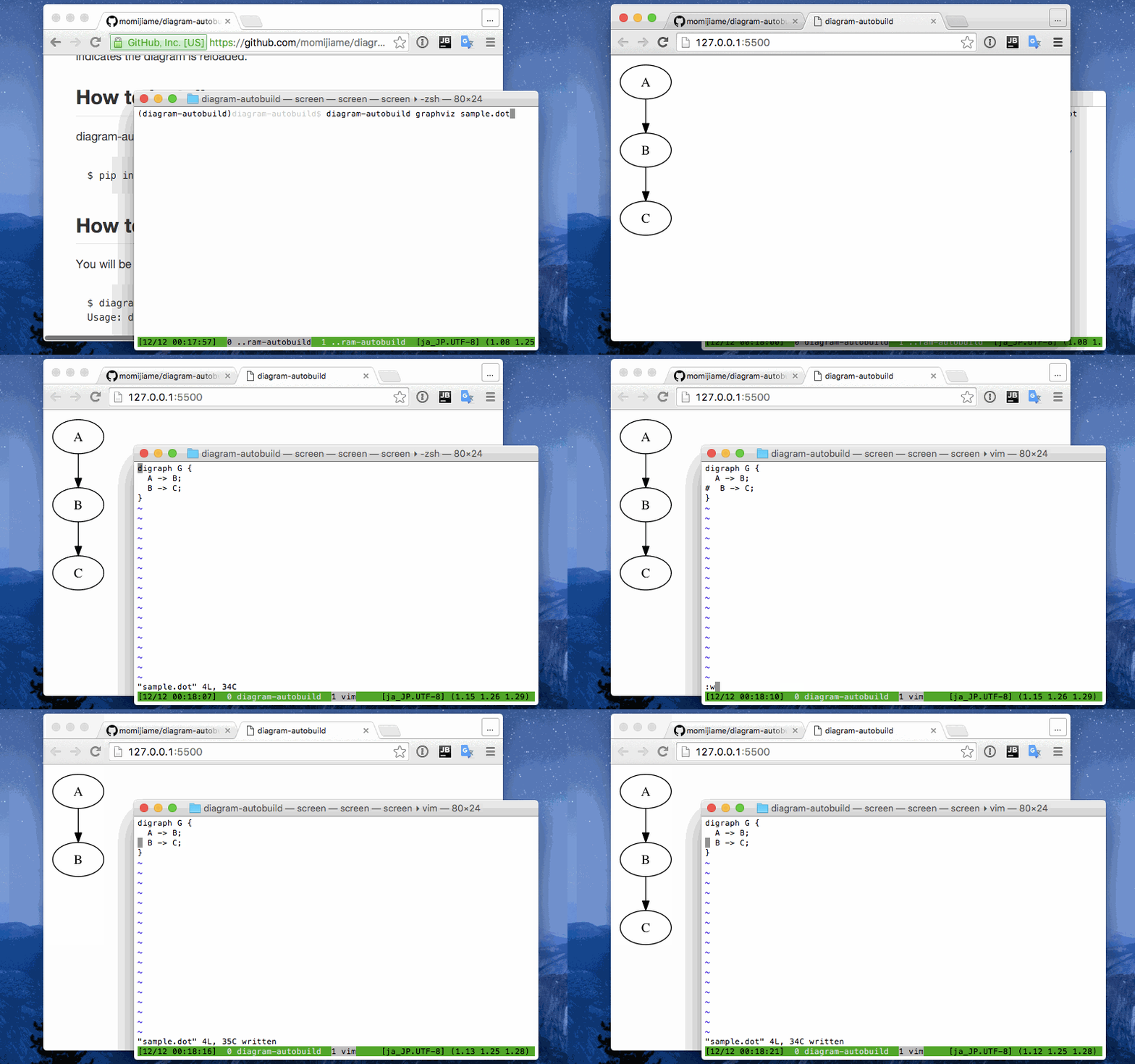
Automation: the above procedure between 2 and 3
diagram-autobuild observes the source file.
If the source file is modified, rebuild the diagram, and the browser which indicates the diagram is reloaded.
## How to install
diagram-autobuild is installed by using pip of Python's package manager.
```
$ pip install diagram-autobuild
```
or
```
$ pip install git+https://github.com/momijiame/diagram-autobuild.git
```
## How to use
You will be able to use 'diagram-autobuild' command.
```
$ diagram-autobuild --help
Usage: diagram-autobuild [OPTIONS] TOOL SOURCE
Options:
--tool-opts TEXT Options that are passed to the tool
--open-browser / --no-open-browser
Open your default browser when the command
is executed
--help Show this message and exit.
```
Execute 'diagram-autobuild' command with the tool name and the path of source file.
(The tool must to be installed already)
Example (graphviz):
```
$ ls
sample.dot
$ diagram-autobuild graphviz sample.dot
```
Example (blockdiag):
```
$ ls
sample.diag
$ diagram-autobuild blockdiag sample.diag
```
Example (ERAlchemy):
```
$ ls
sample.er
$ diagram-autobuild eralchemy sample.er
```
If it succeed, open your default browser and you can see the diagram.
1 maintainer

Metadata
1 maintainer
Release files for diagram-autobuild 0.1.0
For a detailed explanation of source distributions (sdists) and built distributions (wheels), please see the package formats documentation.
Source distribution (sdist)
| File | Size | Uploaded | Provenance | Actions |
|---|---|---|---|---|
| diagram-autobuild-0.1.0.tar.gz | 4.9 kB | Without provenance | Details for diagram-autobuild-0.1.0.tar.gz |
Built distribution (wheel)
| File | Interpreter | ABI | Platform | Actions Reset |
|---|---|---|---|---|
| diagram_autobuild-0.1.0-py2.py3-none-any.whl | Python 2, Python 3 | none | any | Details for diagram_autobuild-0.1.0-py2.py3-none-any.whl |
Total release size: 14.4 kB
Release files / diagram-autobuild-0.1.0.tar.gz
| Download URL | diagram-autobuild-0.1.0.tar.gz |
|---|---|
| Size | 4.9 kB |
| Tags | Source |
|
SHA-256 checksum How to use checksums |
086a9b7e055478c0b94af10848c1ff63bfa576d52e777b2f91609bb31f4b31fb
|
|
BLAKE2b-256 checksum How to use checksums |
a063af293f5a90f8ce57af62fc73979e41360b365f76834c7e16b353aedc602b
|
| Upload date | |
|
Uploaded using Trusted Publishing? What is trusted publishing? |
No |
Release files / diagram_autobuild-0.1.0-py2.py3-none-any.whl
| Download URL | diagram_autobuild-0.1.0-py2.py3-none-any.whl |
|---|---|
| Size | 9.5 kB |
| Tags | Python 2 Python 3 |
|
SHA-256 checksum How to use checksums |
f307fa1f4dcf875b5d7f4ec38e31220dee4dcce5637dc3a8f5a3cf397a343c15
|
|
BLAKE2b-256 checksum How to use checksums |
d3fc34b020fcc5bd7a9713b4df378e18309f1dcd5d64e9f99f46e4f9445a81ff
|
| Upload date | |
|
Uploaded using Trusted Publishing? What is trusted publishing? |
No |
Security for diagram-autobuild 0.1.0
Provenance
Provenance describes where a file came from. On PyPI, provenance is shared via attestations, which provide a verifiable record of the build or publishing details. View details, limitations and caveats.
No provenance found
None of the files in this release were uploaded with provenance metadata.
A note on package security
PyPI is a repository for distributing packages, not a service for auditing them. While third-party security researchers and our staff do their best to detect and remove malicious packages, PyPI cannot guarantee the quality, security or suitability of any given package.
To learn more about protecting yourself from malicious actors, visit our package security documentation.














