
CLI tool to extract synonyms/antonyms from online services, which formats
them into dict structures (word|alt :: definition; etc.) suitable for
ding.
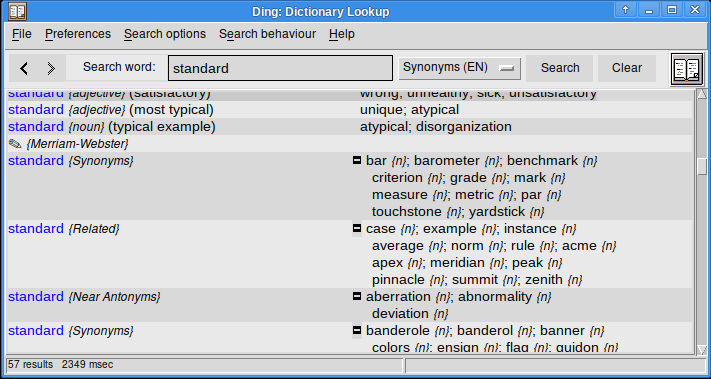
It's fairly basic, and not all result sets are structured alike.
Furthermore the extraction schemes aren't likely to last for long (web
scraping is typically a maintenance task).
Only scans for singular words (most services wouldn't return results
otherwise). And might yield error messages for charset issues as well.
SYNTAX
dingonyms --merriamwebster "find"
| Parameter | Aliases | Class |
|---|---|---|
| --thesaurus | -t --thes | EN |
| --merriamwebster | -mw --merr --webster --merweb | EN |
| --synonym | -s --syn --synonym.com | EN |
| --reverso | --rev // -fr -es -it -pt -nl -ru -jp | EN/** |
| --wordhippo | -hippo --wordhip | EN |
| --mobythesaurus | -mby --moby | EN |
| --urban | -u --urb --ubn | LEXICON |
| --dictcc | --en-es --en-it --de-fr --en-pt | DICT |
| --openthesaurus | -ot --othes --open | DE |
| --woxikon | -wx --woxi | DE |
| --synonyme_de | -sd --desyn | DE |
| --all | (-t -mw -syn -rev -ot -wx -urban) | MIXED |
| --en | (-t -mw -syn -rev) | MIXED |
| --de | (-ot -wx -sd) | MIXED |
| --no-antonyms | -na | FLAG |
| --no-headers | -nh | FLAG |
| --async | --parallel --io | FLAG |
Flags can be abbreviated and also combined: --thes --merrweb would query two
services at once, or --all even all. While --en or --de run through language-
specific functions. (See the man page for more details. There is a man page.)
CONFIG IN ~/.dingrc (take care to change 3 to available index)
set searchmeth(3,name) {Synonyms}
set searchmeth(3,type) {3}
set searchmeth(3,dictfile) {}
set searchmeth(3,separator) { :: }
set searchmeth(3,language1) {Group}
set searchmeth(3,language2) {Synonyms}
set searchmeth(3,grepcmd) {dingonyms}
set searchmeth(3,grepopts) {--async --thesaurus --merriamwebster --synonyms}
set searchmeth(3,maxlength) {30}
set searchmeth(3,maxresults) {200}
set searchmeth(3,minlength) {2}
set searchmeth(3,shapedresult) {1}
set searchmeth(3,foldedresult) {0}
You might want to add one entry for each search backend even. (Unique index, title/name, and grepopts --parameter each.)
SETUP (pip3 install -U dingonyms)
You might have to symlink ~/.local/bin/dingonyms into ~/bin after
installation. pip-package binaries are often only picked up in
terminal/interactive shells.
Hijack as module
Obviously this is priamrily a CLI tool, but can be utilized per monkeypatching:
import dingonyms ls = [] dingonyms.out.alternatives = lambda *x: ls.append(x)
1 maintainer

Metadata
1 maintainer
Release files for dingonyms 0.8
For a detailed explanation of source distributions (sdists) and built distributions (wheels), please see the package formats documentation.
Built distribution (wheel)
| File | Interpreter | ABI | Platform | Reset |
|---|---|---|---|---|
| dingonyms-0.8-py3-none-any.whl | Python 3 | none | any | Details |
Release files / dingonyms-0.8-py3-none-any.whl
| Download URL | dingonyms-0.8-py3-none-any.whl |
|---|---|
| Size | 12.8 kB |
| Tags | Python 3 |
|
SHA-256 checksum How to use checksums |
13c6bdee3f002f5bbf6985e4dab19bea0e80f8bf50ca014a1234a721dd1bedf7
|
|
BLAKE2b-256 checksum How to use checksums |
1e52acf3886ca0fad353e9782a9e4e1caa21a0f3f2781524bb1255a7397d4982
|
| Upload date | |
|
Uploaded using Trusted Publishing? What is trusted publishing? |
No |
| Uploaded via |
twine/3.3.0 pkginfo/1.7.0 requests/2.27.1 setuptools/62.3.2 requests-toolbelt/0.9.1 tqdm/4.58.0 CPython/3.8.2
|
Security for dingonyms 0.8
Provenance
Provenance describes where a file came from. On PyPI, provenance is shared via attestations, which provide a verifiable record of the build or publishing details. View details, limitations and caveats.
No provenance found
None of the files in this release were uploaded with provenance metadata.
A note on package security
PyPI is a repository for distributing packages, not a service for auditing them. While third-party security researchers and our staff do their best to detect and remove malicious packages, PyPI cannot guarantee the quality, security or suitability of any given package.
To learn more about protecting yourself from malicious actors, visit our package security documentation.














