
🗡️Djagger - OpenAPI schema generator for Django using pydantic


Automated OpenAPI documentation generator for Django. Djagger provides you with a clean and straightforward way to generate a comprehensive API documentation of your Django project by utilizing pydantic to create schema objects for your views.
Djagger is designed to be:
🧾 Comprehensive - Every aspect of your API should be document-able straight from your views, to the full extent of the OpenAPi 3.0 specification.
👐 Unintrusive - Integrate easily with your existing Django project. Djagger can document vanilla Django views (function-based and class-based views), as well as any Django REST framework views. As long as you are using Django’s default URL routing, you are good to go. You do not need to redesign your APIs for better documentation.
🍭 Easy - Djagger uses pure, unadulterated pydantic models to generate schemas. If you have used pydantic, there is no learning curve. If you have not heard of pydantic, it is a powerful data validation library that is pretty straightforward to pickup (like dataclasses). Check it out here. Either way, documenting your APIs will feel less like a chore.
Quickstart
Install using pip
pip install djaggerAdd djagger to your INSTALLED_APPS setting in your Django project like this:
INSTALLED_APPS = [
    ...
    'djagger',
]
Include the djagger URLconf in your project urls.py like this if you want to use the built-in document views.
urlpatterns = [
    ...
    path('djagger/', include('djagger.urls')),
]Examples
Example GET Endpoint
from rest_framework.views import APIView
from rest_framework.response import Response
from pydantic import BaseModel as Schema
import datetime


class ArticleDetailSchema(Schema):
    created : datetime.datetime
    title : str
    author : str
    content : str


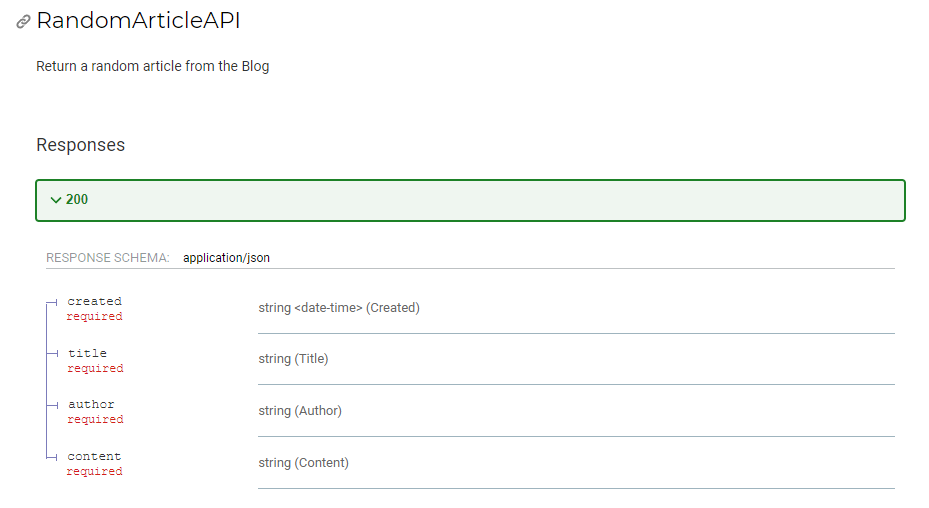
class RandomArticleAPI(APIView):
    """Return a random article from the Blog"""

    response_schema = ArticleDetailSchema

    def get(self, request):
        ...
        return Response({})
Generated documentation
Example POST Endpoint
from rest_framework.views import APIView
from rest_framework.response import Response
from pydantic import BaseModel as Schema, Field
import datetime


class ArticleDetailSchema(Schema):
    created : datetime.datetime
    title : str
    author : str
    content : str

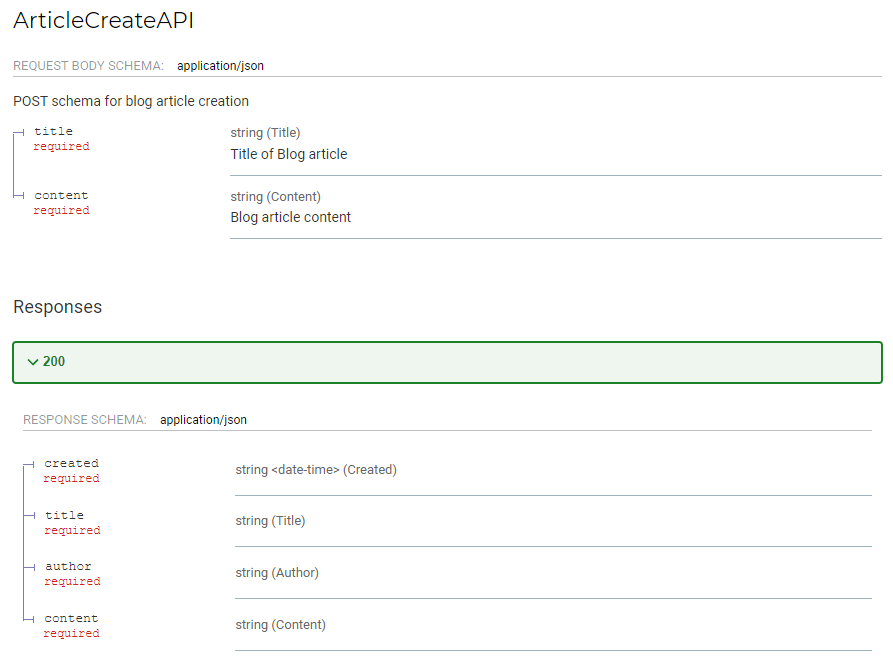
class ArticleCreateSchema(Schema):
    """POST schema for blog article creation"""
    title : str = Field(description="Title of Blog article")
    content : str = Field(description="Blog article content")


class ArticleCreateAPI(APIView):

    request_schema = ArticleCreateSchema
    response_schema = ArticleDetailSchema

    def post(self, request):
        ...
        return Response({})
Generated documentation
For more involved examples, check out the example project and the API documentation generated from that project.
Documentation & Support
Read the full documentation for Djagger: https://djagger-docs.netlify.app
This project is in continuous development. If you have any questions or would like to contribute, please email royhung@protonmail.com
If you want to support this project, do give it a ⭐ on github!
1 maintainer

Metadata
1 maintainer
Release files for djagger 1.1.4
For a detailed explanation of source distributions (sdists) and built distributions (wheels), please see the package formats documentation.
Source distribution (sdist)
| File | Size | Uploaded | Provenance | Actions |
|---|---|---|---|---|
| djagger-1.1.4.tar.gz | 3.0 MB | Without provenance | Details for djagger-1.1.4.tar.gz |
Release files / djagger-1.1.4.tar.gz
| Download URL | djagger-1.1.4.tar.gz |
|---|---|
| Size | 3.0 MB |
| Tags | Source |
|
SHA-256 checksum How to use checksums |
98548f2facc3a1b77c2c2a1a9a15dc371c27ba7c4160ea2ead62dcb57e27076e
|
|
BLAKE2b-256 checksum How to use checksums |
7aa2df7a140aabada2c727352114c82d88ec1553cbd546ab7233a6ee8f1e34af
|
| Upload date | |
|
Uploaded using Trusted Publishing? What is trusted publishing? |
No |
| Uploaded via |
twine/3.8.0 pkginfo/1.8.2 readme-renderer/34.0 requests/2.27.1 requests-toolbelt/0.9.1 urllib3/1.26.9 tqdm/4.64.0 importlib-metadata/4.8.3 keyring/23.4.1 rfc3986/1.5.0 colorama/0.4.4 CPython/3.6.9
|
Security for djagger 1.1.4
Provenance
Provenance describes where a file came from. On PyPI, provenance is shared via attestations, which provide a verifiable record of the build or publishing details. View details, limitations and caveats.
No provenance found
None of the files in this release were uploaded with provenance metadata.
A note on package security
PyPI is a repository for distributing packages, not a service for auditing them. While third-party security researchers and our staff do their best to detect and remove malicious packages, PyPI cannot guarantee the quality, security or suitability of any given package.
To learn more about protecting yourself from malicious actors, visit our package security documentation.














