





django-logger-panel
An easy way to change the log level in runtime
Installation
pip install django-logger-panel
Features
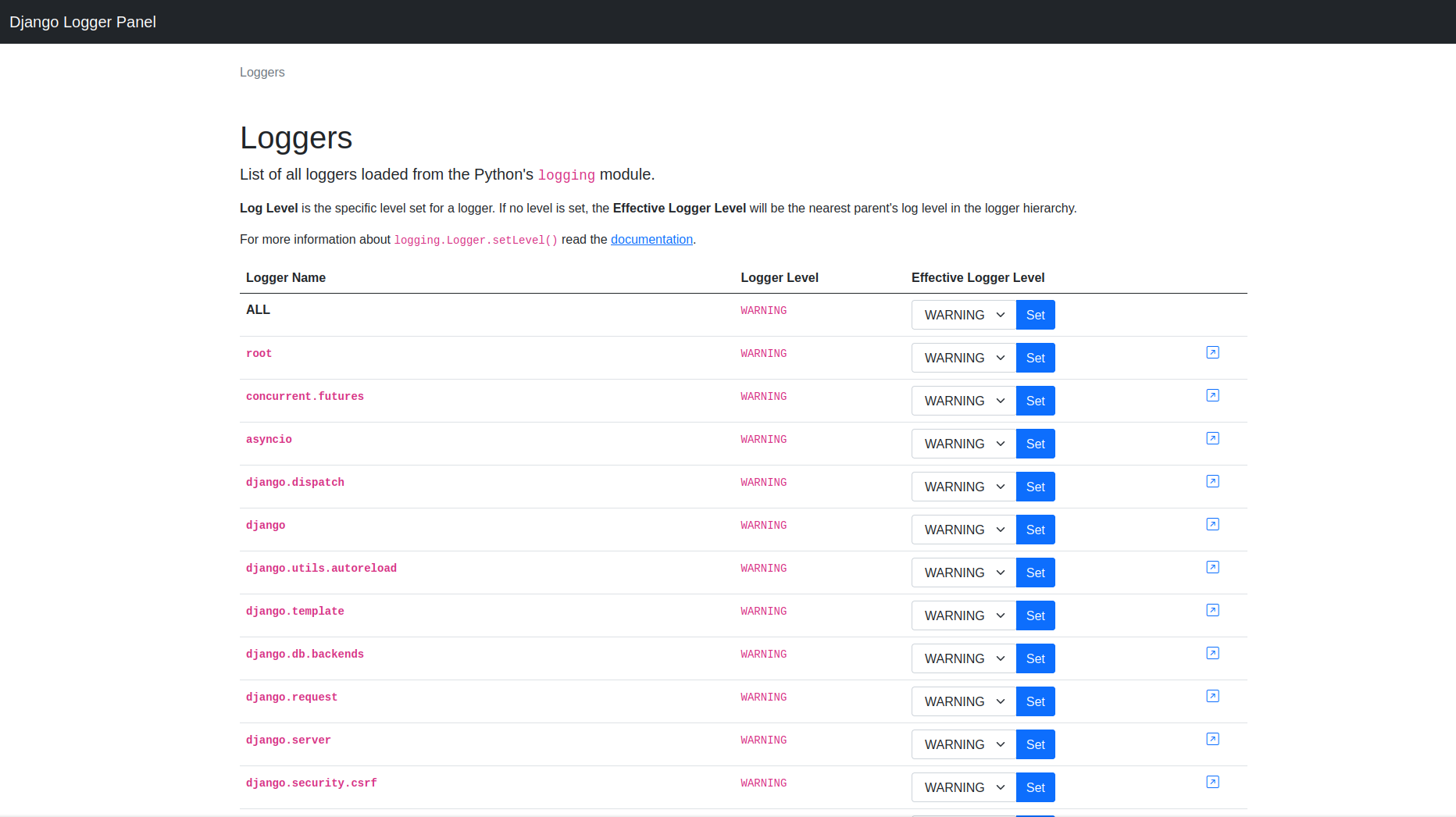
- List all active loggers .
- Change any logger level in run time.
- Change all logger levels at once.
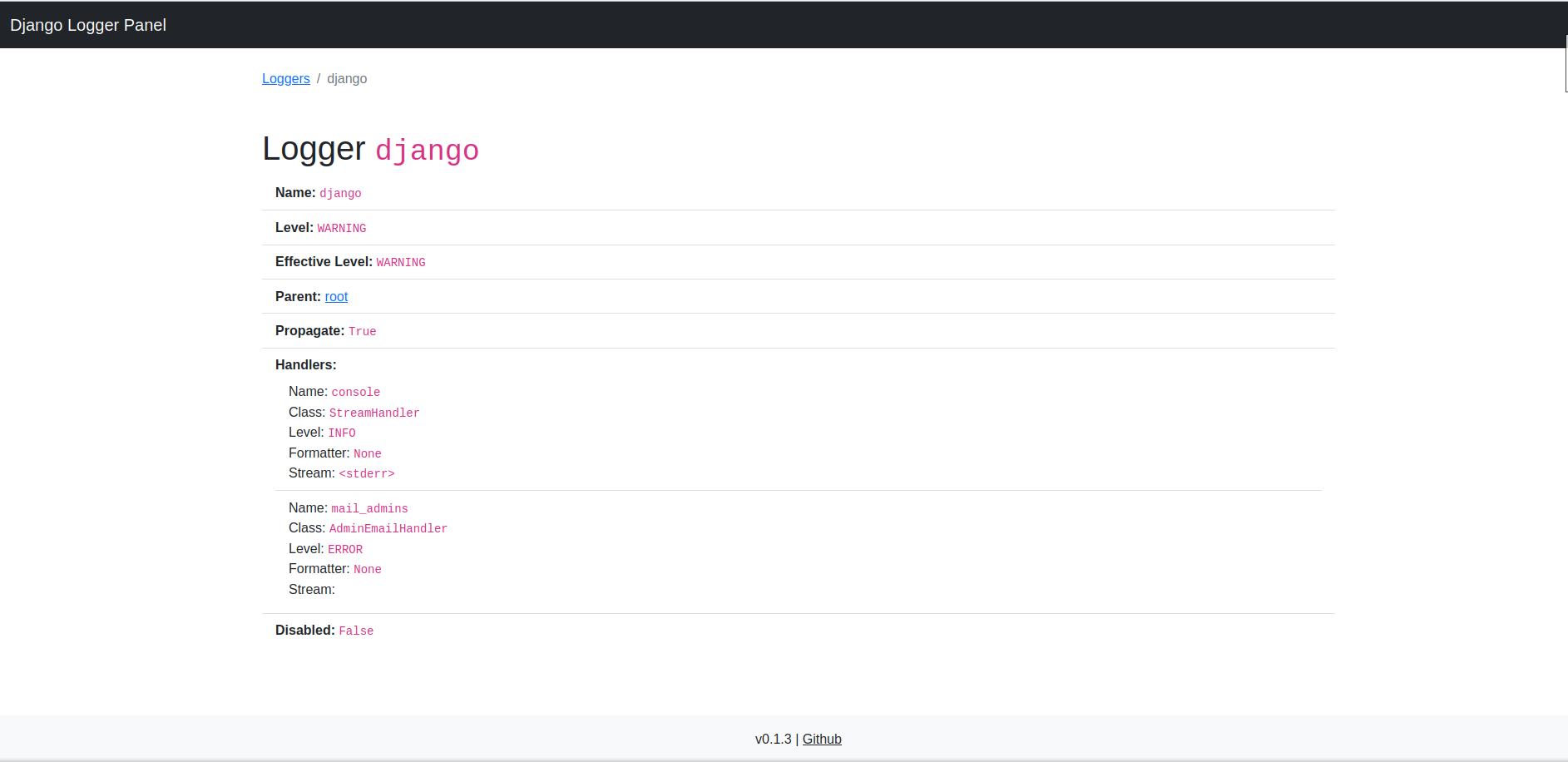
- Display logger information.
Settings.py
INSTALLED_APPS
Add loggerpanel to installed apps
INSTALLED_APPS = [
    ...
    'django_logger_panel',
]
LOGGING
Make sure the root has a handler set at the LOGGING dictionary in settings.py, as described in the Django Documentation.
This is the root logger configuration and will allow all loggers with no handler to inherit it from the root.
Example:
LOGGING = {
    'version': 1,
    'disable_existing_loggers': False,
    'formatters': {
        'console': {
            'format': '%(asctime)s %(levelname)-8s %(name)-12s %(message)s',
        },
    },
    'handlers': {
        'console': {
            'class': 'logging.StreamHandler',
            'formatter': 'console',
        },
    },
    'root': {
        'level': 'DEBUG',
        'handlers': ['console'],
    },
}
LOGGER_PANEL_BASE_URL
Optionally, change the default base url /loggers/ by setting the property LOGGER_PANEL_BASE_URL.
This variable is not required.
LOGGER_PANEL_BASE_URL = "/another-path/"
urls.py
Add the django_logger_panel.urls to the urlpatterns.
urlpatterns = [
    ...
    path("", include("django_logger_panel.urls")),
    ...

]
Screenshots
Logger Panel
Logger Details
REST API
List loggers
Curl Example:
curl http://localhost:8000/loggers/ -H 'Accept:application/json'
Response:
{
  "log_levels": {
    "CRITICAL": 50,
    "ERROR": 40,
    "WARNING": 30,
    "INFO": 20,
    "DEBUG": 10,
    "NOTSET": 0
  },
  "loggers": [
    {
      "name": "_all_loggers_",
      "level": {
        "code": 0,
        "name": "NOTSET"
      },
      "effectiveLevel": {
        "code": 0,
        "name": "NOTSET"
      },
      "parent": null
    },
    {
      "name": "root",
      "level": {
        "code": 30,
        "name": "WARNING"
      },
      "effectiveLevel": {
        "code": 30,
        "name": "WARNING"
      },
      "parent": null
    },
    {
      "name": "django",
      "level": {
        "code": 20,
        "name": "INFO"
      },
      "effectiveLevel": {
        "code": 20,
        "name": "INFO"
      },
      "parent": "root"
    },
    {
      "name": "django.db.backends",
      "level": {
        "code": 0,
        "name": "NOTSET"
      },
      "effectiveLevel": {
        "code": 20,
        "name": "INFO"
      },
      "parent": "django"
    },
    {
      "name": "django.request",
      "level": {
        "code": 0,
        "name": "NOTSET"
      },
      "effectiveLevel": {
        "code": 20,
        "name": "INFO"
      },
      "parent": "django"
    },
    {
      "name": "django.server",
      "level": {
        "code": 20,
        "name": "INFO"
      },
      "effectiveLevel": {
        "code": 20,
        "name": "INFO"
      },
      "parent": "django"
    },
    {
      "name": "django.security.csrf",
      "level": {
        "code": 0,
        "name": "NOTSET"
      },
      "effectiveLevel": {
        "code": 20,
        "name": "INFO"
      },
      "parent": "django"
    },
    {
      "name": "django.db.backends.schema",
      "level": {
        "code": 0,
        "name": "NOTSET"
      },
      "effectiveLevel": {
        "code": 20,
        "name": "INFO"
      },
      "parent": "django.db.backends"
    }
  ]
}
Return a single logger
Curl Example:
curl http://localhost:8000/loggers/django.db.backends -H 'Accept:application/json'
Response:
{
  "name": "django.db.backends",
  "level": {
    "code": 0,
    "name": "NOTSET"
  },
  "effectiveLevel": {
    "code": 20,
    "name": "INFO"
  },
  "parent": "django"
}
Change logger level
Curl Example:
curl -X POST http://localhost:8000/loggers/django.db.backends -d '{"logger_level": "DEBUG"}'
Response:
{
  "name": "django.db.backends",
  "level": {
    "code": 10,
    "name": "DEBUG"
  },
  "effectiveLevel": {
    "code": 10,
    "name": "DEBUG"
  },
  "parent": "django"
}
1 maintainer

Metadata
1 maintainer
Release files for django-logger-panel 0.1.6
For a detailed explanation of source distributions (sdists) and built distributions (wheels), please see the package formats documentation.
Source distribution (sdist)
| File | Size | Uploaded | Provenance | |
|---|---|---|---|---|
| django-logger-panel-0.1.6.tar.gz | 15.2 kB | Without provenance | Details |
Built distribution (wheel)
| File | Interpreter | ABI | Platform | Reset |
|---|---|---|---|---|
| django_logger_panel-0.1.6-py2.py3-none-any.whl | Python 3, Python 2 | none | any | Details |
Total release size: 31.4 kB
Release files / django-logger-panel-0.1.6.tar.gz
| Download URL | django-logger-panel-0.1.6.tar.gz |
|---|---|
| Size | 15.2 kB |
| Tags | Source |
|
SHA-256 checksum How to use checksums |
df128609ec9851025b71adadfe3008bc8307e011076b803d8714ef848b3d4f76
|
|
BLAKE2b-256 checksum How to use checksums |
3eadc0e4e878265d60edae1165b7df911272f6be3ba34811520662f5076205c7
|
| Upload date | |
|
Uploaded using Trusted Publishing? What is trusted publishing? |
No |
| Uploaded via |
twine/3.4.1 importlib_metadata/4.5.0 pkginfo/1.7.0 requests/2.25.1 requests-toolbelt/0.9.1 tqdm/4.61.0 CPython/3.8.5
|
Release files / django_logger_panel-0.1.6-py2.py3-none-any.whl
| Download URL | django_logger_panel-0.1.6-py2.py3-none-any.whl |
|---|---|
| Size | 16.2 kB |
| Tags | Python 2 Python 3 |
|
SHA-256 checksum How to use checksums |
9c19d10707dc1bdbb81ae8661b3f2a7532da410480a1dac9307baf89aa36e6fc
|
|
BLAKE2b-256 checksum How to use checksums |
e71327d839797f64f7ca3d27d97bd39dbbc14df04262644048906bbbc4e7749c
|
| Upload date | |
|
Uploaded using Trusted Publishing? What is trusted publishing? |
No |
| Uploaded via |
twine/3.4.1 importlib_metadata/4.5.0 pkginfo/1.7.0 requests/2.25.1 requests-toolbelt/0.9.1 tqdm/4.61.0 CPython/3.8.5
|
Security for django-logger-panel 0.1.6
Provenance
Provenance describes where a file came from. On PyPI, provenance is shared via attestations, which provide a verifiable record of the build or publishing details. View details, limitations and caveats.
No provenance found
None of the files in this release were uploaded with provenance metadata.
A note on package security
PyPI is a repository for distributing packages, not a service for auditing them. While third-party security researchers and our staff do their best to detect and remove malicious packages, PyPI cannot guarantee the quality, security or suitability of any given package.
To learn more about protecting yourself from malicious actors, visit our package security documentation.














