
Django Maja Newsletter
The problematic was :
How to couple a contact base to a mailing list and sending newsletters throught Django ?
Imagine that we have an application containing some kind of profiles or something like the django.contrib.auth and you want to send newsletters to them and tracking the activity.
This package is a fork of of emencia-django-newsletter with django 1.6 compatibility and other customizations
Features
More than a long speech, here the list of the main features :
Coupling capacities with another django model.
Variables can be used in the newsletter’s templates.
Mailing list managements (merging, importing…).
Import/Export of the contact in VCard 3.0.
Configurable SMTP servers with flow limit management.
Working groups.
Can send newsletter previews.
Subscriptions and unsubscriptions to mailing list.
Attachments in newsletters.
Unique urls for an user.
Tracking statistics.
Architecture
At the level of the application architecture, we can see 2 originalities who need to be explained.
Content types
The content types application is used to link any Contact model instance to another model instance. This allow you to create different kinds of contact linked to differents application, and retrieve the association at anytime.
This is particulary usefull with the templates variables if certain informations are located in the model instance linked.
Cronjob/Command
The maja_newsletter application will never send the newsletters registered in the site until you launch the send_newsletter command.
$ python manage.py send_newsletter
This command will launch the newsletters who need to be launched accordingly to the credits of the SMTP server of the newsletter. That’s mean that not all newsletters will be expedied at the end of the command because if you use a public SMTP server you can be banished temporarly if you reach the sending limit. To avoid banishment all the newsletters are not sended in the same time and immediately.
So it is recommanded to create a cronjob for launching this command every hours for example.
Installation
Dependencies
Make sure to install these packages prior to installation :
Django >= 1.2
html2text
BeautifulSoup
django-tagging
vobject
xlwt
xlrd
The package below is optionnal but handy for rendering a webpage in your newsletter.
lxml
Getting the code
You could retrieve the last sources from http://github.com/nephila/django-maja-newsletter and running the installation script
$ python setup.py install
or use pip
$ pip install -e git://github.com/nephila/django-maja-newsletter.git#egg=maja_newsletter
For the latest stable version use easy_install
$ easy_install django-maja-newsletter
Applications
Then register maja_newsletter, admin, contenttypes and tagging in the INSTALLED_APPS section of your project’s settings.
INSTALLED_APPS = (
  # Your favorites apps
  'django.contrib.contenttypes',
  'django.contrib.sites',
  'django.contrib.admin',
  'django.contrib.sessions',
  'tagging',
  'maja_newsletter',)
Urls
In your project urls.py adding this following line to include the newsletter’s urls for serving the newsletters in HTML.
url(r'^newsletters/', include('maja_newsletter.urls')),
Note this urlset is provided for convenient usage, but you can do something like that if you want to customize your urls :
url(r'^newsletters/', include('maja_newsletter.urls.newsletter')),
url(r'^mailing/', include('maja_newsletter.urls.mailing_list')),
url(r'^tracking/', include('maja_newsletter.urls.tracking')),
url(r'^statistics/', include('maja_newsletter.urls.statistics')),
Media Files
You have to make a symbolic link from maja_newsletter/media/edn/ directory to your media directory or make a copy named edn, but if want to change this value, define NEWSLETTER_MEDIA_URL in the settings.py as appropriate.
Don’t forget to serve this url.
Synchronization
Now you can run a syncdb for installing the models into your database.
Settings
You have to add in your settings the email address used to send the newsletter :
NEWSLETTER_DEFAULT_HEADER_SENDER = 'My NewsLetter <newsletter@myhost.com>'
DBMS considerations
It’s not recommended to use SQLite for production use. Because is limited to 999 variables into a SQL query, you can not create a Mailing List greater than this limitations in the Django’s admin modules. Prefer MySQL ou PgSQL.
Development
A Buildout script is provided to properly initialize the project for anybody who wants to contribute.
First of all, please use VirtualEnv to protect your system.
Follow these steps to start the development :
$ git clone git://github.com/nephila/django-maja-newsletter.git
$ virtualenv --no-site-packages maja_newsletter
$ cd maja_newsletter
$ source ./bin/activate
$ python bootstrap.py
$ ./bin/buildout
The buildout script will resolve all the dependancies needed to develop the application.
Once these operations are done, you are ready to develop on the project.
Run this command to launch the tests.
$ ./bin/test
Or you can also launch the demo.
$ ./bin/demo syncdb
$ ./bin/demo runserver
Pretty easy no ?
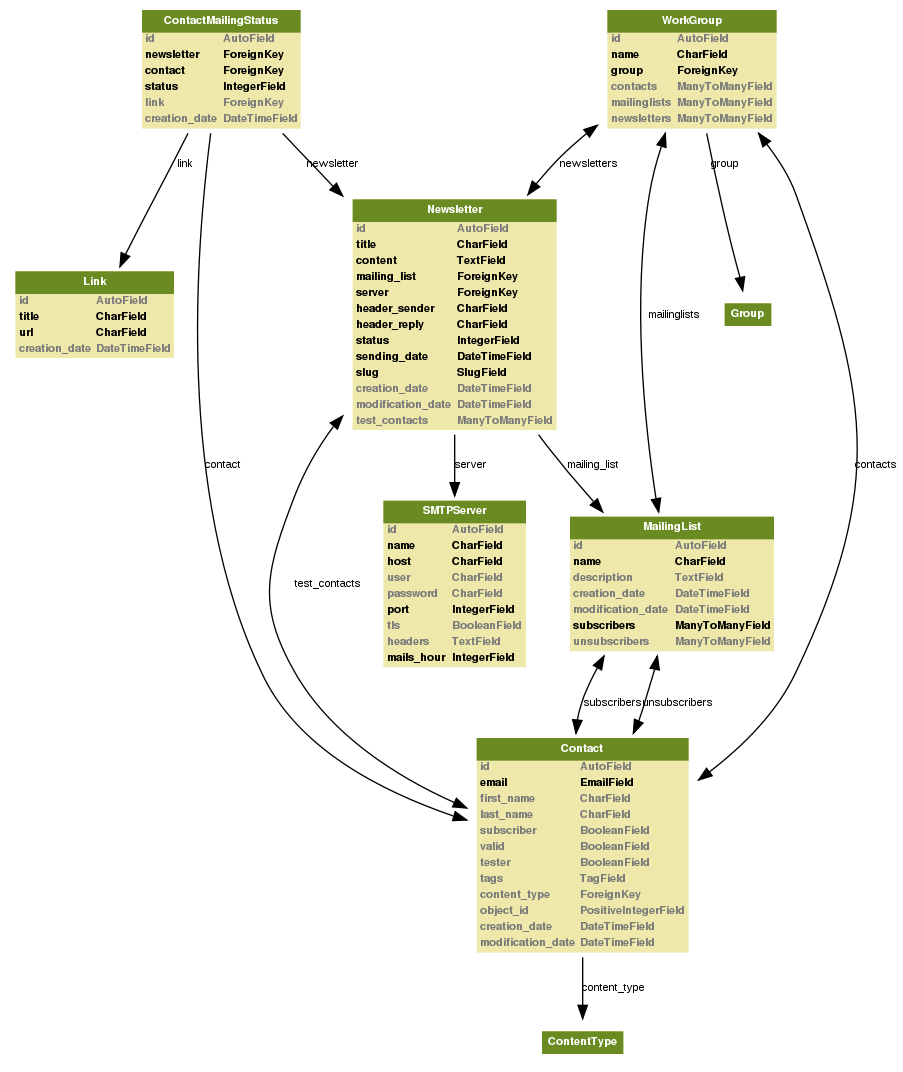
Database Representation
Changelog
0.3
Use UTM Tags
Demo in the package
Improving importation
Premailer for HTML page.
New importation capabilities
Compatibility with django 1.3.1
Unique key variable for newsletter’s title
A lot of bug fixes
0.2
Plugin for django-cms
Multiple importation format
Compatibility with django 1.2
A lot of bug fixes
0.1dev (unreleased)
Initial release
1 maintainer

Metadata
1 maintainer
Release files for django-maja-newsletter 0.6.0
For a detailed explanation of source distributions (sdists) and built distributions (wheels), please see the package formats documentation.
Source distribution (sdist)
| File | Size | Uploaded | Provenance | Actions |
|---|---|---|---|---|
| django-maja-newsletter-0.6.0.tar.gz | 580.8 kB | Without provenance | Details for django-maja-newsletter-0.6.0.tar.gz |
Built distribution (wheel)
| File | Interpreter | ABI | Platform | Actions Reset |
|---|---|---|---|---|
| django_maja_newsletter-0.6.0-py2-none-any.whl | Python 2 | none | any | Details for django_maja_newsletter-0.6.0-py2-none-any.whl |
Total release size: 1.1 MB
Security for django-maja-newsletter 0.6.0
Provenance
Provenance describes where a file came from. On PyPI, provenance is shared via attestations, which provide a verifiable record of the build or publishing details. View details, limitations and caveats.
No provenance found
None of the files in this release were uploaded with provenance metadata.
A note on package security
PyPI is a repository for distributing packages, not a service for auditing them. While third-party security researchers and our staff do their best to detect and remove malicious packages, PyPI cannot guarantee the quality, security or suitability of any given package.
To learn more about protecting yourself from malicious actors, visit our package security documentation.














