





Ra Framework
A light-weight effective Django based framework to create business application and various resource planing systems, equipped with a reporting engine and a responsive dashboard.
Features
A responsive dashboard built on top of Django’s admin.
Reporting Engine that filters and compute several types of reports with simple lines of code.
A charting capabilities to turn reports into attractive charts.
A widget system to display reports and its charts on dashboard home , or on object’s view pages.
Tools and goodies to extend and customize the framework behavior from top to bottom.
Python 3.6 / 3.7 / 3.8
Django 2.2, 3.0 Compatible
Dependencies
Installation
$ pip install django-raQuick start
Create a virtual environment and install ra-framework from Pypi
$ pip install django-raOnce Ra installed, it provides a command to generate a new project.
$ ra-admin start myprojectThis will create a new project folder myproject, based on a template containing everything you need to get started. You can always integrate ra framework to your existing project, please refer to the docs Integrating into an existing django project
Create a postgres database, and assign its details to DATABASES setting
Run the usual commands needed for any django project
$ ./manage.py migrate
$ ./manage.py createsuperuser
$ ./manage.py runserver
Voila!! Your site should now up and running at http://localhost:8000. Enter your super user credentials and login.
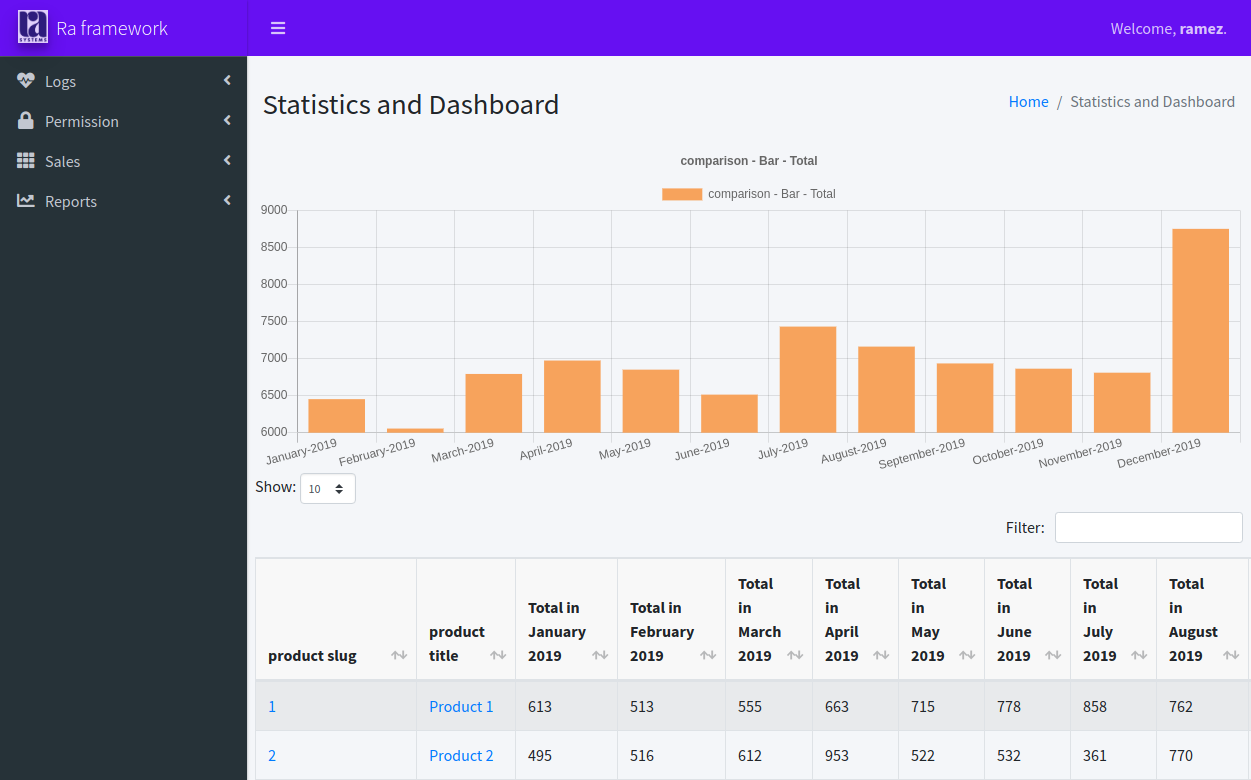
Documentation
Available on Read The Docs
Please Proceed to the tutorial Create a sales application Part 1
Testing and contribution
To run the test suite, first, create and activate a virtual environment. Then clone the repo, install the test requirements and run the tests:
# 1. Clone and install requirements
$ git clone git+git@github.com:ra-systems/RA.git
$ cd tests
$ python -m pip install -e ..
$ python -m pip install -r requirements/py3.txt

# 2. Set the test database connection details in the environment
$ export DATABASE_NAME=<database name>
$ export DATABASE_USER=<database user>
$ export DATABASE_PASSWORD=<database password if any>

# 3. Run the tests
$ ./runtests.py
# And for Coverage report
$ coverage run --include=../* runtests.py [-k]
$ coverage html
For more information on contributing, we honor Django’s guidelines.
1 maintainer

Metadata
1 maintainer
Release files for django-ra 0.1.1
For a detailed explanation of source distributions (sdists) and built distributions (wheels), please see the package formats documentation.
Source distribution (sdist)
| File | Size | Uploaded | |
|---|---|---|---|
| django-ra-0.1.1.tar.gz | 9.3 MB | Details |
Release files / django-ra-0.1.1.tar.gz
| Download URL | django-ra-0.1.1.tar.gz |
|---|---|
| Size | 9.3 MB |
| Tags | Source |
|
SHA-256 checksum How to use checksums |
6280b413048a4c29ce42ed6636fe9276630234b0d5af099aabef6ac6548757db
|
|
BLAKE2b-256 checksum How to use checksums |
c0fe03d43671622f218506aff5b6bf4534a0f091dfc306012ff6390db2b72e44
|
| Upload date | |
|
Uploaded using Trusted Publishing? What is trusted publishing? |
No |
| Uploaded via |
twine/3.1.1 pkginfo/1.5.0.1 requests/2.22.0 setuptools/40.8.0 requests-toolbelt/0.9.1 tqdm/4.40.2 CPython/3.6.8
|














